

On this page
Ask a poultry farmer about summer and you will hear about thin, cracked eggshells. Ask a chemistry textbook why, and you may get a neat Le Chatelier story about carbon dioxide. The story is a good exercise, but it only works if you quietly hold one thing constant: blood pH. Work it through with real numbers and the simple chain breaks, which is the more useful lesson for JEE and NEET.
What is the textbook Le Chatelier explanation?
Hens cannot sweat. In hot weather they pant to lose heat by evaporating water from their airways, and panting also blows off extra CO₂. A 2024 study of heat-stressed laying hens by Kim and colleagues in the journal Animals lists panting as a main sign of heat stress, and reports that severe heat stress reduced eggshell thickness and strength.
The shell itself is mostly calcium carbonate. A 2021 review of eggshell mineralisation by Gautron and colleagues puts the mineral at about 95% of the shell, as calcite.
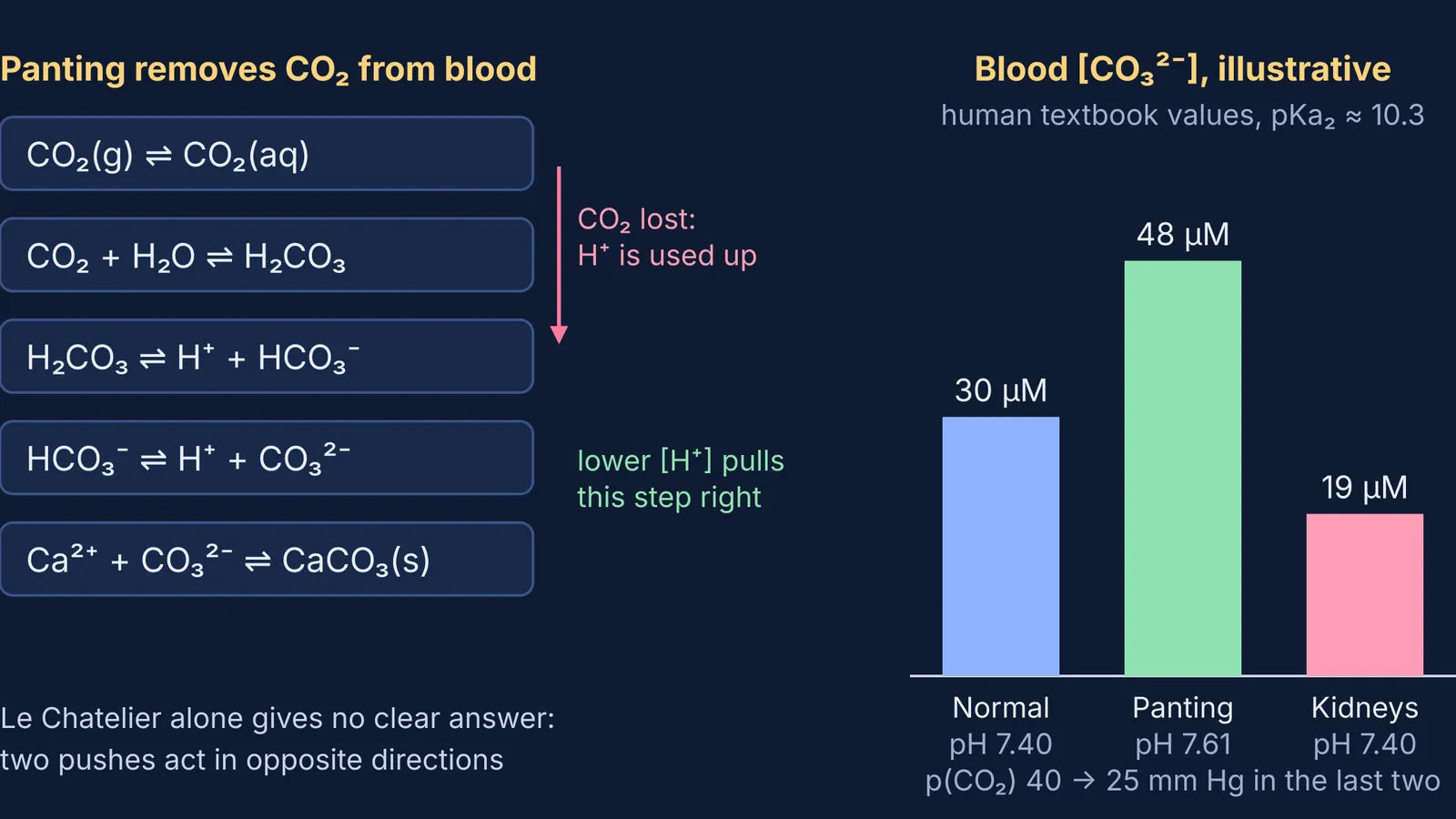
The textbook links the two with a ladder of equilibria:
CO₂(g) ⇌ CO₂(aq)
CO₂ + H₂O ⇌ H₂CO₃
H₂CO₃ ⇌ H⁺ + HCO₃⁻
HCO₃⁻ ⇌ H⁺ + CO₃²⁻
Ca²⁺ + CO₃²⁻ ⇌ CaCO₃(s)
The argument goes: less CO₂ in the blood pulls step 1 to the left, which pulls step 2 left, then step 3, then step 4. Less carbonate is left for step 5, so less CaCO₃ is laid down and the shell is thinner. Each link is a correct use of Le Chatelier's principle. The chain as a whole is not.
Where does the Le Chatelier chain break?
Look at steps 3 and 4. They share a species: H⁺. When CO₂ leaves, step 3 runs backwards, H⁺ + HCO₃⁻ → H₂CO₃ → CO₂ + H₂O, and that uses up H⁺. Lower [H⁺] is a disturbance to step 4 too, and Le Chatelier says step 4 responds by making more H⁺, which means shifting right and making more CO₃²⁻.
So the same event pushes carbonate down through one route and up through another. Le Chatelier's principle tells you the direction of a shift for one disturbance to one equilibrium. With coupled equilibria and two disturbances pulling opposite ways, it cannot tell you which wins. You need numbers.
The tidy textbook chain silently assumes that pH stays fixed. That is the hidden condition.
How much does blood carbonate really change? A worked example
The numbers below are standard human-blood textbook values, the same ones used in our post on how the bicarbonate buffer keeps blood pH at 7.4. Hen blood values differ, so treat this as an illustration of the chemistry, not as hen physiology.
Data: pKa₁ = 6.1 (for dissolved CO₂ to HCO₃⁻), [HCO₃⁻] = 24 mM, CO₂ solubility = 0.03 mM per mm Hg, and pKa₂ ≈ 10.3 (an approximate value for HCO₃⁻ to CO₃²⁻; values in plasma differ slightly).
Step 1: pH before panting. At p(CO₂) = 40 mm Hg, dissolved CO₂ = 0.03 × 40 = 1.2 mM. pH = 6.1 + log(24/1.2) = 6.1 + log 20 = 7.40.
Step 2: pH after panting. Let p(CO₂) fall to 25 mm Hg, with [HCO₃⁻] roughly unchanged in the first minutes. Dissolved CO₂ = 0.03 × 25 = 0.75 mM. pH = 6.1 + log(24/0.75) = 6.1 + log 32 = 7.61. This rise in pH is respiratory alkalosis.
Step 3: carbonate before. From step 4 of the ladder, [CO₃²⁻] = [HCO₃⁻] × 10^(pH − pKa₂). [CO₃²⁻] = 24 × 10^(7.40 − 10.3) ≈ 0.030 mM.
Step 4: carbonate after. [CO₃²⁻] = 24 × 10^(7.61 − 10.3) ≈ 0.048 mM. Carbonate goes up by a factor of 10^0.20 ≈ 1.6.
Step 5: the textbook case, pH held fixed. Combining all the steps gives [CO₃²⁻] = Ka₁Ka₂K_H·p(CO₂)/[H⁺]². If [H⁺] did not change, cutting p(CO₂) from 40 to 25 mm Hg would cut carbonate by 25/40 = 0.625. But [H⁺]² actually fell by 10^(2 × 0.20) ≈ 2.6 times, and dividing by a smaller [H⁺]² outweighs the 0.625. Net factor: 0.625 × 2.56 = 1.6, which matches Step 4.
Step 6: when the body corrects the pH. Over hours to days the kidneys excrete bicarbonate to bring pH back towards 7.40. At p(CO₂) = 25 mm Hg that needs [HCO₃⁻] = 20 × 0.75 = 15 mM. Then [CO₃²⁻] = 15 × 10^(7.40 − 10.3) ≈ 0.019 mM, which is 0.625 of the starting value. Now, and only now, the textbook prediction comes true, because pH really is back where it started.
So why do hens actually lay thinner shells in the heat?
The honest answer is that several things happen at once, and the CO₂ ladder is at most one strand. The causes discussed in the poultry literature include:
Lower bicarbonate after compensation. The Kim study notes that respiratory alkalosis lowers blood CO₂ and HCO₃⁻ and raises blood pH. Less bicarbonate means less raw material for the shell gland, which builds the shell from blood calcium and carbonate made from bicarbonate and CO₂.
Calcium handling in alkalosis. The same paper links higher blood pH to lower blood calcium. At higher pH, more Ca²⁺ binds to blood proteins, so less is free in solution.
Eating less. Hot hens eat less feed, so less calcium comes in for each egg.
Do not try to settle this with the Ksp of CaCO₃. The shell gland fluid is a controlled, protein-rich compartment, not pure water at equilibrium, so a solubility product calculated for pure water does not describe it.
Farmers and scientists have tested giving heat-stressed hens carbonated drinking water to put CO₂ back. Odom, Harrison and Darre reported in Poultry Science (1985, volume 64, pages 594–596) that it eased the loss of shell quality in hens kept at high temperature. Later trials from the same research group did not all agree, so it is not a reliable fix.
How should you use Le Chatelier on coupled equilibria?
Apply the principle to one equilibrium and one change at a time.
When a species appears in two equilibria, follow its change into both.
If two pushes disagree, stop arguing in words and calculate, as in the worked example.
State the condition: fixed pH, fixed total carbonate, or fixed pressure.
The closed-vessel cases in our Le Chatelier simulation avoid this problem because N₂O₄ and NO₂ form one equilibrium. If you want to practise multi-step equilibrium problems like this one, the Fermi Problem Library has a step-by-step solver that explains the reasoning at each stage. For what happens when acid later attacks the finished shell, see why vinegar dissolves an eggshell.
Quick checklist
Panting blows off CO₂ and raises blood pH (respiratory alkalosis).
The textbook ladder predicts less carbonate only if pH is held fixed.
At fixed bicarbonate, losing CO₂ raises [CO₃²⁻], about 1.6 times in the worked example.
After the kidneys lower HCO₃⁻ and restore pH, carbonate falls to about 0.625 of normal.
Real thin shells involve bicarbonate loss, calcium handling and lower feed intake together.
With coupled equilibria, state what is held constant, then calculate.


