On this page
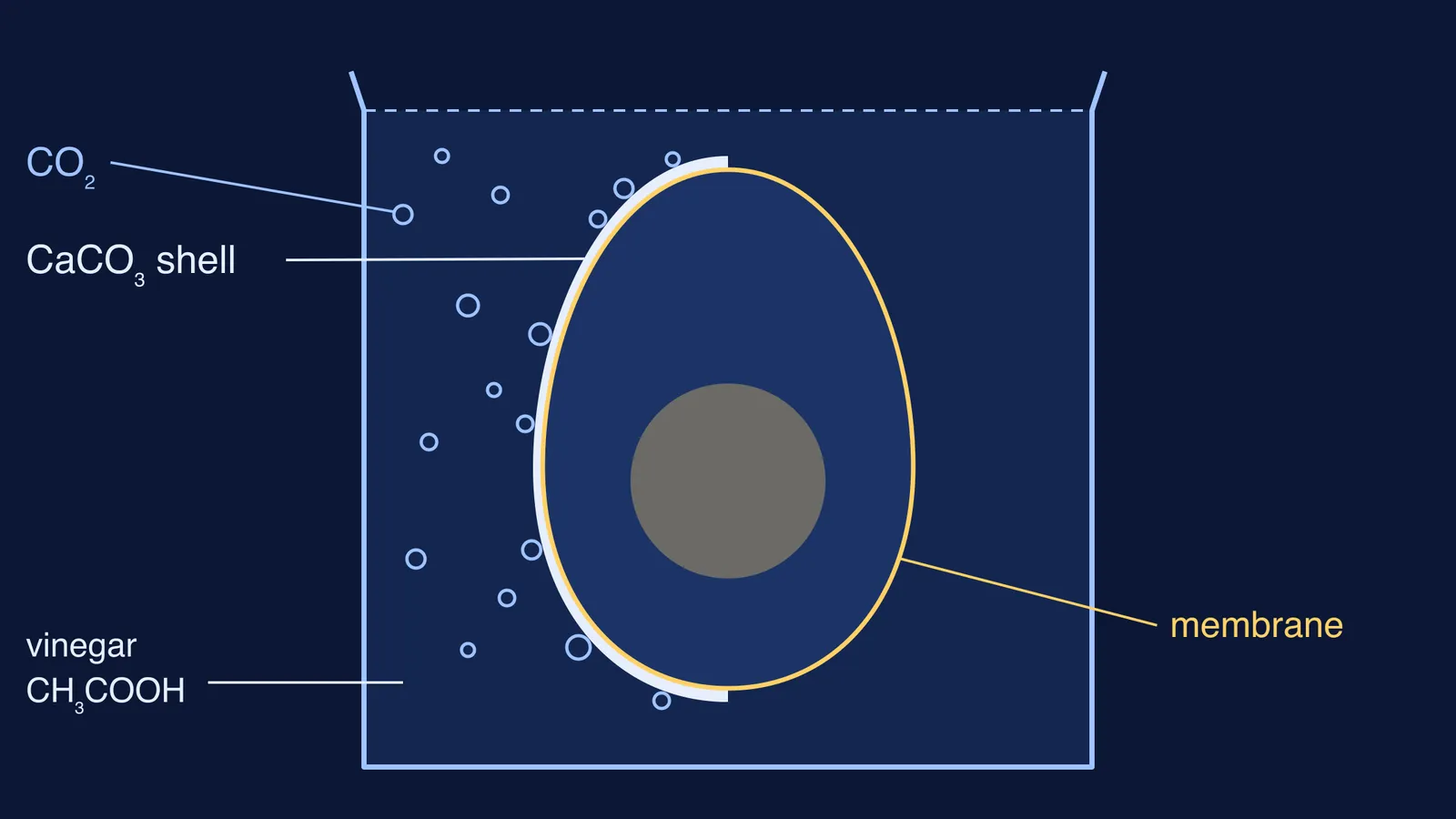
Drop an egg into a glass of vinegar and within minutes tiny bubbles cling to the shell. A day or two later the hard shell is gone, and what is left feels like a water balloon. This cheap home experiment covers three ideas that keep coming back in school science: acids reacting with carbonates, mole ratios and osmosis.
What is an eggshell made of?
A hen's eggshell is a thin mineral wall built on soft membranes. A 2021 review of how eggshells form, in BMC Molecular and Cell Biology, reports that calcium carbonate makes up 98.4% of the shell's mineral part, in the crystal form called calcite. The same review puts the mineral layer of a chicken egg at about 320 micrometres thick, formed by the hen in under 20 hours.
Under the mineral sit the shell membranes, which the review describes as interlacing protein fibres. That difference is the whole trick. Calcium carbonate reacts with acid; protein fibres are not a carbonate, so they release no gas and stay behind to hold the egg together.
Why does vinegar dissolve an eggshell?
Vinegar is a dilute solution of acetic acid in water. In India, the FSSAI standard requires vinegar to have an acidity of not less than 3.75% (mass per volume), calculated as acetic acid, as set out in this summary of the FSSAI vinegar standard.
On the shell, the acid follows the familiar pattern: carbonate plus acid gives a salt, water and carbon dioxide. The balanced equation, as given by Science Notes, is:
2CH₃COOH + CaCO₃ → Ca(CH₃COO)₂ + H₂O + CO₂
Each part matches something you can see:
CO₂ is the gas in the bubbles on the shell.
Ca(CH₃COO)₂, calcium acetate, dissolves in water, so the shell goes into the liquid instead of piling up as a solid.
2CH₃COOH means two acetic acid molecules are used up for each unit of calcium carbonate, so the vinegar gets weaker as it works.
How much vinegar does it take to dissolve an eggshell?
This step is good stoichiometry practice. Suppose a shell contains 5.0 g of calcium carbonate (a round number for the sum; weigh a dried shell from your kitchen for a real one).
Moles of CaCO₃: 5.0 g ÷ 100.1 g/mol = 0.050 mol.
The equation needs 2 mol of acetic acid per mole of CaCO₃, so 0.10 mol of acetic acid.
Mass of acetic acid: 0.10 mol × 60.05 g/mol = 6.0 g.
Vinegar at the FSSAI minimum of 3.75 g per 100 mL holds 0.0375 g per mL, so 6.0 g ÷ 0.0375 g/mL = 160 mL.
Carbon dioxide released: 0.050 mol × 44.0 g/mol = 2.2 g. At 25 °C and 1 atm a mole of gas takes up about 24.5 L, so that is roughly 1.2 L of gas.
Two practical lessons follow. A small cup of vinegar may not hold enough acid to finish the job, and around a litre of gas has to escape, so never seal the jar.
Why does the naked egg get bigger?
Once the shell is gone, only the membrane separates the egg from the liquid. Science Notes explains that the membrane is semipermeable: water passes through, but larger molecules do not. The inside of the egg has more dissolved proteins and salts than the vinegar, so water moves in by osmosis and the egg swells.
Next, predict what happens if you move the naked egg into thick sugar syrup, then test it.
How do you make a rubbery egg at home?
This plan follows the Science Notes method, which says bubbles appear after about 15 minutes; after about a day you change to fresh vinegar and wait another day or two.
Day 0: weigh the egg on a kitchen scale. Put it in a glass jar, cover it with white vinegar and leave the lid loose.
After 15 minutes: note where the first bubbles form.
Day 1: lift the egg out with a spoon and replace the vinegar. Softened raw eggs burst easily; a hard-boiled egg is sturdier for bouncing.
Day 2 or 3: rinse the egg, rub off any leftover shell and weigh it again. Shine a torch through it.
Clean up: do not eat the egg, and wash your hands after handling raw egg.
If the mole-ratio steps are where you got stuck, the Fermi Problem Library has worked problems with a step-by-step solver that explains the reasoning rather than printing an answer. If the gap is the idea itself, such as weak acids or osmosis, the Fermi Concept Library gives every concept in chemistry and biology its own lesson.
Start a jar tonight and you could have a bouncy egg by the weekend.