

On this page
It is a classic Class 12 genetics puzzle. If a recessive allele causes a serious disease, and affected people have fewer children, why hasn't natural selection removed it? Three reasons explain it, each with a number you can calculate.
Why doesn't natural selection remove harmful recessive alleles?
Selection acts on phenotype, not on the genes an organism carries. A recessive allele (call it a) only shows in an aa person. An Aa person, a carrier, is usually healthy, so the allele travels through them unseen. Discussing a recessive coat-colour allele in red foxes, Graham Coop's population genetics textbook notes that the allele "is slow to respond to selection as it is 'hidden' from selection in the heterozygote state" (Coop, Population and Quantitative Genetics, chapter 10/10%3A_One-Locus_Models_of_Selection)).
The rarer the allele, the better it hides. That is reason one. Reason two is new mutations; reason three, carriers who do better than everyone else.
How many copies hide in carriers? A worked example
Under Hardy-Weinberg conditions, the genotype frequencies are p² (AA), 2pq (Aa) and q² (aa), where p and q are the two allele frequencies (Coop, chapter 2/02%3A_Allele_and_Genotype_Frequencies)).
Cystic fibrosis affects 1 in 2,500 to 3,500 white newborns in the United States, according to MedlinePlus Genetics. Take the 1 in 2,500 figure and work it through:
Affected births: q² = 1/2,500, so q = 0.02 and p = 0.98.
Carriers: 2pq = 2 × 0.98 × 0.02 ≈ 0.039, about 1 person in 26.
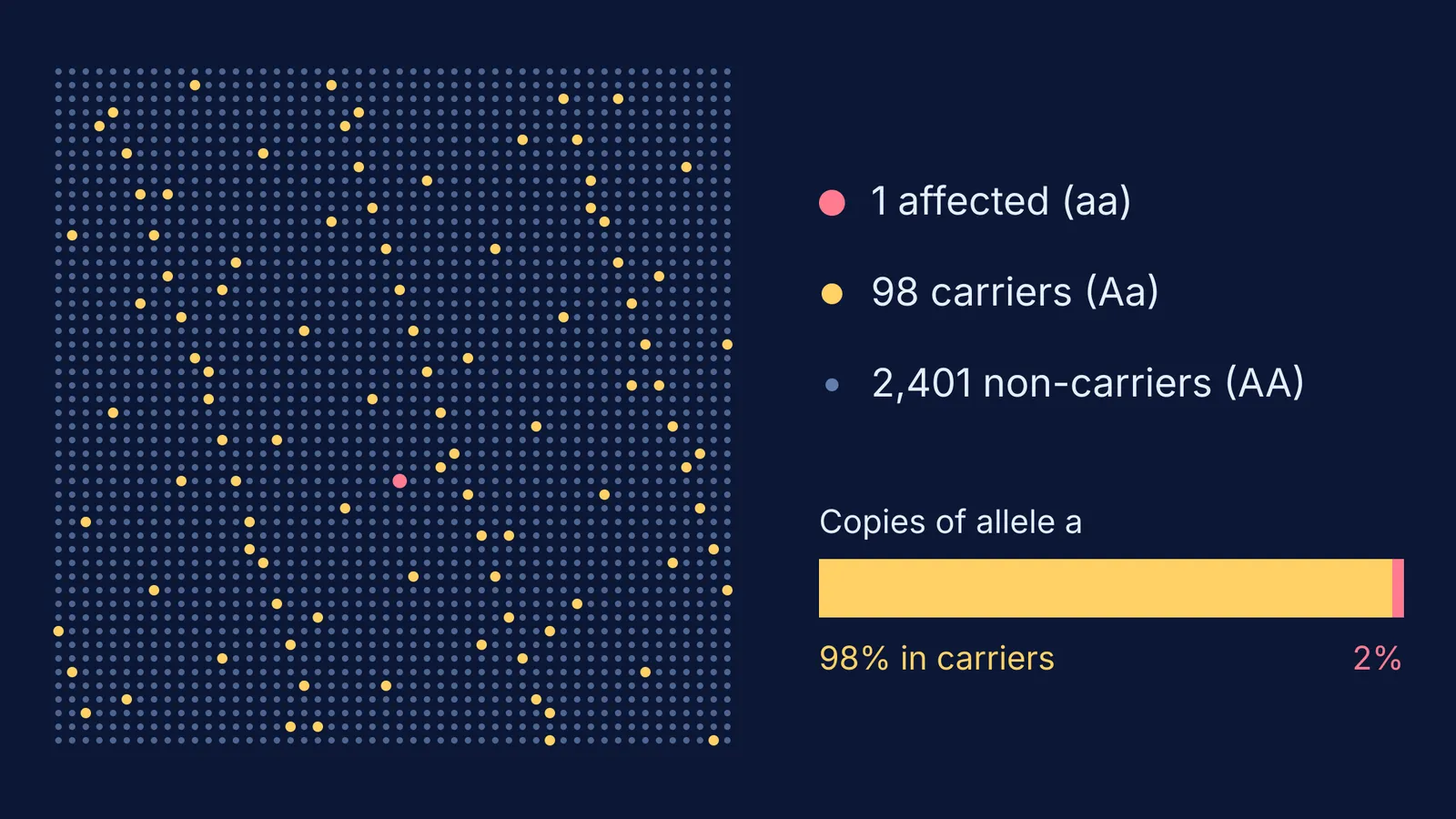
In 2,500 people, that is 1 affected person and about 98 carriers.
Count the copies of a: the affected person holds 2, the carriers hold 98. So 98 of every 100 copies sit in healthy carriers.
Selection can only reach the other 2%. Even if no affected person had children, q would become q / (1 + q) each generation, so 1/q rises by 1 per generation. Halving q from 0.02 to 0.01 (1/q from 50 to 100) takes 50 generations. At an assumed 25 years per generation, that is about 1,250 years.
For more practice, see our walk-through on finding the carrier frequency of a rare disorder.
Do new mutations keep adding harmful alleles?
Yes. Each generation, copying errors create fresh copies of a disease allele while selection removes a few. Where the two cancel is called mutation-selection balance. For a fully recessive allele, the equilibrium frequency is q = √(μ/s), where μ is the mutation rate and s is the fitness lost by aa individuals (Coop, chapter 11/11%3A_The_Interaction_of_Selection_Mutation_and_Migration)).
Try it with round numbers (illustrative, not for a real gene). If μ = 1 in 100,000 per generation and s = 1, then q = √0.00001 ≈ 0.003. Square it and q² = μ: about 1 in 100,000 births would be affected, while 2pq ≈ 0.6% of people, roughly 1 in 160, would be carriers. Because selection only sees q², the allele settles at more than 300 times the mutation rate.
Why do sickle-cell carriers have an advantage?
Sickle-cell disease (HbSS) is severe, yet carriers (HbAS, sickle-cell trait) are protected against falciparum malaria. In two cohorts of children on the coast of Kenya (323 and 2,655 children), Williams and colleagues found HbAS was 50% protective against mild clinical malaria, 75% protective against hospital admission for malaria and almost 90% protective against severe or complicated malaria (Journal of Infectious Diseases, 2005).
This is heterozygote advantage. When Aa does better than both AA (malaria risk) and aa (sickle-cell disease), selection pulls the allele towards a stable middle frequency instead of zero. Coop gives that equilibrium as p = s₂/(s₁ + s₂), where p is the frequency of A, and s₁ and s₂ are the fitness costs of AA and aa compared with Aa (Coop, chapter 10/10%3A_One-Locus_Models_of_Selection)). Our post on how sickle-cell trait protects against malaria goes further into the biology.
This matters in India. Sickle-cell disease is prevalent among tribal populations, and in July 2023 the government launched the National Sickle Cell Anaemia Elimination Mission, which planned to screen 70 million people in its first three years, aiming to lower prevalence by 2047 (Piel, Colah and Jain, HemaSphere, 2024). Finding carriers matters for the same reason: as the maths shows, that is where most copies are. If sickle-cell disease or thalassaemia runs in your family, a doctor or genetic counsellor can explain carrier testing.
How do you answer this in an exam?
A five-point plan for a long answer:
Hiding: selection acts on phenotype, and Aa carriers look normal.
The number: carriers outnumber affected people by 2p/q, roughly 2/q. For q = 0.02, that is 98 carriers per affected person.
Mutation: new copies arrive every generation; at balance q = √(μ/s).
Heterozygote advantage: sickle-cell trait and falciparum malaria.
The consequence: removing affected people barely changes q when q is small.
If the hiding effect is hard to picture, the Fermi Simulation Lab has interactive simulations for ideas that are easier to see than to read. For numericals, the Fermi Problem Library has worked problems with a step-by-step solver that explains the reasoning rather than printing an answer.
When asked why a harmful gene survives, start with the 98%.


