

On this page
Your kidneys filter glucose out of your blood all the time, then take it back. Sugar shows up in urine only when they cannot take all of it back. That limit is the renal threshold, and once you see it as a capacity problem, "glycosuria indicates diabetes mellitus" stops being a fact to memorise.
Why does glucose normally stay out of urine?
According to the NCERT Class 11 Biology chapter on excretory products, a healthy person's glomerular filtration rate (GFR) is about 125 ml per minute, or 180 litres a day. The same chapter says glucose and amino acids are reabsorbed actively, and the proximal convoluted tubule (PCT) reabsorbs nearly all the essential nutrients.
Glucose passes through the glomerular filter, so the filtrate starts with roughly the plasma's glucose concentration. The PCT pulls it back with sodium-glucose cotransporters. A 2015 review in the American Journal of Physiology: Renal Physiology by Abdul-Ghani, Norton and DeFronzo gives the split: SGLT2, in the early proximal tubule, reabsorbs 80 to 90% of filtered glucose, and SGLT1, further along, takes back the remaining 10 to 20%.
There are only so many transporters, so there is a ceiling.
What is the renal threshold for glucose?
The same review gives two numbers to keep apart:
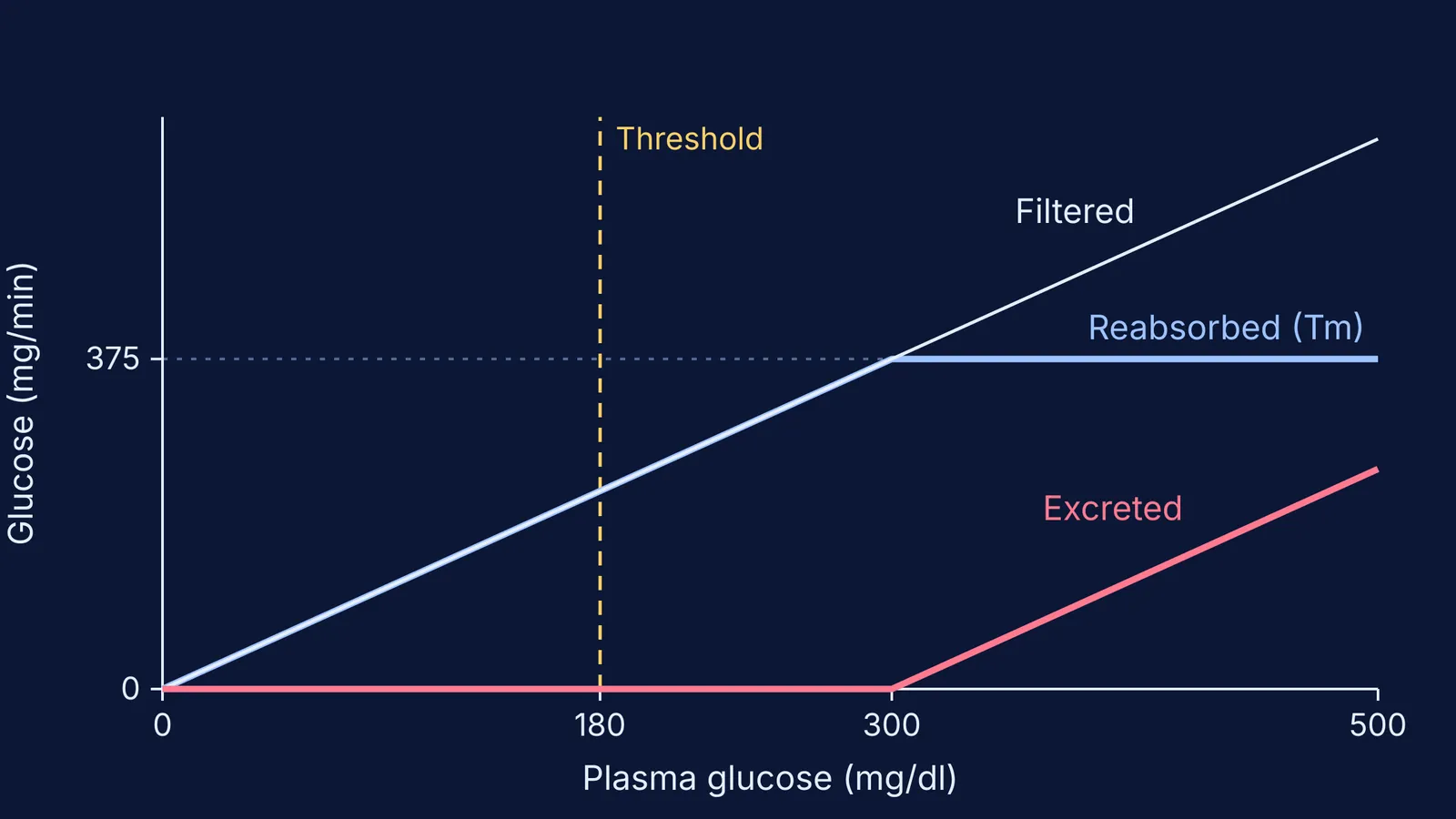
Transport maximum (Tm): the most glucose the proximal tubules can reabsorb, on average about 375 mg per minute (Abdul-Ghani et al., 2015).
Renal threshold: the plasma glucose level at which glucose starts to appear in urine, about 180 mg/dl in healthy people (Abdul-Ghani et al., 2015).
Tm is a rate (mg per minute); the threshold is a blood concentration (mg/dl). Assertion-reason questions often swap them, so keep the units next to the words.
Worked example: blood glucose below and above the threshold
Take the NCERT GFR of 125 ml per minute (1.25 dl per minute) and the review's Tm of 375 mg per minute (NCERT; Abdul-Ghani et al., 2015). Filtered load = plasma glucose × 1.25.
Plasma glucose 100 mg/dl. Filtered load = 125 mg per minute, well under 375, so all of it is reabsorbed and urine glucose is essentially nil. The review quotes this same load, about 125 mg per minute or 180 g a day, for people with normal glucose tolerance.
Plasma glucose 250 mg/dl. Filtered load = 312.5 mg per minute. That is still below 375, so a simple model predicts no glycosuria. But 250 is above the typical 180 mg/dl threshold, so a kidney with that threshold is already losing some glucose. Nephrons are not identical, and some hit their own limit early; the review explains the rounded curve by "heterogeneity in the Tm of individual nephrons". This rounding is called splay.
Plasma glucose 400 mg/dl. Filtered load = 500 mg per minute. The tubules return at most 375, so at least 125 mg spills into urine every minute, about 7.5 g an hour.
The simple model saturates at 375 ÷ 1.25 = 300 mg/dl, which the review calls the theoretical threshold, but real kidneys leak from about 180 mg/dl. If an exam asks for the threshold, answer 180 mg/dl, not 300.
Why does glucose appear in urine in diabetes?
In uncontrolled diabetes mellitus, plasma glucose runs high. Once it stays above the threshold, the filtered load exceeds what the tubules can carry back, and the extra ends up in urine. That is why NCERT says glucose (glycosuria) and ketone bodies (ketonuria) in urine indicate diabetes mellitus (NCERT).
Two details from the review make good exam material. People with poorly controlled type 2 diabetes have a raised Tm, and lowering their glucose with insulin has been shown to bring it back to normal. And people with mutations in the SGLT2 gene pass large amounts of glucose in urine throughout life while keeping normal kidney function (Abdul-Ghani et al., 2015). So glucose in urine does not always mean diabetes.
Diabetes insipidus is a different problem, about ADH and water rather than sugar; our explainer on diabetes insipidus vs mellitus and what each does to urine compares the two.
How do you solve a renal threshold question?
Convert GFR to dl per minute (125 ml = 1.25 dl).
Filtered load = plasma glucose × GFR.
Compare it with Tm. Once the tubules are saturated, excreted ≈ filtered load − Tm.
Quote the threshold separately: about 180 mg/dl (Abdul-Ghani et al., 2015), lower than the simple model predicts because of splay.
If the PCT still feels hazy, revise what the PCT and DCT each reabsorb and urine formation step by step. The Fermi Concept Library has a lesson for each idea here, from GFR to cotransport, with its place in the map of biology. For practice, the Fermi Problem Library has worked problems with a step-by-step solver that explains the reasoning rather than printing an answer.


