

On this page
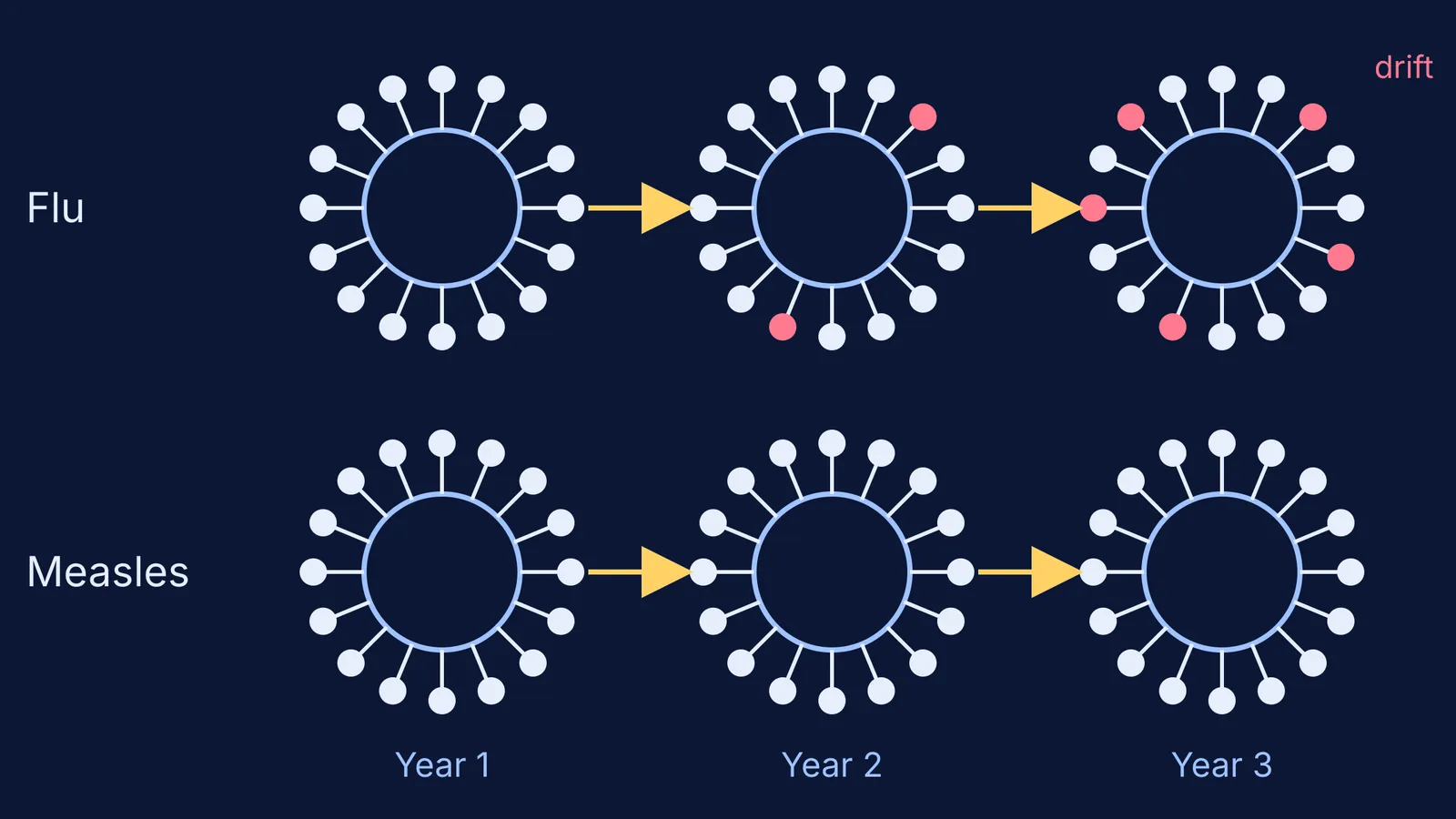
Measles vaccines still rely on a virus strain first isolated in 1954. The flu vaccine is reformulated every year, because flu keeps changing the part of itself your antibodies learn to recognise.
Why is the flu vaccine given every year?
Influenza carries two main proteins on its surface, haemagglutinin (HA) and neuraminidase (NA). The US Centers for Disease Control and Prevention (CDC) calls them antigens, because your immune system recognises them and can make antibodies against them.
Antigenic drift is the build-up of small mutations in flu genes that can change HA and NA. Over time, a person's antibodies may bind differently or not at all to the newer virus, reducing protection (CDC). The CDC says drift is a primary reason flu vaccine composition is reviewed every year and updated as needed.
Drift doesn't happen at a steady pace. In a 2004 study in *Science*, Derek Smith and colleagues mapped H3N2 flu from 1968 to 2003. They found its antigenic evolution was more punctuated than its genetic evolution, and that a genetic change sometimes had a disproportionately large antigenic effect. To see how an antibody grips its target, read how antibodies recognise specific antigens.
What is the difference between antigenic drift and antigenic shift?
The CDC defines antigenic shift as an abrupt, major change in an influenza A virus that gives the viruses infecting humans a new HA, or a new HA and NA. When shift happens, most people have little or no immunity to the new virus.
The CDC lists 18 haemagglutinin subtypes and 11 neuraminidase subtypes of influenza A, but only A(H1N1) and A(H3N2) routinely circulate in people. In 2009, an H1N1 virus carrying genes from North American pigs, Eurasian pigs, humans and birds emerged and caused a pandemic (CDC).
How does WHO choose flu vaccine strains twice a year?
The World Health Organization) recommends flu vaccine compositions twice a year, one for each hemisphere's season. The February recommendation covers the northern hemisphere and the September one covers the southern.
The data comes from the Global Influenza Surveillance and Response System (GISRS), which has carried out global flu surveillance since 1952 and now includes 166 institutions in 136 WHO member states. For the 2026-2027 northern season, experts held a 4-day consultation and announced their choice on 27 February 2026. WHO noted that a notably different H3N2 variant, called subclade K, had emerged in August 2025 and spread rapidly across the globe.
Worked example: how did the 2026 vaccine recipes change?
Compare the egg-based vaccine recipes in ICMR's 2026 summary.pdf), checked against WHO's 2026-2027 recommendation. The southern 2026 vaccine was chosen in September 2025, the northern 2026-2027 vaccine in February 2026.
H1N1: A/Missouri/11/2025 in both. Unchanged.
H3N2: A/Singapore/GP20238/2024 replaced by A/Darwin/1454/2025. Updated.
B/Victoria: B/Austria/1359417/2021 replaced by B/Tokyo/EIS13-175/2025. Updated.
Two of the three parts changed in about five months.
India feeds the same system. According to ICMR.pdf), the WHO National Influenza Centre at ICMR-NIV Pune is part of GISRS, and 73 sentinel sites report flu testing data all year. Because viruses circulating in India by and large matched the northern hemisphere choice, ICMR said the northern vaccine would be ideal, and that the southern one may be used until it is available. Whether and when you or a family member should get a flu shot is a question for your doctor.
Why does the measles vaccine not need yearly updates?
A 2021 study in *Cell Reports Medicine* by Muñoz-Alía and colleagues found that measles evolution is severely constrained by numerous co-dominant antibody target sites on its H protein. A mutant that keeps even one key site is still neutralised by serum from people immune to measles. That's why a vaccine strain isolated from David Edmonston in 1954 still protects against all the measles genotypes circulating when the study was published.
The CDC says one dose of MMR is 93% effective against measles and two doses are 97% effective. For how that memory works, see the principle of vaccination and memory cells.
How can you predict whether a vaccine needs updating?
Ask three questions about any virus:
Which surface protein do protective antibodies target? (Flu: HA. Measles: H.)
Can it change and still work? (Flu HA: yes, often. Measles H: many sites would have to change at once.)
Is there an animal reservoir of new subtypes? (Influenza A: birds and pigs. Measles: no.)
Yes answers to the last two are a sign to expect regular updates. If antigens, antibodies or mutation feel shaky, the Fermi Concept Library gives each biology concept its own lesson and shows its place in the map. If drift still feels abstract, Fermi's AI tutor can work out what you already know and draw the figure as it explains.


