

On this page
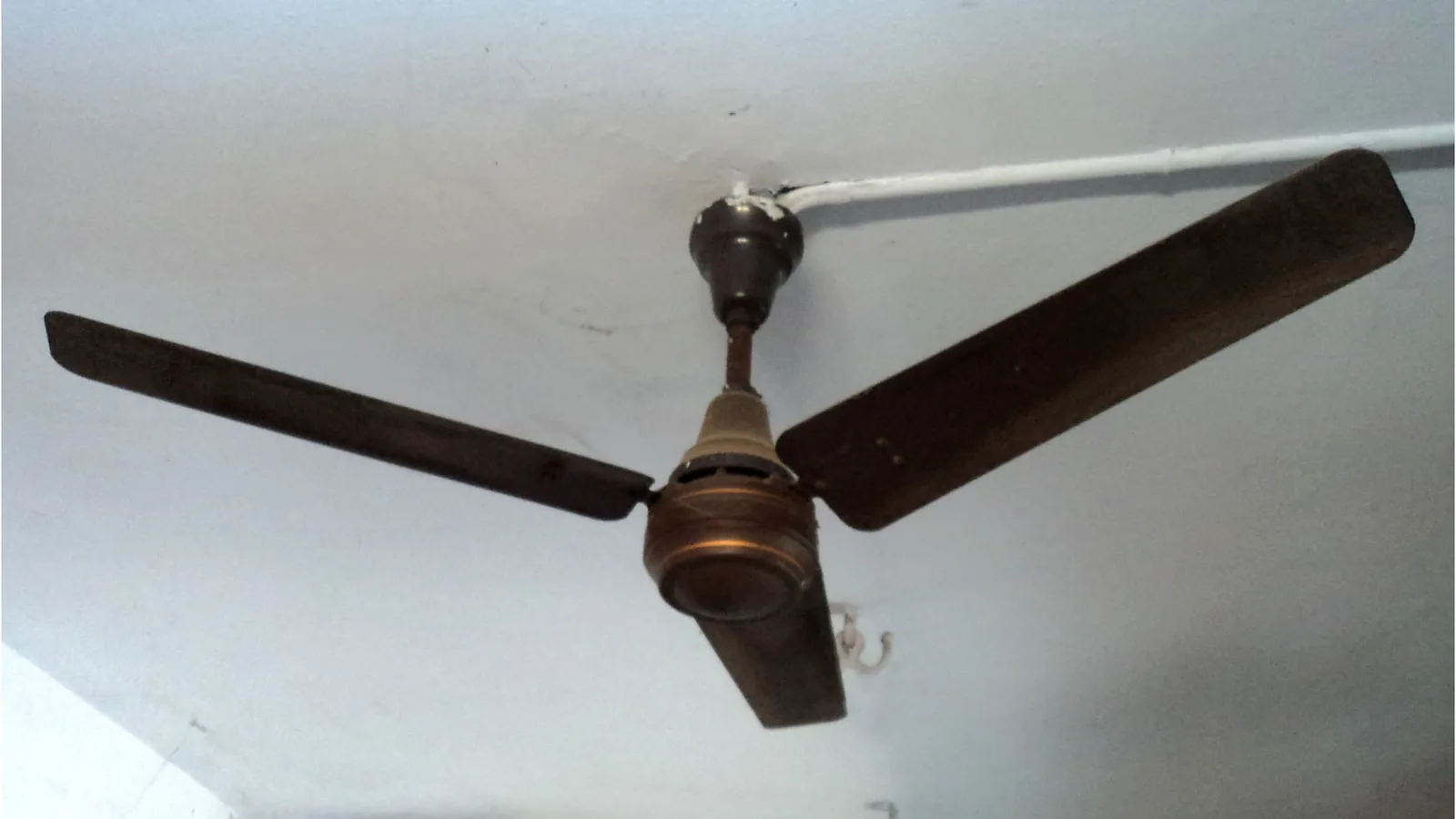
You climb a stool to clean the fan before Diwali and find a grey ridge of dust along one edge of every blade. It has spun for months, so why didn't the dust fly off? Three pieces of physics explain it: a thin layer of air that clings to the blade, dust too heavy to follow the air, and static charge.
Why does dust stick to a blade that is always moving?
Spinning doesn't scrub a blade clean, because the air touching the blade doesn't move relative to it. NASA's Glenn Research Center explains that as air flows past an object, the molecules right next to the surface stick to the surface. Engineers call this the no-slip condition.
So a dust grain that reaches the blade feels almost no wind trying to blow it off, and small sticking forces are enough to hold it.
What is the thin layer of slow air on a fan blade?
The boundary layer is the thin layer of fluid near a surface in which the speed rises from zero at the surface to the full speed of the stream further out, as NASA's beginner's guide to aerodynamics defines it. The same page says a boundary layer can be laminar (smooth layers) or turbulent (unsteady swirls), depending on the Reynolds number, which compares inertial forces with viscous forces.
That difference shows up in the dust. Our post on Ludwig Prandtl and the thin layer where fluid friction lives tells how the idea began.
Why does the leading edge get the thickest layer of dust?
The leading edge is the edge that meets the air first as the fan turns. The blade is also tilted, which is what pushes air downwards (see why ceiling fan blades are tilted). The air splits around the leading edge, but dust can't turn as sharply.
In a 2023 paper in Physical Review Fluids, Matthew Turner and Richard Sear point out that particles that followed the air perfectly would never hit an obstacle. Inertia, the tendency to keep moving in a straight line, is what makes a particle collide. In their model of air flowing past a cylinder, what happens near the forward stagnation point, where the oncoming air slows and divides, decides whether particles land. Below a critical value of the Stokes number, which compares a particle's inertia with the drag of the air, point particles don't land at all.
Fans show the same thing. In 1963, E. T. Hignett and M. M. Gibson used the dust on an 18-inch, quarter-scale model of a wind-tunnel fan to see its airflow. In the Journal of the Royal Aeronautical Society they reported that dust was deposited along the leading edge and on the suction surface, over an area they took to be the turbulent part of the boundary layer. When they stuck small bumps on clean parts of the blade, dust built up in wedge-shaped trails of turbulence behind them. They also found a large area of smooth, laminar flow on the suction surface near the blade root.
Does static electricity make fan blades dustier?
It probably helps. A 2023 study in Scientific Reports puts it simply: electrical charge can be exchanged when two materials touch, and this is called triboelectric charging. The same study found that insulating particles charge up towards a limit, much like a capacitor. Every grain that strikes a blade is such a contact. If your blades are plastic, they are insulators, so charge they pick up stays put, and a charged surface attracts nearby grains. Many ceiling fans have metal blades, though, so this matters less for them.
The 1963 fan study didn't measure charge; the airflow alone explains where the dust lands. Static is a likely helper, and matters more in dry air, as our post on why static shocks are worse in dry winter weather explains.
How can you read the dust on your own fan?
Treat the blade like a lab result before you wipe. Switch off at the switchboard, wait for the fan to stop, and have someone hold the stool.
Find the thickest line of dust. Predict first: it should be on the edge that leads as the fan turns.
Compare top and bottom. When the fan blows downwards, the top is the low-pressure suction side, but gravity also drops dust there, so which cause can you rule out?
Compare the end near the motor with the tip. The tip moves fastest, and the Stokes number grows with flow speed, so you might expect more dust towards the tip.
Look for a dusty trail behind anything that sticks out, such as a screw head.
Clean by sliding an old pillowcase over each blade and pulling it back, so the dust falls inside. Then watch which spot gets dusty first.
If inertia and airflow are hard to picture, the Fermi Simulation Lab has interactive simulations for ideas that are easier to see than to read, and the Fermi Concept Library gives each physics concept its own lesson.
Next time you clean the fan, look before you wipe: the dust shows where the air went.


