

On this page
Look at a ceiling fan that is switched off and you will see the blades are not flat. Each is set at a slant, with one long edge higher than the other. That slant is why a fan moves air at all. A flat blade would slice through the air edge-on and push almost nothing.
Why are ceiling fan blades tilted at an angle?
Engineers call the tilt the angle of attack. NASA's Glenn Research Center defines it as the angle between the chord line and the flight direction. For a fan blade, the flight direction is the circle it sweeps as it spins.
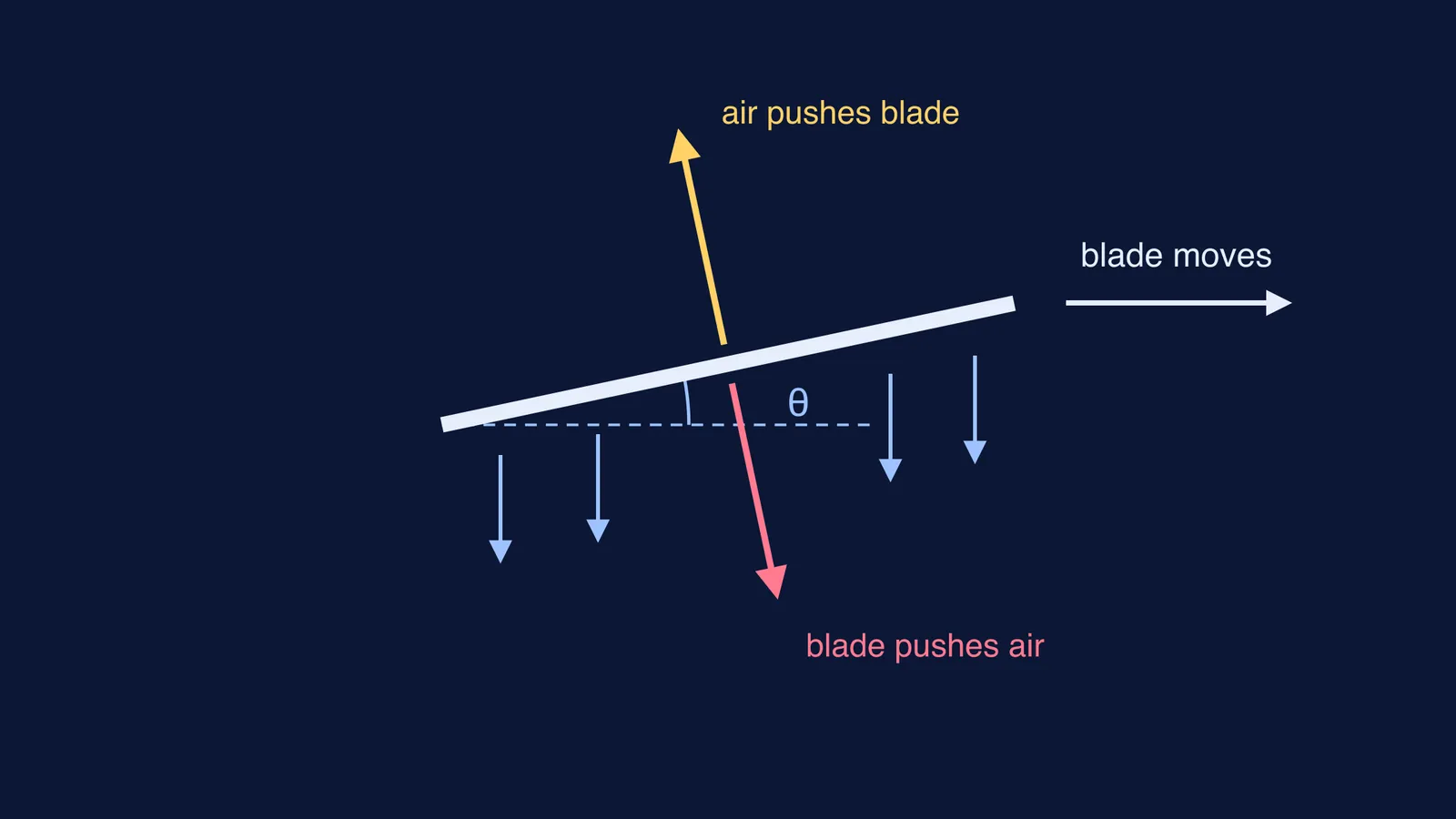
On a tilted blade, the leading edge (the one in front as it turns) sits higher and the trailing edge lower, so the underside faces slightly forward and down. As the blade sweeps round, it keeps meeting fresh air and shoving it downward, like your hand held at a slant out of a moving car window.
NASA says a propeller acts like a rotating wing and models it as a disc through which the surrounding air passes. A ceiling fan is a slow, wide propeller pointed at the floor.
How does Newton's third law explain a ceiling fan?
NASA states the third law as: whenever one object exerts a force on a second object, the second object exerts an equal and opposite force on the first. Its example is a wing: the air is deflected downward, and in reaction the wing is pushed upward.
For one fan blade:
Action: the blade pushes air down and slightly forward.
Reaction: the air pushes the blade up and slightly backward, with a force of the same size.
The two forces act on different objects, so they do not cancel. The air is free to move, and that moving air is the breeze you feel. The blade is fixed to the motor and downrod, so the ceiling mount takes its upward push. The backward part acts as drag on the blade, and the motor keeps working against it.
If you mix up which force acts on which body, our guide to identifying action-reaction pairs walks through four checks.
Where does air pressure come in?
Pressure tells the same story another way. NASA's propeller page notes that a spinning propeller sets up a pressure lower than free stream in front of the propeller and higher than free stream behind it, with a jump in pressure at the disc itself.
For a ceiling fan, in front means above the blades and behind means below. Lower pressure above draws air in; higher pressure below drives it down. That pressure difference, spread over the area the blades sweep, is the push on the air, and its partner is the push on the blades.
Why not tilt the blades even more?
More tilt pushes more air, but only up to a point. NASA notes that for thin aerofoils drag stays nearly constant at small angles (about 5 degrees either way) and rises quickly above 5 degrees. At steep angles the air can also peel away from the blade surface, so the motor works harder for little extra breeze.
Designers twist the blade along its length too. On propellers, NASA explains, the angle at the tip is lower than at the hub because the tip moves faster. A 2016 computer-simulation study of ceiling fan blades by Adeeb, Maqsood, Mushtaq and Sohn treated the root and tip angles of attack as design variables, checking their effect on airflow, torque and energy efficiency.
This matters at home in India. Mongabay India reports that manufacturers were barred from making or selling unstarred ceiling fans from 1 January 2023, after the Bureau of Energy Efficiency made star labels mandatory, and that India sells around 41 million ceiling fans a year. Blade angle is one of the design choices, alongside the motor, that decides how much air a fan moves for the electricity it uses.
Try it: a five-minute check on your own fan
No equipment needed. If you climb to look, use a steady stool with someone holding it, and get down before switching on.
With the fan off and fully stopped, look at one blade edge-on. Note which long edge is higher.
Switch on at the lowest speed and watch which way it turns. The higher edge should lead.
Standing on the floor, hold a strip of tissue paper up under the fan, well clear of the blades. It should flutter downward.
Predict: if the fan turned the other way, the lower edge would lead and air would move upward. The Wikipedia article on ceiling fans notes that blades led by the downturned edge give an updraft.
Explain it in two sentences using the words action, reaction and pressure. If you can, you have it.
For a related puzzle, see why a ceiling fan cools you but not the room. The same push-air-down idea keeps a drone up, as in how a drone flies and turns with four propellers.
Forces on a moving blade are hard to picture from words alone. The Fermi Simulation Lab has interactive simulations for ideas that are easier to see than to read, and the Fermi Concept Library gives each physics concept its own lesson, so you can fill a gap in Newton's laws or pressure before your next test.


