

On this page
A diver can feel fine at 30 metres. The trouble starts on the way up, and the cause is Henry's law from Class 12 chemistry.
What happens to the air a diver breathes at 30 m?
NOAA Ocean Exploration puts it simply: pressure in the ocean increases by about one atmosphere for every 10 metres of water depth.
Add the one atmosphere of air above the sea, and a diver at 30 m is under about 1 + 3 = 4 atmospheres. Breathing compressed air at that pressure, the body takes up extra nitrogen, as the MSD Manual explains.
Dry air is 78.08% nitrogen by volume, according to NASA's Earth fact sheet. So the partial pressure of nitrogen (its share of the total pressure) also goes up four times between the surface and 30 m.
What does Henry's law say?
Henry's law says that at a fixed temperature, the amount of a gas dissolved in a liquid is proportional to the partial pressure of that gas above it. In symbols, c = kH × p, where c is the concentration, p the partial pressure and kH the Henry's law constant.
The NIST Chemistry WebBook lists kH for nitrogen in water as 0.00065 mol per kg per bar at 25 °C, and a temperature factor of 1300 K for correcting it to other temperatures. Our guide to Henry's law with worked problems covers the textbook versions of the law.
How much extra nitrogen dissolves at 30 m?
Here is a rough estimate, treating body fluid as water at 37 °C, using the NIST values and assuming full saturation.
Correct kH to 37 °C with NIST's formula: kH = 0.00065 × e^(1300 × (1/310.15 − 1/298.15)) ≈ 0.00055 mol per kg per bar. Warmer water holds a little less gas.
Surface: total pressure 1 atm = 1.013 bar, so nitrogen's partial pressure is 0.7808 × 1.013 ≈ 0.79 bar.
At 30 m: total pressure 4 atm ≈ 4.05 bar, so nitrogen's partial pressure is about 3.16 bar.
Dissolved nitrogen: 0.00055 × 0.79 ≈ 0.00043 mol per kg at the surface, and 0.00055 × 3.16 ≈ 0.0017 mol per kg at 30 m.
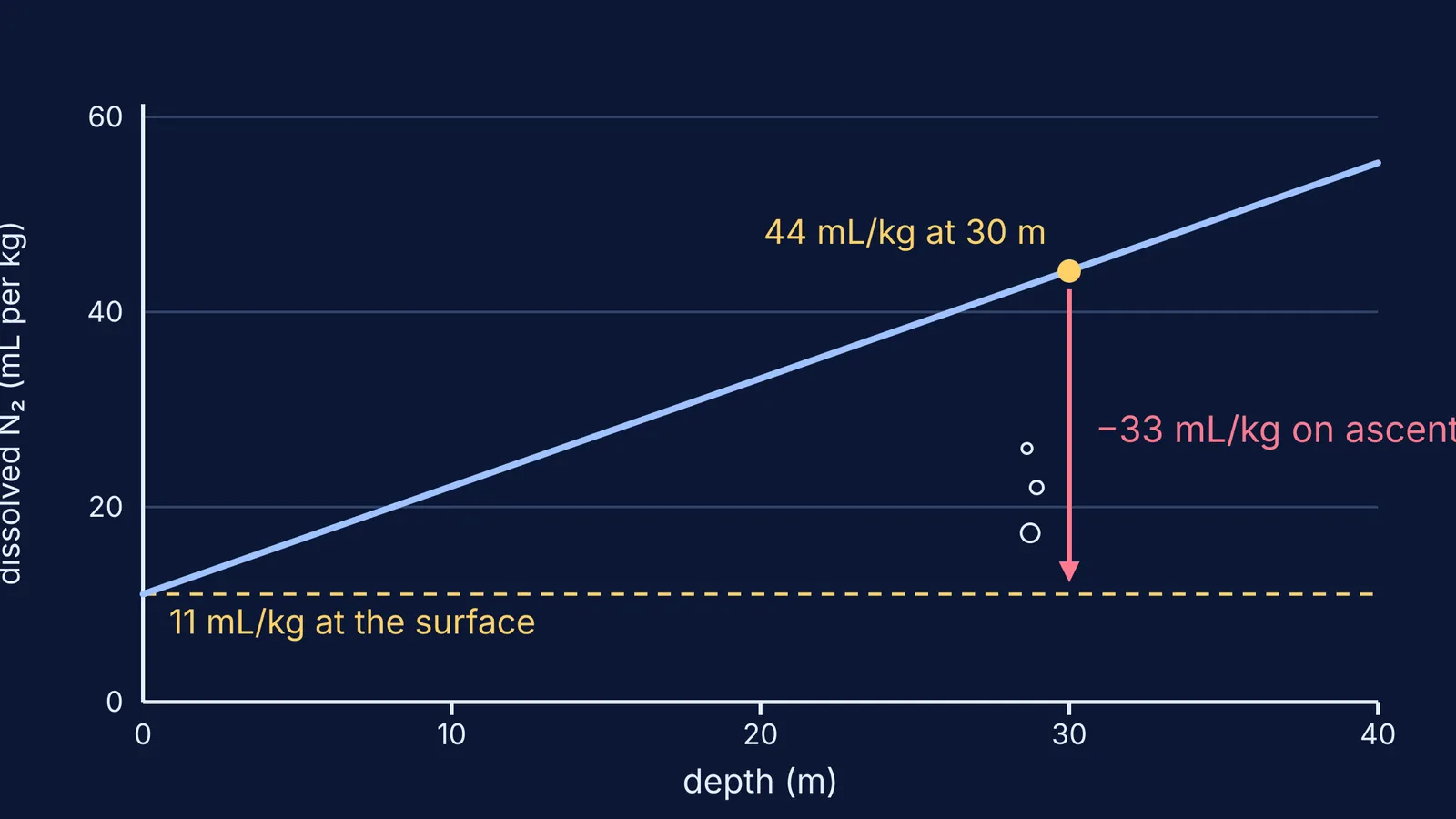
Turn moles into a volume of gas. At 37 °C and 1 atm, one mole of gas takes up RT/P ≈ 25.4 litres. So the surface amount is about 11 mL of nitrogen per kg of fluid, and the 30 m amount is about 44 mL per kg.
The difference, about 33 mL of nitrogen gas per kg of fluid, is gas the body has to get rid of on the way back up.
Why does coming up too fast cause the bends?
Think of opening a bottle of soda: the pressure drops, the liquid now holds more gas than Henry's law allows, and the extra comes out as bubbles. A diver's body works in a similar way. On a slow ascent, the blood carries the extra nitrogen to the lungs and the diver breathes it out. On a fast ascent, the MSD Manual says, the nitrogen that cannot be breathed out right away forms gas bubbles in the blood and tissues. This is decompression sickness. "The bends" is its less severe, musculoskeletal form, with pain usually in the joints of the arms or legs, the back or the muscles. The more severe form most often causes neurological symptoms.
The same MSD page notes:
Only half of people with decompression sickness have symptoms within 1 hour of surfacing, but 90% have symptoms by 6 hours.
Treatment is oxygen and recompression in a high-pressure (hyperbaric) chamber.
Many divers make a safety stop of a few minutes at about 4.5 m on the way up.
After several days of diving, 12 to 24 hours at the surface is commonly recommended before flying.
How do you use this in a board, JEE Main or NEET-UG answer?
Use this checklist:
Convert depth to pressure: add 1 atm for every 10 m of seawater, plus 1 atm for the air above.
Find the partial pressure: mole fraction of the gas × total pressure.
Apply c = kH × p, or use ratios: at one temperature, 30 m gives four times the surface amount.
Check which form of the law your textbook uses. Some write p = KH × x, and then a larger KH means a less soluble gas.
Explain the bends in one line: lower pressure means lower solubility, so the dissolved gas comes out as bubbles.
For the depth-to-pressure step, practise with these hydrostatics problems on pressure at depth, then try Boyle's law on the gas side with why water half fills a diving bell at 10 m.
If you get the right formula but the wrong number, the Fermi Problem Library has worked problems with a step-by-step solver that explains the reasoning, so you can see which step went wrong. If partial pressure itself is unclear, the Fermi Concept Library gives every concept in physics, chemistry, biology, mathematics and computing its own lesson.


