

On this page
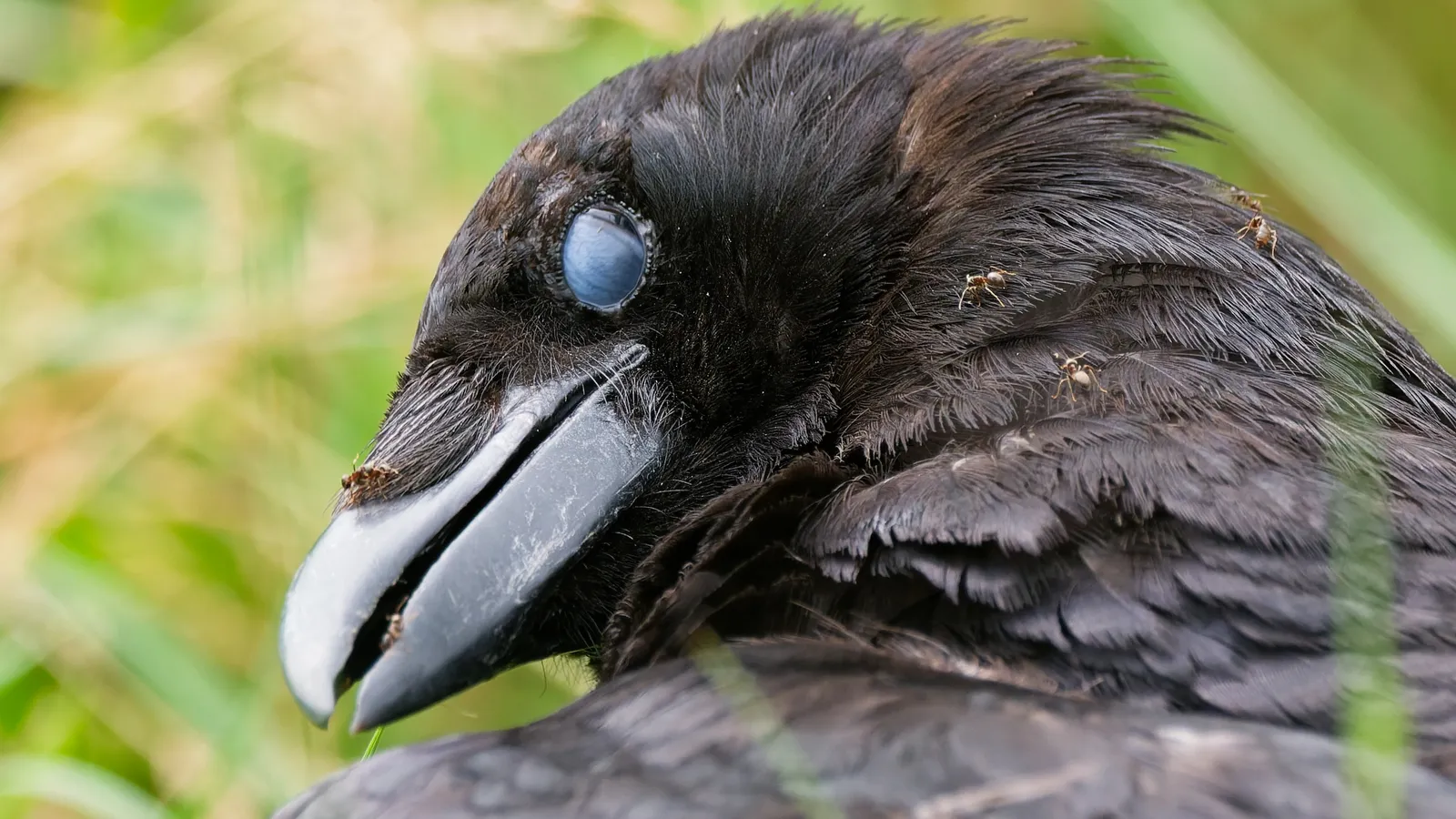
You may have seen it on a terrace or a lawn: a crow flattened on the ground, wings spread, beak open, looking almost unwell. Then it shakes itself and flies off. Scientists have tested several reasons for that posture.
Why do birds spread their wings in the sun?
There are three main reasons, and which one applies depends on the bird.
Drying. Cormorants dive for fish, and only the outer parts of their feathers get wet. The Stanford Birds essay on spread-wing postures notes that cormorants apparently spread their wings only to dry them, not to keep warm.
Warming up. The same essay describes anhingas opening their wings in bright sun on cool days, backs to the sun, which points to temperature control.
Fighting feather lice. The essay also lists getting parasites moving so they are easier to remove, and several experiments, described below, have tested whether sun helps birds against lice.
Upkeep takes real time: across bird species, birds spend an average of 9.2% of their time on maintenance behaviour, mostly preening, according to Koop, Huber and Clayton in the Journal of Parasitology.
How does sunbathing get rid of feather lice?
Feather lice are tiny insects that spend their whole life cycle on the bird's body; the dove lice in the Koop study feed mainly on feathers and dead skin. Enough heat kills them.
In a 1993 experiment, Charles and Leann Blem sprayed violet-green swallows with a pesticide used against mites and lice; the sprayed birds then spent less time sunning than untreated ones, as Audubon magazine reports.
Two years later, Moyer and Wagenbach fitted model wings with real black noddy feathers and put a single louse on them. Audubon's summary says about 10 minutes of direct sun heated the wings to 60-71°C (140-160°F), and the louse died in 6 of 12 trials. A later study on hooded vultures in Guinea-Bissau, also described by Audubon, put lice on feathers in dishes: 3 minutes of sun at 60°C killed 26 of 31 lice, or 84%.
Bright light also drives feather lice out of their hiding places between the barbs, which should make them easier to pick off. But when Koop and colleagues tested this with 48 captive mourning doves, birds in direct sun did not preen more often or more effectively than birds in shade. So the evidence so far points to heat, rather than easier preening, as the way sunbathing helps.
What is anting, and does ant acid really kill parasites?
Anting is when a bird puts ants into its feathers. In active anting, the bird picks up ants in its beak and rubs them on its feathers. In passive anting, it spreads its wings on an ant nest and lets the ants swarm up among its feathers, as described in the Stanford Birds essay on anting.
The popular explanation is that birds use the formic acid many ants carry as a natural pesticide. Revis and Waller tested this in 2004. Pure formic acid did stop the bacteria and fungi that attack feathers, but the amounts actually found in ants did not. Their conclusion: the idea that birds apply ants to control feather parasites "was not supported."
So the parasite story is still a hypothesis. The Stanford essay lists other ideas, such as topping up the bird's own preen oil or soothing skin while new feathers grow. For how feathers themselves are built, see our explainer on whether feathers, hair and scales are made of the same protein.
India has fresh records too. In a 2026 note, Moinudheen and colleagues used video to study a large-billed crow anting among yellow ants in Coonoor, in the Nilgiris. Two house crows then showed the same behaviour after watching it. The authors say anting is still poorly documented in India, which is why careful notes from students can be useful.
What should you look for when crows or mynas do it?
Watch for 10 minutes and turn a strange sight into a small field study.
Time and weather. Cool morning, hot midday, or just after a bath or rain?
Posture. Both wings spread flat, one wing raised, tail fanned, head feathers fluffed?
Ground. Bare soil, terrace, lawn, ant trail? Look for ants on the bird or beside it.
Beak. Is it picking up ants and wiping them under its wings and tail? That is active anting.
Eyes. Does a pale film slide across the eye when ants get near? That is the third eyelid, explained in our post on which animals have a nictitating membrane.
Afterwards. Does it shake, preen hard, or fly off? Do nearby crows or mynas copy it?
Keep the log for a few weeks. A link to certain ants or months is the kind of pattern researchers are still trying to explain.
When a term in your notes is new, such as ectoparasite or thermoregulation, the Fermi Concept Library has a lesson for every concept in biology and shows its place in the map, so your observations connect to what you study in class.


