

On this page
Look closely at a dropping on a car bonnet or a balcony railing and you will see two parts: a dark centre and a white, chalky smear around it. They are two different wastes. Only the dark part is faeces. The white part is the bird's version of urine.
What is the white part of bird poop?
The white part is uric acid. The Natural History Museum, London explains that birds do not make urea, as we do; their livers turn excess nitrogen into uric acid instead, which leaves the body as a white, paste-like substance.
That nitrogen comes from breaking down proteins and other nitrogen-containing molecules. OpenStax Biology 2e says uric acid does not dissolve in water and tends to form a white paste or powder, and that birds, insects and reptiles excrete it. So bird pee is not missing. It is the white bit.
Why do birds make uric acid instead of urine?
The short answer is water, with weight as a bonus.
Water. The Stanford Birds essay on drinking notes that uric acid does not dissolve easily, is relatively nontoxic and can be voided nearly dry, so birds in dry places can clear their waste while losing very little water.
Weight. The Natural History Museum puts it simply: by excreting a thick paste, birds do not have to fly around carrying a heavy tank of urine.
Safety. OpenStax explains that land animals turn toxic ammonia into a relatively nontoxic form such as urea or uric acid, and the Stanford essay describes urea as rather poisonous and uric acid as relatively nontoxic.
There is a cost. The same Stanford essay points out that birds use much more energy to make uric acid than mammals use to make urea. Birds pay in energy to save water and weight.
If you are revising for NEET, this is the uricotelic group in the NCERT excretion chapter; our post on ammonotelic, ureotelic and uricotelic animals puts all three side by side.
Why does it come out with the faeces?
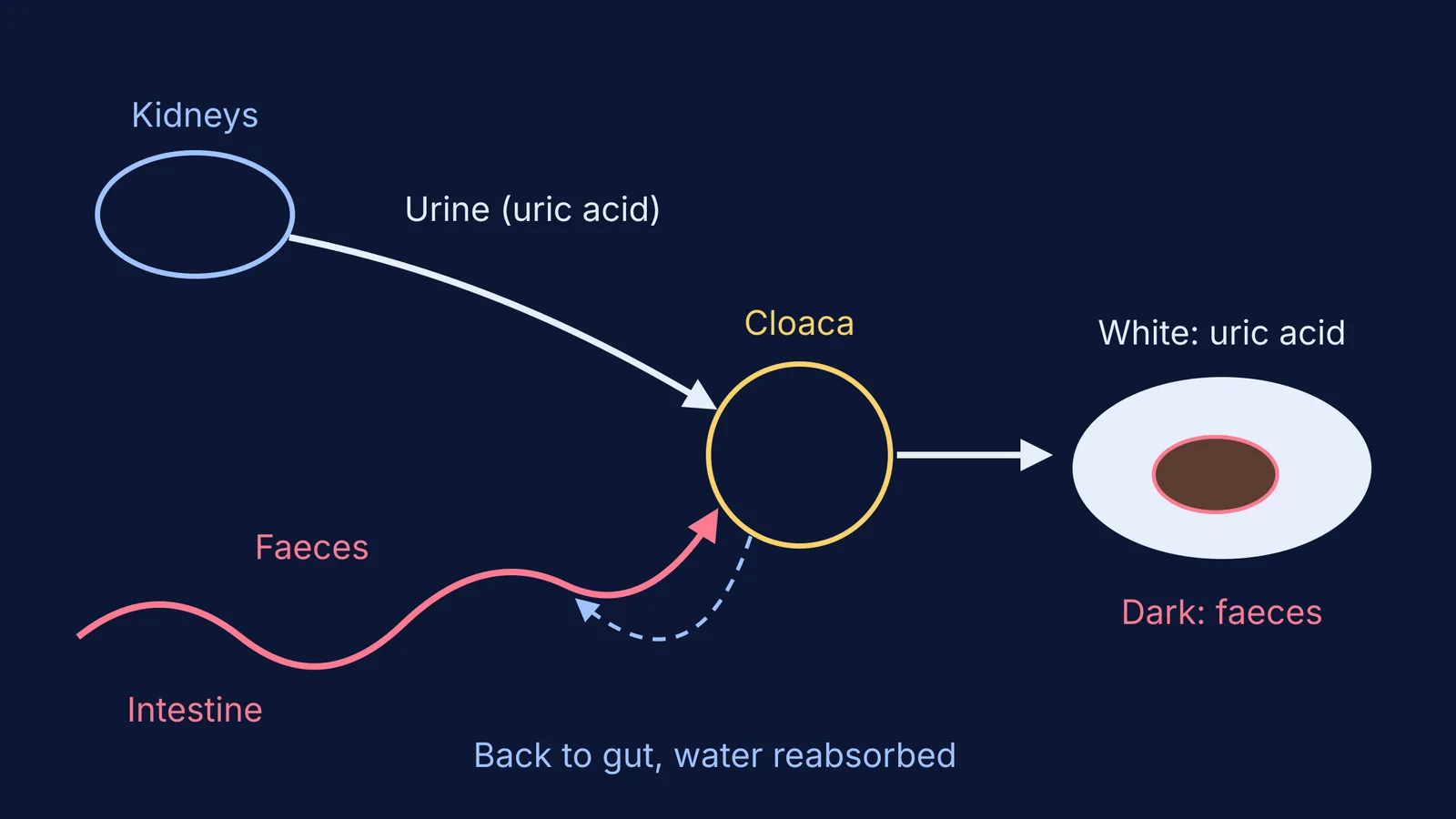
Because birds have one exit, not two. Urine and faeces both end up in the cloaca, a shared chamber with a single opening.
Poultry Hub Australia describes the route in the domestic fowl:
The kidneys send urine down the ureters. Like almost all birds, the fowl has no bladder to store it.
The urine enters the cloaca, and reverse peristalsis pushes it back up into the large intestine.
There the bird takes back extra water before anything leaves the body.
What remains is a thick paste, high in uric acid and low in water, passed as a whitish or cream cap on the faeces.
Step 2 is the surprising one: the bird sends its urine backwards into the gut to squeeze out more water. The Natural History Museum adds that the cloaca is also used for mating and laying eggs. More on which animals have a cloaca, and why humans do not.
Worked example: is uric acid just packed with more nitrogen?
A common guess is that uric acid carries more nitrogen. Test it: PubChem gives uric acid as C5H4N4O3 (168.11 g/mol) and PubChem gives urea as CH4N2O (60.06 g/mol). Nitrogen is about 14.01 g/mol.
Uric acid: 4 × 14.01 = 56.04 g of nitrogen in 168.11 g, so about 33% nitrogen by mass.
Urea: 2 × 14.01 = 28.02 g of nitrogen in 60.06 g, so about 47% nitrogen by mass.
Gram for gram, urea carries more nitrogen, so that is not the trick. The real difference is solubility.
PubChem lists the water solubility of uric acid as 60 mg per litre at 20 °C and of urea as 545,000 mg per litre at 25 °C. That is roughly 9,000 times more urea dissolving in a litre (the temperatures differ slightly, so treat it as a rough ratio). Urea stays dissolved and needs water to carry it out. Uric acid falls out as a solid, so the bird can take the water back and keep the waste as paste.
How do you write this as an exam answer?
Birds are uricotelic: nitrogen waste is excreted as uric acid.
Uric acid is insoluble, so it leaves as a white paste with very little water.
This saves water and avoids carrying stored urine in flight; there is no bladder.
Urine reaches the cloaca, water is reabsorbed, and urate leaves with the faeces through the one opening.
To learn the three waste types with memory hooks, try our NCERT excretory products mnemonics. If the link between solubility and water loss still feels shaky, the Fermi Concept Library gives every concept in biology and chemistry its own lesson and its place in the map, so you can see how excretion connects to the chemistry behind it.


