

On this page
Roll up your sleeve and look at the inside of your forearm. You can probably see a few bluish lines under the skin. Those are veins. Now press two fingers lightly on the thumb side of your wrist and you will feel a pulse. That is the radial artery, at one of the few spots where an artery comes close to the surface. Along most of the forearm, the arteries run deep, between muscles and beside bone. Here is why the body is built this way, and how to draw it for an exam answer.
Why are arteries deeper than veins?
The short answer is pressure. A normal adult blood pressure, measured in the arteries, is about 120/80 mm Hg, according to OpenStax Anatomy and Physiology. The same chapter notes that pressure in the atria, where the big veins empty, normally approaches zero when the atria are relaxed.
In between, the pressure keeps falling. Capillary pressure is about 35 mm Hg where blood enters a capillary bed and about 18 mm Hg by the venous end (OpenStax, capillary exchange).
You can see the difference in the walls. Arteries have thicker walls than veins because they receive blood "surging at a far greater pressure" (OpenStax, structure of blood vessels).
Now think about injury. Blood escapes from a cut high-pressure vessel much faster than from a low-pressure one; we work through the physics in why a cut artery spurts but a vein oozes. Tucking the main arteries under muscle and next to bone makes them harder to cut, scrape or crush. This is reasoning from layout rather than from an experiment, but it fits: the big arteries are hidden, and the vessels you can see are the low-pressure ones.
What does the inside of a forearm look like?
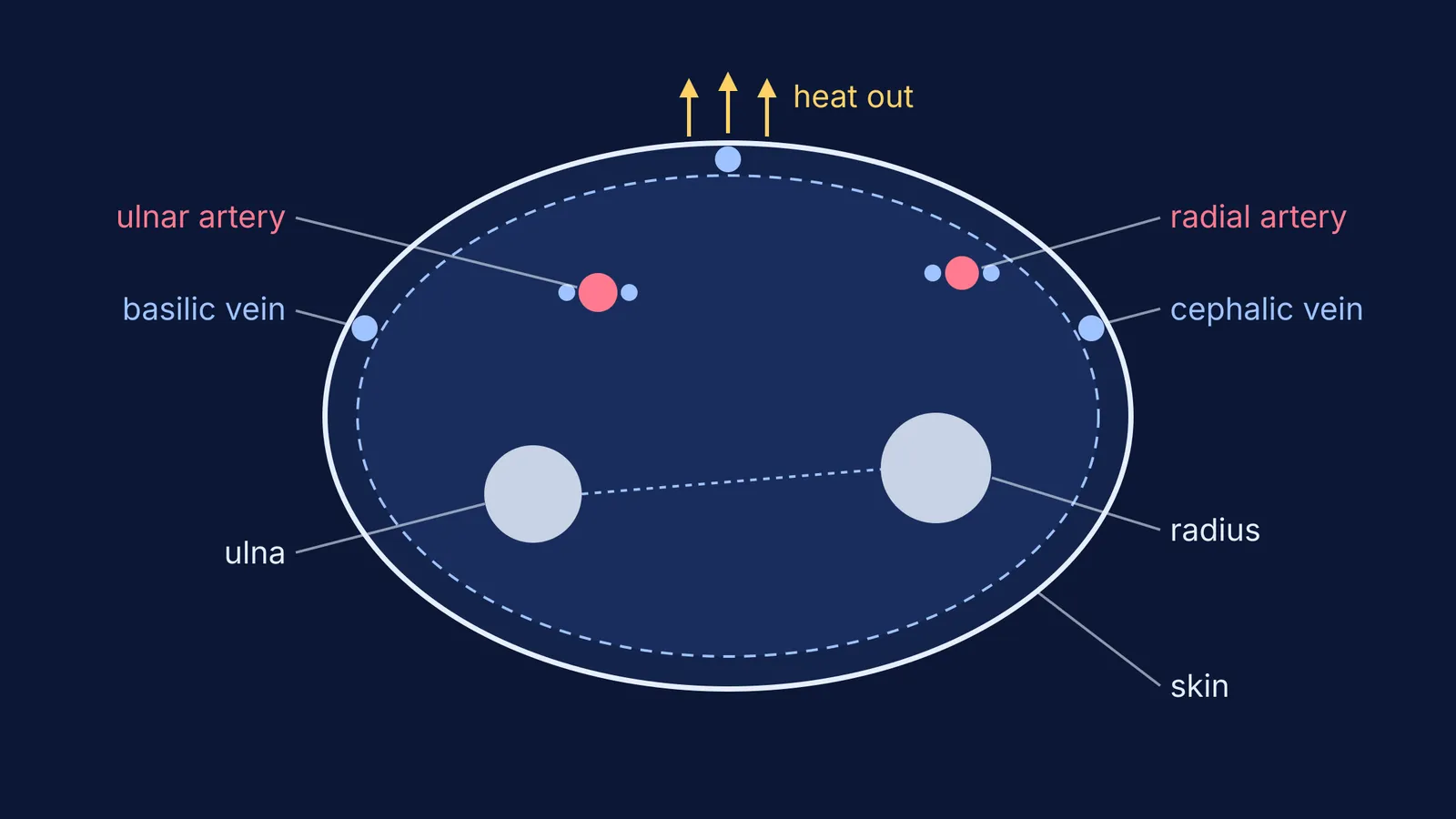
The sketch at the top of this post is a slice across the middle of a right forearm, palm side up.
Two bones: the radius on the thumb side and the ulna on the little-finger side.
Deep arteries: the radial and ulnar arteries run among the muscles, well inside the dashed line of deep fascia.
Paired deep veins: each deep artery has a thin vein on either side. Deep veins are typically paired with an artery of the same name, while superficial veins are not (Wikipedia, superficial vein).
Superficial veins: in the fatty layer just under the skin. The cephalic vein runs up the radial (thumb) side (Wikipedia, cephalic vein), and the basilic vein starts on the ulnar side and travels in the fat above the muscles, often visible through the skin (Wikipedia, basilic vein).
Why do those veins look blue when blood is red? See why veins look blue.
Why are some veins close to the skin at all?
Because they double as a radiator. A 2015 article by Lars Walløe in the journal Temperature describes two routes for blood returning from the limbs.
When it is cool, blood returns through the deep veins, right next to the arteries. Warm arterial blood heading out passes heat to the cooler venous blood heading back. This is countercurrent exchange, and it keeps heat in the body's core.
As it gets warmer, more blood returns through the superficial veins, which warm the skin along the full length of the limbs. Walløe notes that this skin surface accounts for a large part of the body's heat loss toward the warm end of the comfortable temperature range.
Countercurrent exchange is easier to see than to read; the Fermi Simulation Lab has interactive simulations for ideas like this, where watching the flow helps.
How do you draw and explain this in an exam?
Use this five-step sketch.
Draw a wide oval for the skin, then a dashed oval just inside it for the deep fascia.
Add two circles for bones: radius on the thumb side, ulna on the other.
Draw the radial and ulnar arteries inside the dashed line, each with two small veins beside it.
Draw the cephalic and basilic veins in the gap between the two ovals.
Add two arrows: "pressure high, keep deep" at an artery, and "heat out" at a superficial vein.
Then write a three-point answer:
Arteries carry blood at high pressure (about 120/80 mm Hg in a normal adult, per OpenStax), so injury would cause rapid blood loss; deep placement protects them.
Veins carry low-pressure blood, so a superficial position is less dangerous.
Superficial veins help regulate temperature by carrying warm blood near the skin; deep veins beside arteries conserve heat by countercurrent exchange.
If the wider topic is shaky, the Fermi Concept Library gives every biology concept its own lesson and its place in the map. For a side-by-side revision table, read our guide to artery, vein and capillary differences.


