

On this page
Your textbook says a vaccine contains an antigen that the body learns to recognise. But inject a clean, purified protein on its own and the immune system often barely responds. Such vaccines usually need a helper called an adjuvant. Here is what it does, why live vaccines manage without one, and how scientists changed their minds about alum.
What is an adjuvant in vaccines?
An adjuvant is "a substance that is added to a vaccine to stimulate and enhance the magnitude and durability of the immune response", according to a 2021 review by Pulendran, Arunachalam and O'Hagan in Nature Reviews Drug Discovery.
The World Health Organization says an adjuvant improves the immune response, "sometimes by keeping the vaccine at the injection site for a little longer or by stimulating local immune cells." It names the aluminium salts used: aluminium phosphate, aluminium hydroxide and potassium aluminium sulphate, often loosely called alum.
According to the 2021 review, alum was introduced in the 1920s and remained the only adjuvant licensed for human use for the next 70 years, until MF59 was included in a licensed flu vaccine in Europe in the late 1990s.
Why do purified-protein vaccines need adjuvants?
Innate immunity is your body's first, fast line of defence (see the four barriers of innate immunity). Its cells watch for molecular patterns that only microbes carry, such as bacterial cell-wall pieces or viral RNA, called PAMPs (pathogen-associated molecular patterns). Without that alarm, the adaptive response of B and T cells often stays weak.
A live attenuated vaccine still has those patterns. The 2021 review notes that live attenuated pathogens "activate innate immunity through the expression of various PAMPs." A 2009 review by Marrack, McKee and Munks in Nature Reviews Immunology makes the comparison directly. Live or killed whole-pathogen vaccines contain their own built-in adjuvants. Vaccines made from purified antigens "usually require the addition of an exogenous adjuvant".
The hepatitis B vaccine's antigen is a single viral surface protein, made in yeast cells by recombinant DNA technology (how the recombinant hepatitis B vaccine is made). The UK product information for Engerix B says each 1 ml adult dose contains 20 micrograms of this protein adsorbed on aluminium hydroxide, which provides 0.50 milligrams of aluminium. The protein sets the target; the aluminium makes the immune system notice it.
How does alum actually work?
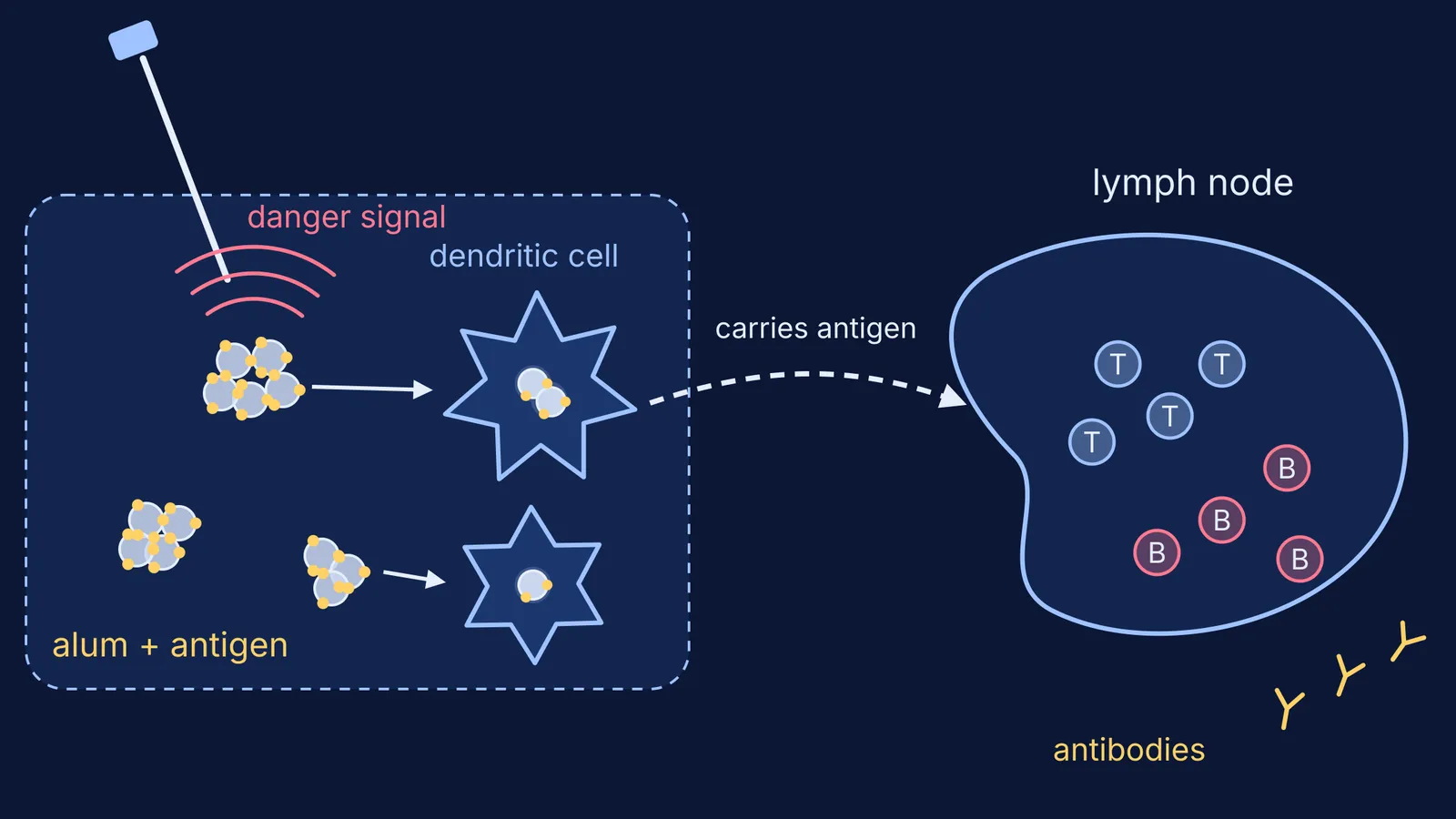
The diagram above follows one dose: antigen stuck to alum, a local danger signal, dendritic cells carrying antigen to a lymph node, then T and B cells responding. Marrack and colleagues describe how Alexander Glenny's team reported in 1926 that antigen stuck onto aluminium potassium sulphate particles gave better antibody responses than soluble antigen. Glenny proposed a depot effect: alum holds the antigen in place and releases it slowly. That idea was accepted for about 60 years.
In a 2012 FASEB Journal study, Hutchison and colleagues removed the injection site in mice as early as 2 hours after the vaccine was given. Doing so "had no appreciable effect" on antigen-specific T- and B-cell responses, so a long-lasting depot is not what makes alum work.
Current evidence points to two other effects, reviewed by Ghimire in SpringerPlus in 2015. Alum helps antigen-presenting cells such as macrophages and dendritic cells take up the antigen. It also releases danger signals such as uric acid and switches on an alarm system inside cells called the NLRP3 inflammasome. Scientists still debate how much each step matters, so be wary of any option that claims to give "the" mechanism.
How do you answer a vaccine-type question quickly?
Work through four checks:
What is inside? A live organism, a killed one, a toxoid, or one purified protein?
Does it carry its own PAMPs? Live and whole-killed vaccines do. A purified protein does not.
So does it need an adjuvant? No built-in alarm usually means an added one, most often an aluminium salt.
What does the adjuvant change? How strongly and how long you respond, not which antigen you are protected against.
Worked example: "Why does the recombinant hepatitis B vaccine contain aluminium hydroxide when a live attenuated vaccine needs no adjuvant?" A strong answer: the recombinant vaccine is one purified protein with no PAMPs, so innate cells are not alerted. Alum adds that signal and helps dendritic cells take up the antigen. The live vaccine displays its own PAMPs, so it acts as its own adjuvant. For more, see toxoid vs killed vs live vaccines.
If terms like PAMP or antigen-presenting cell still feel loose, the Fermi Concept Library has a lesson for every concept in biology, each with its place in the map, so you can see how innate and adaptive immunity connect.
Is the aluminium in vaccines safe?
In 2012 the WHO's Global Advisory Committee on Vaccine Safety cited a US FDA analysis indicating that the aluminium body burden from vaccines "never exceeds safe US regulatory thresholds", even for low birth-weight infants. Questions about a particular child's vaccines should go to your doctor or paediatrician.
Next time you read a vaccine label, find the aluminium salt and ask what alarm the antigen would lack without it.


