

On this page
Eight original waves and sound questions for the JEE Main numerical-value section, easy to hard, each with a worked solution and the most common wrong number. Take g = 10 m/s².
What does the JEE Main numerical section look like?
The Information Bulletin for JEE (Main) 2027 from NTA says each subject in Paper 1 has Section A (MCQs) and Section B, with numerical-value answers. Physics has 5 Section B questions, marked +4 if correct and −1 if incorrect. You enter an integer on an on-screen keypad, and the answer should be rounded off to the nearest integer.
All eight questions sit inside the waves topics of Unit 10, Oscillations and Waves, in NTA's Syllabus for JEE (Main) 2027, and inside NCERT Class 11 Physics Chapter 14, Waves (Reprint 2026-27). For theory first, see how to prepare waves and sound for JEE Main.
Easy: can you read a wave correctly?
Q1 (easy). A particle on a stretched rope takes 5.0 ms to move from its mean position to its maximum displacement as a wave passes. The nearest particle that always moves exactly opposite to it is 0.75 m away. What is the wave speed, in m/s?
Answer: 75. Mean to extreme is T/4, so T = 20 ms. Opposite phase is λ/2 apart, so λ = 1.5 m. Then v = λ/T = 1.5/0.020 = 75 m/s.
Trap: 38 (37.5 rounded), taking 0.75 m as a full wavelength.
Q2 (easy). A string 60 cm long has a mass of 30 g. A wave on it is y = 0.02 sin(4.0x − 200t), in SI units. What is the tension in the string, in newtons?
Answer: 125. Wave speed v = ω/k = 200/4.0 = 50 m/s. Linear mass density μ = 0.030/0.60 = 0.05 kg/m. Tension T = μv² = 0.05 × 2500 = 125 N.
Trap: 75, using the whole mass instead of mass per metre.
Q3 (easy). Two waves of the same frequency travel the same way along a string, with amplitudes 3.0 mm and 4.0 mm and a phase difference of 60°. What is the amplitude of the resultant wave, in mm, to the nearest integer?
Answer: 6. A² = 3² + 4² + 2 × 3 × 4 × cos 60° = 37, so A ≈ 6.08 mm, which rounds to 6.
Trap: 5, which treats the phase difference as 90°.
Medium: what changes when the setup changes?
Q4 (medium). A sonometer wire resonates in its fundamental mode with a tuning fork when the length between the bridges is 60 cm and the hanging mass is 4.0 kg. The mass is changed to 9.0 kg. What length, in cm, now resonates with the same fork in the fundamental?
Answer: 90. f = (1/2L)√(T/μ). With f and μ fixed, L ∝ √T, so L = 60 × √(9/4) = 90 cm.
Trap: 135, from taking L ∝ T instead of √T.
Q5 (medium). Two identical pipes, each open at both ends, sound a 500 Hz fundamental at 7 °C. One pipe's air is warmed to 21 °C while the other stays at 7 °C. How many beats per second are heard, to the nearest integer?
Answer: 12. Sound speed goes as √T in kelvin, so the warm pipe gives f = 500 × √(294/280) ≈ 512.35 Hz. The beat frequency is about 12.35, which rounds to 12.
Trap: 366, from putting 21/7 in Celsius into the square root.
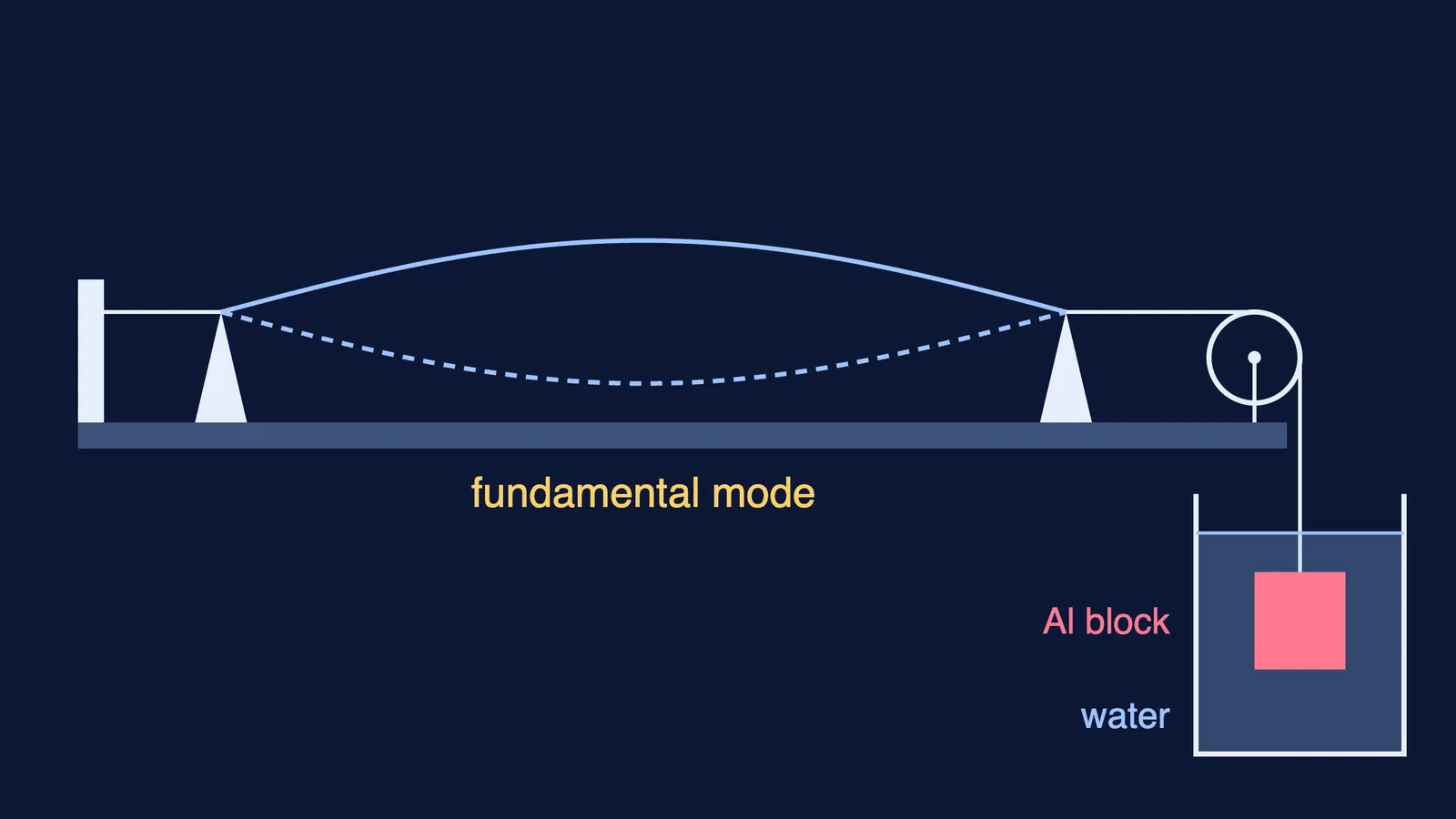
Q6 (medium). A sonometer wire, kept taut by a hanging aluminium block (density 2700 kg/m³), has a fundamental frequency of 300 Hz. The block is then fully immersed in water (density 1000 kg/m³). What is the new fundamental frequency, in Hz, to the nearest integer?
Answer: 238. Buoyancy cuts the tension to T(1 − 1000/2700) ≈ 0.630T. Frequency goes as √T, so f = 300 × √0.6296 ≈ 238.05 Hz, which rounds to 238.
Trap: 189, from scaling the frequency by the tension ratio without the square root.
Hard: can you handle two conditions at once?
Q7 (hard). A tuning fork sounds beside a sonometer wire in its fundamental mode at fixed tension. With 40 cm of wire between the bridges, 5 beats per second are heard. Moving one bridge to give 42 cm also gives 5 beats per second. What is the fork's frequency, in Hz?
Answer: 205. f ∝ 1/L, so the 40 cm wire is above the fork and the 42 cm wire below it: f₄₀ − n = 5 and n − f₄₂ = 5. With f = k/L, k/40 − k/42 = 10, so k = 8,400. So f₄₀ = 210 Hz, f₄₂ = 200 Hz and n = 205 Hz.
Trap: 210, the frequency of the 40 cm wire, not the fork.
Q8 (hard). A string (vibrating length 1.0 m, 25 g/m) is driven at a fixed frequency at one end and runs over a pulley to a hanging mass at the other. With 4.0 kg hanging, a steady standing wave forms. With 6.25 kg hanging, the standing wave has exactly one loop fewer. What is the driving frequency, in Hz?
Answer: 100. At fixed f and L, the number of loops n ∝ 1/√T. So n/(n − 1) = √(6.25/4.0) = 5/4, which gives n = 5 at 4.0 kg. There, T = 40 N and v = √(40/0.025) = 40 m/s, so f = nv/2L = 5 × 40/2 = 100 Hz.
Trap: 80, from taking 4 loops at 4.0 kg.
For mixed practice with options, try our waves and sound JEE Main practice questions with solutions.
How do you get the number right in waves and sound?
Convert to SI before squaring, and use mass per metre, not total mass, in T = μv².
Use kelvin in every temperature ratio for the speed of sound.
Check what the question counts: half a wavelength between opposite-phase points, λ/2 per loop on a string.
Decide which frequency is higher before writing a beats equation; the sign matters in Q7.
Carry unrounded values (512.35 Hz, not 512) and round only the final answer to the nearest integer, as the bulletin asks.
Stuck on where a solution went wrong? The Fermi Problem Library has worked problems with a step-by-step solver that explains the reasoning rather than printing an answer.


