

On this page
With no options to check against, the condition you pick and the unit you answer in matter as much as the formula. Here are eight original wave optics questions, easy to hard.
What do JEE Main numerical-value questions look like?
The JEE (Main) 2027 information bulletin gives each subject a Section B of questions whose answers are filled in as a numerical value. You enter an integer on an on-screen virtual numeric keypad, and the answer should be rounded off to the nearest integer. A correct answer scores +4 and a wrong one −1, so a guess can cost you.
Every question sits inside Wave optics, Unit 16 of the NTA's Syllabus for JEE (Main) 2027 and NCERT Class 12 Physics Chapter 10, Wave Optics. New to the chapter? Start with our guide on how to prepare wave optics for JEE Main.
Answer each to the nearest integer in the unit stated.
Easy
Q1 (easy). Unpolarised light passes through two Polaroids in turn. The light leaving the second has 30% of the intensity that fell on the first. Find the angle between their pass axes, in degrees.
Answer: 39. The first Polaroid passes 50%. Malus's law gives 0.5 cos²θ = 0.30, so cos²θ = 0.6, cos θ = 0.775 and θ = 39.2°.
Trap: 57, from skipping the halving and setting cos²θ = 0.30.
Q2 (easy). Light in air strikes a liquid surface at the angle where the reflected light is completely plane-polarised. The refracted ray is deviated by 16° from the direction of the incident ray. Find the refractive index of the liquid, in units of 0.01.
Answer: 133. At Brewster's angle the reflected and refracted rays are perpendicular, so i + r = 90°. The deviation gives i − r = 16°. Then i = 53°, r = 37°, and n = tan 53° = 1.327.
Trap: 75, from swapping the angles and taking tan 37°.
Q3 (easy). Light of vacuum wavelength 600 nm passes normally through a glass plate 0.48 mm thick, of refractive index 1.5. How many more wavelengths fit inside the plate than in the same thickness of air (n = 1)?
Answer: 400. The plate holds nt/λ = 1200 wavelengths and the same air t/λ = 800, a difference of (n − 1)t/λ = 400.
Trap: 1200, the total in the glass.
Medium
Q4 (medium). In a Young's double-slit experiment with 600 nm light, the fourth dark fringe from the centre is seen at an angle of 0.20° from the central line. Find the slit separation, in micrometres.
Answer: 602. Dark fringes need d sin θ = (n + ½)λ, and the fourth one is n = 3: d sin θ = 3.5λ. With sin 0.20° = 3.49 × 10⁻³, d = 3.5 × 600 × 10⁻⁹ / 3.49 × 10⁻³ m = 601.6 μm.
Trap: 688, from writing 4λ, the condition for the fourth bright fringe.
Q5 (medium). Define fringe visibility as V = (I_max − I_min)/(I_max + I_min). In a double-slit pattern, the light from the two slits reaches the screen with intensities in the ratio 16 : 1. Find V as a percentage.
Answer: 47. Amplitudes go as √I, 4 : 1, so I_max ∝ (4 + 1)² = 25 and I_min ∝ (4 − 1)² = 9, so V = 16/34 = 0.471.
Trap: 88, from (16 − 1)/(16 + 1), which treats the intensities as amplitudes.
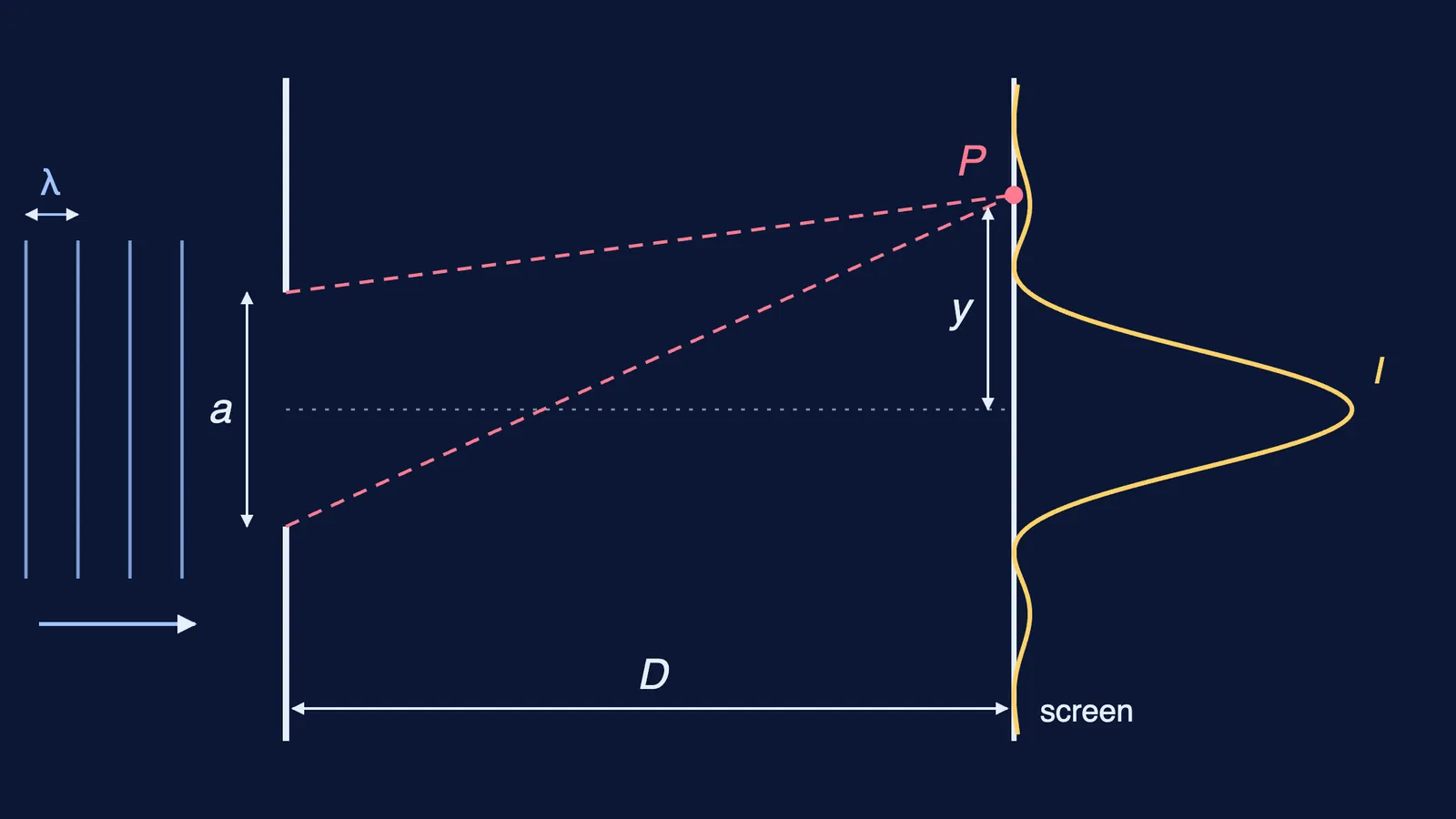
Q6 (medium). Light of 500 nm falls normally on a single slit 0.30 mm wide, and the screen is 2.0 m away. Point P on the screen is 5.0 mm from the centre of the pattern. Find the path difference between the rays reaching P from the two edges of the slit, in nanometres.
Answer: 750. P is at θ ≈ y/D = 2.5 × 10⁻³ rad, so the edge rays differ by a sin θ ≈ 0.30 × 10⁻³ m × 2.5 × 10⁻³ = 7.5 × 10⁻⁷ m. That is 1.5λ: P is near the first secondary maximum.
Trap: 375, from using a/2, as in the half-slit pairing argument.
Hard
Q7 (hard). White light (400 nm to 700 nm) falls on two slits 0.30 mm apart, with the screen 1.5 m away. Point P is 12.0 mm from the central white fringe. Find the longest wavelength in this range that gives a dark fringe at P, in nanometres.
Answer: 686. The path difference at P is yd/D = 2.4 μm. Dark needs 2.4 μm = (n + ½)λ. n = 2 gives 960 nm, too long; n = 3 gives λ = 2.4/3.5 μm = 685.7 nm.
Trap: 600, from using the bright condition 2.4 μm = nλ, which makes 600 nm brightest at P.
Q8 (hard). In a double-slit set-up, the slits are 0.40 mm apart, the screen is 1.2 m away and the light has vacuum wavelength 500 nm. A sheet 5.0 μm thick, of refractive index 1.6, covers one slit, and the whole apparatus is under water of refractive index 4/3. Find how far the central bright fringe shifts, in units of 0.1 mm.
Answer: 30. The sheet replaces water, not air, so the extra optical path is (1.6 − 4/3) × 5.0 μm = 1.33 μm, or 2.67 vacuum wavelengths. Fringes in water are λD/(n_w d) = 1.125 mm wide, so the shift is 2.67 × 1.125 mm = 3.0 mm, towards the covered slit.
Trap: 90, from the air formula (μ − 1)tD/d, which ignores the water.
How do you get the number right in wave optics?
Convert nm, μm and mm to metres before substituting, then into the unit the stem asks for: Q6's 7.5 × 10⁻⁷ m is 750 nm, and typing 1 scores −1.
Count dark fringes from n = 0: the fourth dark fringe is (3 + ½)λ, not 4λ.
Halve unpolarised light at the first Polaroid only; after that, every sheet follows cos²θ.
In a liquid, divide the wavelength by its index and measure a sheet's extra path against the liquid, not air.
Round once, at the last step: Q4 is 601.6 μm.
Got a different number? The Fermi Problem Library has worked problems with a step-by-step solver that explains the reasoning rather than printing an answer.
For multiple-choice practice, try set 1 of our wave optics JEE Main practice questions.


