

On this page
Water at 10 °C cannot turn into ice at −10 °C in one step that you have data for. You have a heat capacity for liquid water, a heat capacity for ice and an enthalpy of fusion measured at 0 °C. So you build a path out of those three pieces and add them. This is an NCERT Class 11 thermodynamics exercise, and the same path, run slightly differently, answers a harder JEE question about supercooled water.
What data do you need for the water to ice calculation?
NCERT gives these values for 1 mol of water:
Enthalpy of fusion at 0 °C: ΔfusH = 6.03 kJ mol⁻¹
Molar heat capacity of liquid water: Cp(l) = 75.3 J K⁻¹ mol⁻¹
Molar heat capacity of ice: Cp(s) = 36.8 J K⁻¹ mol⁻¹
These are molar heat capacities, so they multiply moles, not grams. If your book gives the specific heat of water as 4.18 J g⁻¹ K⁻¹ instead, multiply by 18 g mol⁻¹ to get about 75.3 J K⁻¹ mol⁻¹.
Some sources, and our post on why water freezes below 0 °C, use 6.01 kJ mol⁻¹ for the enthalpy of fusion. The difference is small. Here we use NCERT's 6.03 kJ mol⁻¹ throughout so the answer matches the book.
Enthalpy is a state function, so ΔH depends only on the start and end states. Any path you can calculate gives the same total.
How do you calculate ΔH for water at 10 °C turning into ice at −10 °C?
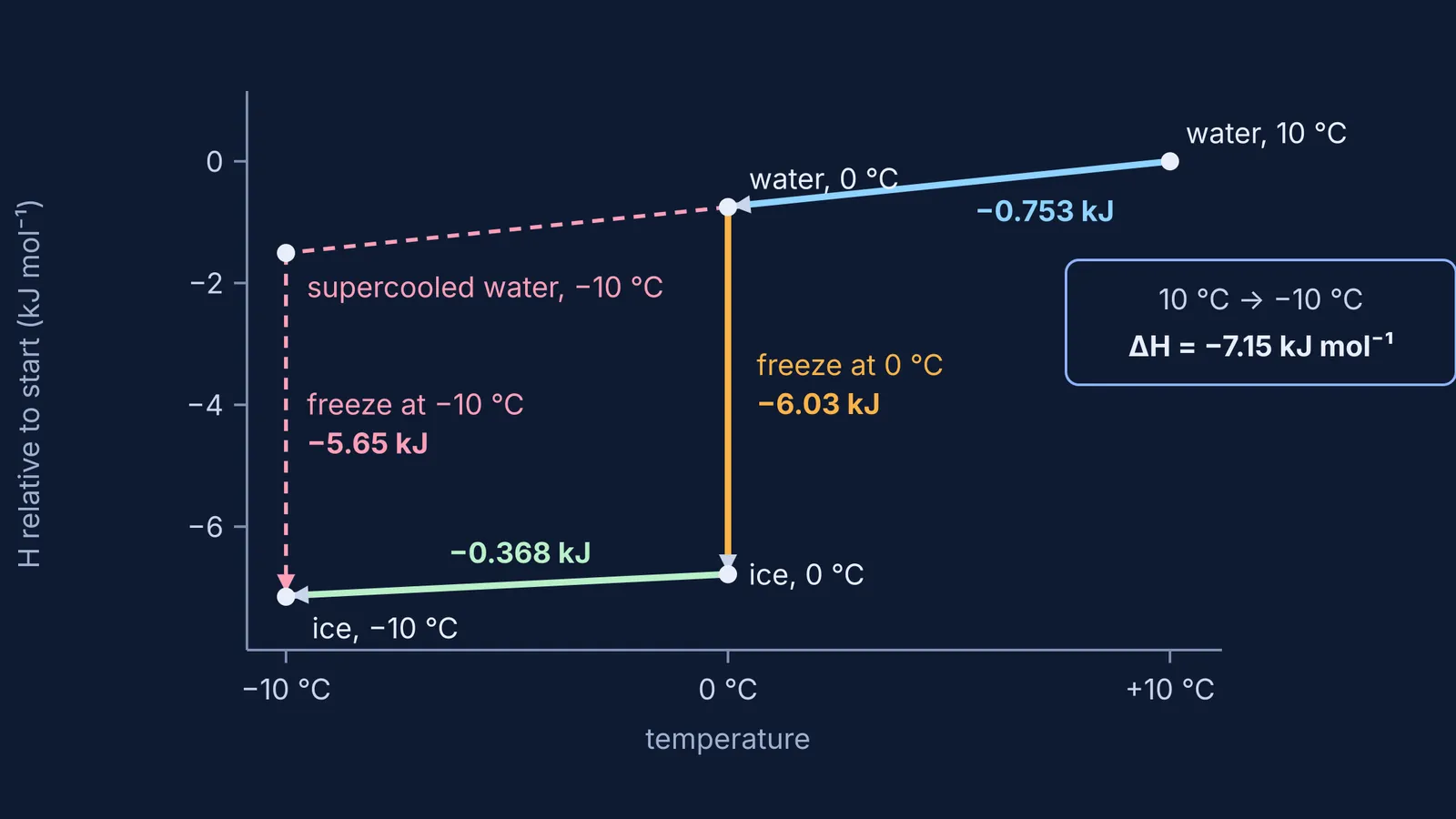
Use a three-step path. Every step releases heat, so every ΔH is negative.
Cool the liquid from 10 °C to 0 °C. ΔH₁ = n × Cp(l) × ΔT = 1 × 75.3 × (0 − 10) = −753 J.
Freeze the water at 0 °C. Freezing is the reverse of fusion, so ΔH₂ = −6.03 kJ = −6030 J.
Cool the ice from 0 °C to −10 °C. ΔH₃ = 1 × 36.8 × (−10 − 0) = −368 J.
Add the steps. ΔH = −753 − 6030 − 368 = −7151 J ≈ −7.15 kJ mol⁻¹.
That is NCERT's answer. Notice how lopsided the steps are. Freezing supplies about 84% of the total, and the two cooling steps together supply the rest.
A temperature change of 10 °C is the same as a change of 10 K, so you can put ΔT in either unit. Absolute temperatures only matter when you divide by T, which you will do for entropy below.
What is ΔH for supercooled water freezing at −10 °C?
Pure water can be cooled below 0 °C without freezing. When this supercooled water finally freezes at −10 °C, what is ΔH? This is a different question with a different answer.
Build a cycle that only uses changes you have data for:
Warm the supercooled water from −10 °C to 0 °C. ΔH = 75.3 × (+10) = +753 J.
Freeze it at 0 °C. ΔH = −6030 J.
Cool the ice back to −10 °C. ΔH = 36.8 × (−10) = −368 J.
Add. ΔH = 753 − 6030 − 368 = −5645 J ≈ −5.65 kJ mol⁻¹.
So freezing at −10 °C releases less heat than freezing at 0 °C. The reason is that ice has a smaller heat capacity than liquid water, so the gap in enthalpy between them narrows as the temperature falls. You can write the same result in one line: ΔH(−10 °C) = ΔH(0 °C) + ΔCp × ΔT = −6030 + (36.8 − 75.3)(−10) = −5645 J. That one line is the Kirchhoff equation, which our post on the Kirchhoff equation for ΔH at a new temperature works through for reactions.
Keep the two answers apart. −7.15 kJ is the total for 10 °C water becoming −10 °C ice. −5.65 kJ is only the freezing step, done at −10 °C.
How do you prove supercooled water freezing is spontaneous?
Use the second law: the change is spontaneous if ΔS(univ) = ΔS(sys) + ΔS(surr) is positive. Find ΔS(sys) along the same reversible path. For heating or cooling, ΔS = n × Cp × ln(T₂/T₁). For freezing at the melting point, ΔS = ΔH/T. Use kelvin: 0 °C is 273.15 K and −10 °C is 263.15 K.
Warm the liquid from 263.15 K to 273.15 K. ΔS = 75.3 × ln(273.15/263.15) = +2.81 J K⁻¹.
Freeze at 273.15 K. ΔS = −6030/273.15 = −22.08 J K⁻¹.
Cool the ice from 273.15 K to 263.15 K. ΔS = 36.8 × ln(263.15/273.15) = −1.37 J K⁻¹.
System total. ΔS(sys) = 2.81 − 22.08 − 1.37 = −20.64 J K⁻¹.
The water loses entropy, as you expect when a liquid turns into a crystal. Now the surroundings. They sit at −10 °C and receive the 5645 J released by the actual freezing, so ΔS(surr) = +5645/263.15 = +21.45 J K⁻¹.
ΔS(univ) = −20.64 + 21.45 = +0.81 J K⁻¹, which is positive, so the freezing is spontaneous.
As a cross-check, ΔG = ΔH − TΔS(sys) = −5645 − 263.15 × (−20.64) ≈ −214 J. It is negative, and it equals −T × ΔS(univ), as it must.
Our water freezing post gets +0.84 J K⁻¹ by treating ΔH and ΔS as constant. The heat-capacity path above gives +0.81 J K⁻¹. The conclusion is the same, and the small gap is the price of that approximation.
Why use ln(T₂/T₁) and not ΔT/T for the entropy steps?
During heating, T changes all the time, so you cannot divide the heat by one fixed temperature. Adding up tiny steps of Cp dT/T gives Cp ln(T₂/T₁). Dividing by a single temperature gives a slightly wrong answer, and the error depends on which T you pick. Over a 10 K range it is only a few hundredths of a J K⁻¹. In a problem where the final answer is 0.81, a few hundredths matter.
The freezing step is different. It happens at one fixed temperature, so ΔS = ΔH/T is exact there.
Which mistakes cost marks on this question?
Using specific heat in J g⁻¹ K⁻¹ with moles, or molar heat capacity with grams.
Giving the freezing step a positive sign.
Mixing J and kJ when you add the steps. Convert everything to J first.
Reporting −7.15 kJ when the question asks only about the freezing step at −10 °C (−5.65 kJ).
Using Celsius temperatures inside ln or in ΔH/T.
Forgetting the surroundings, and concluding from ΔS(sys) < 0 that freezing cannot happen.
For more cycles like these, the Fermi Problem Library has a step-by-step solver that explains the reasoning, so you can see exactly which step's sign went wrong. To see how this fits with the other named enthalpies, read enthalpies of atomisation, sublimation and phase change compared.
Quick checklist
Split the change into steps you have data for: cool the liquid, change phase, cool the solid.
Use molar heat capacities with moles; 10 °C and 10 K are the same interval.
Water at 10 °C to ice at −10 °C: −753 − 6030 − 368 = −7151 J ≈ −7.15 kJ mol⁻¹.
Supercooled water freezing at −10 °C: −6030 + (36.8 − 75.3)(−10) = −5645 J.
Entropy: Cp ln(T₂/T₁) for temperature changes, ΔH/T only at the phase change.
ΔS(univ) = −20.64 + 21.45 = +0.81 J K⁻¹, so supercooled water freezes on its own.


