

On this page
Take the numbers 1 to N and paint each one red or blue. Can you always dodge three numbers of the same colour that are equally spaced, like 2, 5, 8? For small N you can. Past a certain point you cannot. That certainty is van der Waerden's theorem, and the two-colour, length-3 case is small enough to check by hand.
What does van der Waerden's theorem say?
The Wikipedia article on the theorem states it like this: for any positive integers r and k, there is some number N such that if 1, 2, ..., N are each coloured with one of r colours, there are k numbers of the same colour in arithmetic progression.
The least such N is called the van der Waerden number W(r, k).
The page credits the conjecture to Pierre Baudet in 1921, and says van der Waerden heard of it in 1926 and published his proof in 1927, titled "Beweis einer Baudetschen Vermutung" (Proof of Baudet's conjecture), in Nieuw Archief voor Wiskunde.
The theorem promises the pattern once N is large enough, but says nothing easy about how large. MathWorld's entry notes that no formula for these numbers is known.
Why is W(2, 3) equal to 9?
We need two facts: 1 to 8 can avoid a one-colour 3-term progression, and 1 to 9 cannot.
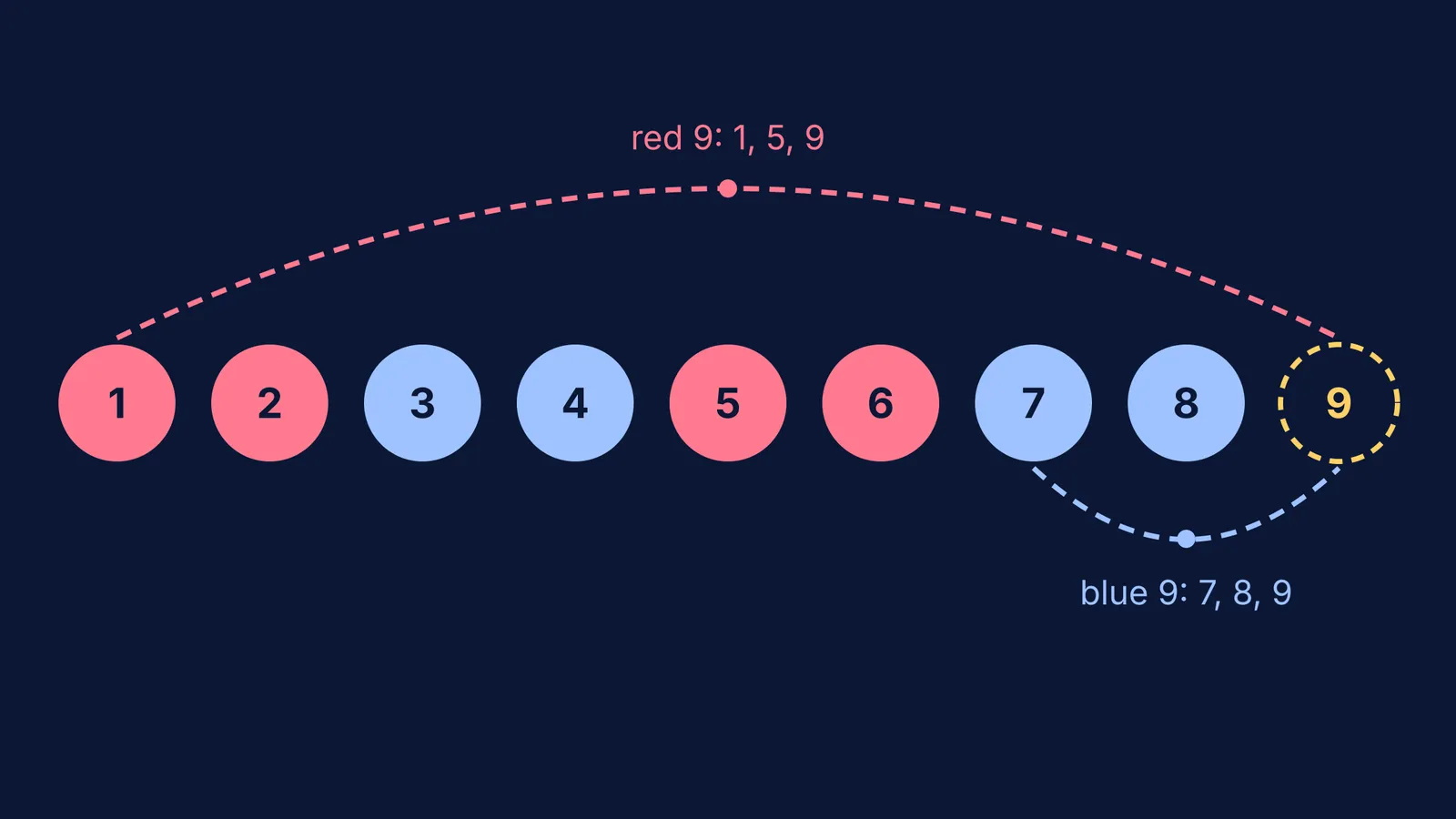
First, a safe colouring of 1 to 8. Colour in pairs: R R B B R R B B. So red is {1, 2, 5, 6} and blue is {3, 4, 7, 8}.
A 3-term progression needs a middle number exactly halfway between the other two. The red triples (1, 2, 5), (1, 2, 6), (1, 5, 6) and (2, 5, 6) have gaps 1 and 3, 1 and 4, 4 and 1, 3 and 1. None has two equal gaps, so red is safe. Blue is red shifted by 2, so it is safe too. W(2, 3) is therefore bigger than 8.
Second, every colouring of 1 to 9 fails. Look at 4 and 6.
If 4 and 6 share a colour, say red. Then 5 must be blue (because of 4, 5, 6), 2 must be blue (2, 4, 6) and 8 must be blue (4, 6, 8). But 2, 5, 8 is a blue progression. Contradiction.
If 4 and 6 differ, say 4 red and 6 blue. Flipping the line (x becomes 10 minus x) and swapping colours keeps this setup, so we may take 5 to be red. Now 4, 5 are red, so 3 is blue. Then 3, 6 are blue, so 9 is red. Then 5, 9 are red, so 1 and 7 are blue (1, 5, 9 and 5, 7, 9). Then 6, 7 are blue, so 8 is red. Then 1, 3 are blue, so 2 is red. That leaves 2, 5, 8 all red. Contradiction.
Both cases break, so W(2, 3) = 9.
How do you check a small case like this yourself?
The same method works for many problems in this family:
Build first. Find the longest safe colouring you can. Patterns in blocks (RRBB...) are a good first guess.
Pick a pivot. Choose two numbers placed symmetrically, like 4 and 6, and split into "same colour" and "different colour".
Force and follow. Each pair of one colour forces the third member of any progression to take the other colour.
Use symmetry. Reflection (x to N + 1 minus x) and swapping the colours often cut the cases in half.
Stop at the first contradiction, then return to the next case.
The same forcing drives the party problem in why six people always contain three friends or three strangers. For a refresher on progressions, see arithmetic progression key terms. To look up a term such as the pigeonhole principle, the Fermi Concept Library covers concepts in mathematics, physics, chemistry, biology and computing, each with its own lesson.
How does it link to Szemerédi's theorem?
Van der Waerden's theorem is about colourings. Do you even need the colours? In 1936, Paul Erdős and Pál Turán conjectured that any set of whole numbers with positive density (taking up a positive share of all numbers) must contain progressions of every length, according to the Wikipedia article on Szemerédi's theorem.
Endre Szemerédi proved this in 1975, in a paper in Acta Arithmetica, volume 27.
MathWorld calls van der Waerden's theorem a corollary of Szemerédi's theorem. The reason: with finitely many colours, at least one colour takes up a positive share of the numbers, so it holds long progressions.
The primes take up a vanishing share, so Szemerédi's theorem does not cover them. In a separate result, Ben Green and Terence Tao showed that the primes contain arbitrarily long arithmetic progressions, in the Annals of Mathematics in 2008. For infinitely many primes in one progression, see Dirichlet's theorem on primes in progressions.
To practise forcing arguments, the Fermi Problem Library has worked problems with a step-by-step solver that explains the reasoning rather than printing an answer.


