

On this page
Irrigation engineers often need to know how much water a small channel carries, in litres per second, using nothing but a ruler. One simple answer is a thin metal plate with a V cut into it, set across the channel. All the water has to spill through the V, and the height of the water above the bottom of the V tells you the flow. Because of the shape of the notch, the flow rises with the 5/2 power of that height. Double the height and the flow goes up 5.7 times. This post derives the formula and puts numbers on it.
What is a V-notch weir?
A weir is a barrier across a channel that water flows over. A sharp-crested V-notch weir is a thin plate with a triangular notch, usually 90°, with its edges bevelled to a sharp edge. Water backs up behind the plate and pours through the notch as a free jet, called the nappe.
The quantity you measure is the head H: the height of the still water surface upstream above the lowest point of the V. The US Bureau of Reclamation's Water Measurement Manual, chapter 7 calls the thin-plate V-notch "an accurate flow measuring device particularly suited for small flows" and notes that it is used for the small flows met when measuring irrigation water.
Why can't you just use Torricelli's law for one hole?
For a small hole at depth h in a tank, the whole jet leaves at one speed, √(2gh). That case is covered in Torricelli's law for the speed of efflux, and how the level falls as a tank drains through one hole is worked out in time to empty a tank through a small hole.
A notch is different. It is a "hole" as tall as the water above it. Water near the surface leaves slowly, and water near the bottom of the V leaves fast. The opening is also wide at the top and narrow at the bottom. So you have to split the notch into thin horizontal strips and add them up.
How do you derive the V-notch formula?
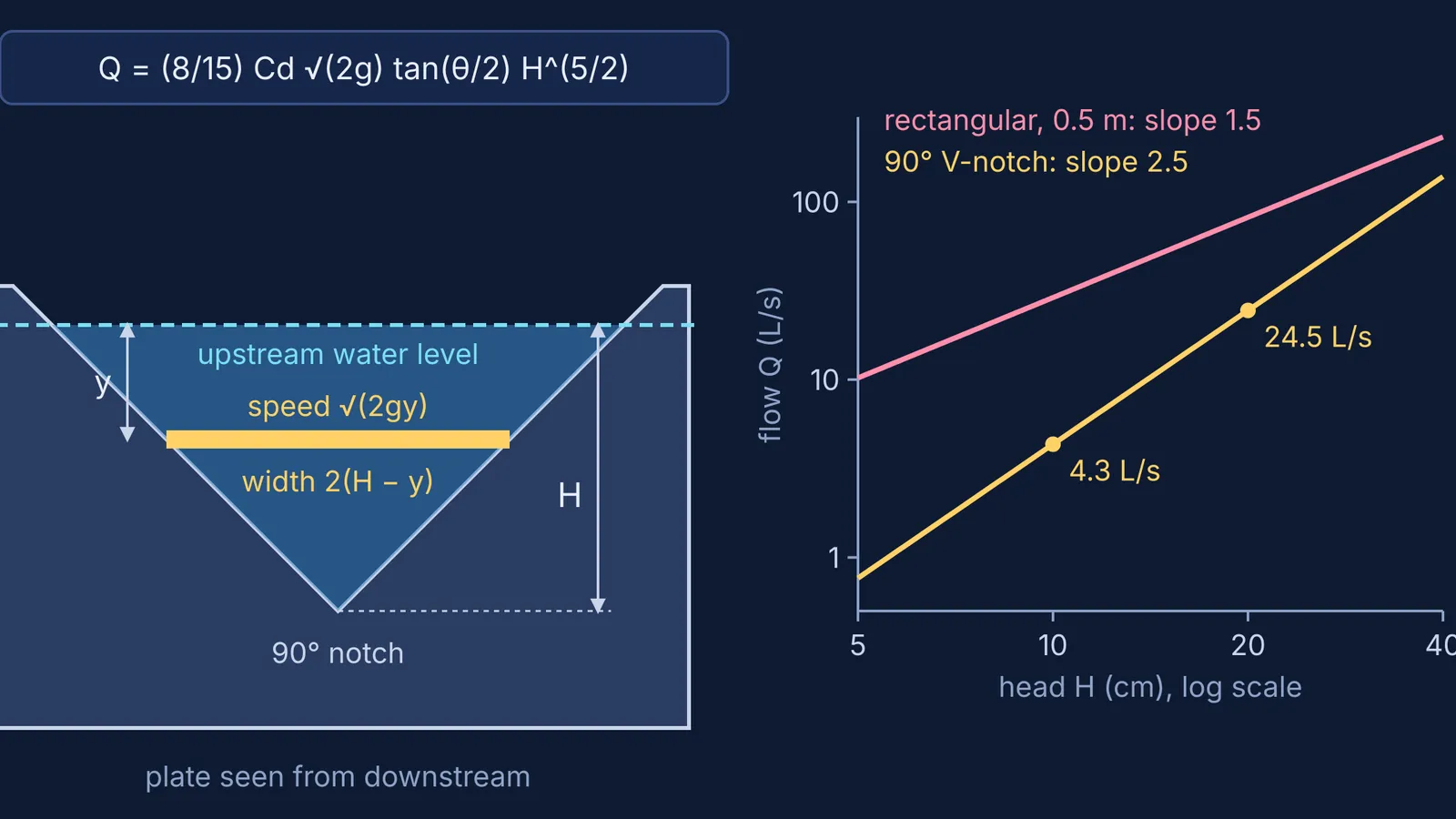
Measure depth y downward from the upstream water surface.
Speed of one strip. Water at depth y leaves at v = √(2gy), from Bernoulli's equation, the same way as Torricelli's law.
Width of the strip. The strip is at height (H − y) above the apex of the V. For a notch of total angle θ, each side leans at θ/2 from the vertical, so the width is 2(H − y)·tan(θ/2). For a 90° notch, tan 45° = 1, and the width is just 2(H − y).
Flow through the strip. dQ = width × thickness × speed = 2(H − y)·tan(θ/2)·dy·√(2gy).
Add the strips from y = 0 to y = H. The integral of (H − y)·√y from 0 to H is (4/15)H^(5/2). Multiply by 2·tan(θ/2)·√(2g) to get the ideal flow: Q = (8/15)·√(2g)·tan(θ/2)·H^(5/2).
Correct for the real jet. The nappe narrows as it leaves the sharp edges, and the surface dips as it approaches the notch, so less water passes than the ideal result. A discharge coefficient Cd takes care of this:
Q = (8/15)·Cd·√(2g)·tan(θ/2)·H^(5/2)
Check the units: √(m/s²) × m^(5/2) = m³/s. The H^(5/2) comes from two factors: the speed grows as H^(1/2), and the area of the triangle grows as H².
What value of Cd should you use?
For a sharp, fully contracted 90° notch, Cd is close to 0.58. You can check this against the USBR manual's own rating, the Cone equation for a standard 90° notch, Q = 2.49 h^2.48, with Q in ft³/s and h in feet. In the same units, (8/15)·√(2g) = 4.28, so 2.49 ÷ 4.28 = 0.58. The Cone equation's exponent of 2.48 instead of 2.5 is the small drift in Cd with head.
With Cd = 0.58, g = 9.81 m/s² and tan 45° = 1:
Q = (8/15) × 0.58 × √19.62 × H^(5/2) = 1.37 H^(5/2), with Q in m³/s and H in metres.
Worked example: how much water flows at 10, 20 and 30 cm?
H = 10 cm = 0.10 m. H^(5/2) = 0.10^2.5 = 3.16 × 10⁻³. Q = 1.37 × 3.16 × 10⁻³ = 4.33 × 10⁻³ m³/s = 4.33 L/s. (Without Cd, the ideal flow would be 7.47 L/s.)
H = 20 cm. Q = 24.5 L/s. That is 2^2.5 = 5.66 times the 10 cm flow.
H = 30 cm. Q = 67.5 L/s.
Reverse it: what head means 10 L/s? H = (0.010 ÷ 1.37)^(2/5) = 0.140 m, so 14.0 cm.
Cross-check with the Cone equation. At 10 cm (0.328 ft) it gives 4.45 L/s, and at 20 cm 24.8 L/s, within about 3% of our values.
All of these sit inside the USBR limits for this weir: heads from 0.2 ft (6.1 cm) up, and flows from 0.05 to 4.25 ft³/s, which is about 1.4 to 120 L/s.
Why is a V-notch better than a rectangular weir for small flows?
A rectangular notch of width b has a strip width that does not shrink with depth. The same strip sum gives Q = (2/3)·Cd·b·√(2g)·H^(3/2). Take b = 0.5 m and an illustrative Cd of 0.62. At H = 10 cm you get about 29 L/s, and at 20 cm about 82 L/s, only 2.83 times as much.
At small flows the rectangular weir's water layer becomes very thin and hard to read. The V-notch squeezes the same small flow into a deeper, narrower pool, so the head you read is larger and the relative reading error is smaller. For large flows the trade reverses. The USBR manual notes that near the top of the V-notch range, a 2 ft rectangular weir passes the same flow at 40% less head.
When does a V-notch read wrong?
The nappe must spring clear. Air must reach the underside of the jet. If the jet clings to the plate, as it can at very low heads, the reading is unreliable, which is one reason for the 6 cm minimum.
Downstream water must stay low. The USBR V-notch rating page asks for the downstream surface to stay at least 0.2 ft below the notch. A drowned notch reads wrong.
The edge must stay sharp. A rounded or dented crest changes Cd.
The approach must be calm. The channel just upstream should be straight and slow, so that the speed of approach is small. Fast or swirling approach flow adds energy the formula does not include.
If you want practice with integrals over strips like this one, the Fermi Problem Library has a step-by-step solver that explains the reasoning.
Quick checklist
Each strip of the notch leaves at √(2gy); the strip width shrinks to zero at the apex.
Ideal flow: (8/15)·√(2g)·tan(θ/2)·H^(5/2). Multiply by Cd ≈ 0.58 for a sharp 90° notch.
For a 90° notch, Q ≈ 1.37 H^(5/2) in SI units: 4.33 L/s at 10 cm, 24.5 L/s at 20 cm.
Twice the head gives 5.66 times the flow; a rectangular weir gives only 2.83 times.
Measure H upstream, at least four heads back, not at the plate.
Keep the nappe aerated, the tailwater low and the edge sharp.


