

On this page
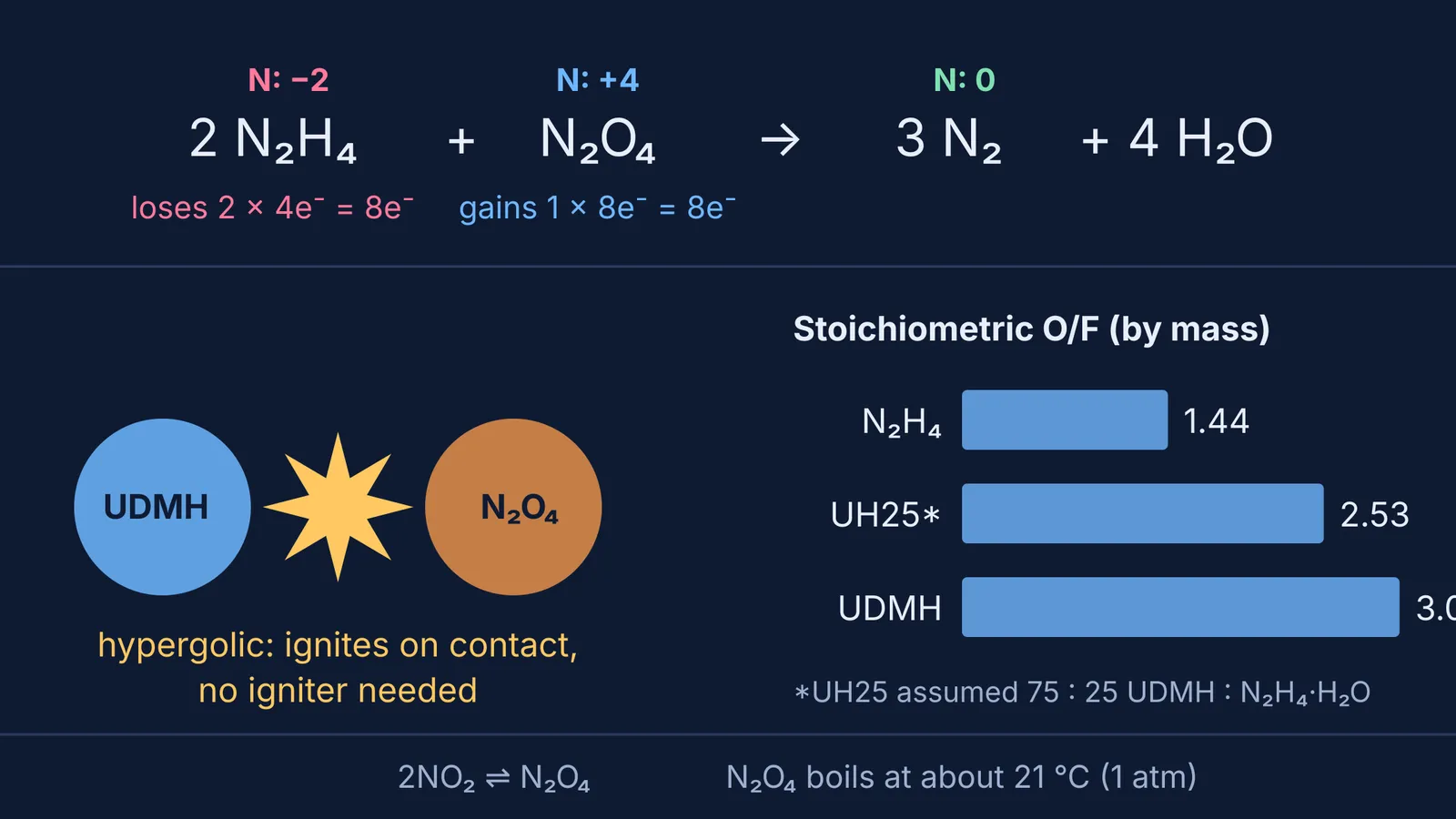
Petrol in a bike engine waits for a spark plug. The propellants in ISRO's Vikas engine need no spark. Unsymmetrical dimethylhydrazine (UDMH) and dinitrogen tetroxide (N₂O₄) start burning the moment they meet. Such a pair is called hypergolic, and the chemistry behind it is a redox reaction you can balance with Class 11 tools: every nitrogen atom, whether it starts in the fuel or in the oxidiser, ends up as N₂ gas.
Which ISRO stages burn hydrazine fuels with N₂O₄?
ISRO's PSLV page lists the Vikas engine of the second stage (PS2) as burning UDMH + N₂O₄, and the fourth stage (PS4) as burning MMH + MON. MMH is monomethylhydrazine, CH₃NHNH₂. MON stands for mixed oxides of nitrogen: N₂O₄ with a small amount of nitric oxide (NO) dissolved in it.
The LVM3 core stage (L110) also uses Vikas engines. ISRO's LVM3-M5 brochure lists its propellant as UH25 + N₂O₄, about 115.9 tonnes. UH25 is a fuel blend usually described as 75% UDMH and 25% hydrazine hydrate (N₂H₄·H₂O) by mass. ISRO's public pages name the blend but do not spell out the split, so treat the calculation later in this post as illustrative.
What does hypergolic mean, and why do these pairs ignite on contact?
Hypergolic means self-igniting: the pair reacts fast enough at room temperature that the heat released sets it alight without a spark.
Two ideas explain it.
A strong reducing agent meets a strong oxidising agent. Hydrazine and its methyl derivatives are good reducing agents. Nitrogen in N₂O₄ is at +4, close to its highest common oxidation state, so it readily accepts electrons.
The products are very stable. The reaction makes N₂, with its strong triple bond, plus H₂O and CO₂. A large drop in enthalpy means the first few reacting molecules release enough heat to speed up their neighbours, and the reaction runs away almost at once.
The real mechanism at the liquid surface is complicated; for exams, "strong reductant + strong oxidant + very stable products" is the reasoning to give. With no ignition system to fail, such an engine can be restarted reliably, which is why hypergolic pairs are common on upper stages and spacecraft thrusters.
How do you balance hydrazine with N₂O₄ by the oxidation number method?
Start with the simplest fuel, hydrazine itself.
Assign oxidation numbers. In N₂H₄, each H is +1, so each N is −2. In N₂O₄, each O is −2, so each N is +4. In N₂, N is 0.
Count electrons per formula unit. One N₂H₄ has two N atoms going from −2 to 0: it loses 2 × 2 = 4 electrons. One N₂O₄ has two N atoms going from +4 to 0: it gains 2 × 4 = 8 electrons.
Equalise. Two N₂H₄ lose 8 electrons; one N₂O₄ gains 8. So the ratio is 2 : 1.
Balance the rest. 2N₂H₄ + N₂O₄ → 3N₂ + 4H₂O. Check: N 6 = 6, H 8 = 8, O 4 = 4.
Fuel nitrogen at −2 and oxidiser nitrogen at +4 both end at 0. When one element in two oxidation states meets in the middle, the reaction is a comproportionation, the reverse of disproportionation. Our post on disproportionation and comproportionation reactions covers more examples.
What about UDMH?
UDMH is (CH₃)₂N–NH₂, formula C₂H₈N₂. Assign oxidation numbers from the structure: each carbon (three H, one N) is −2, and each nitrogen is −2. On burning, C goes to +4 in CO₂ and N goes to 0 in N₂.
Carbon: 2 × (+4 − (−2)) = 12 electrons lost.
Nitrogen: 2 × (0 − (−2)) = 4 electrons lost.
Total: 16 electrons lost per UDMH. Each N₂O₄ gains 8, so you need 2 N₂O₄.
C₂H₈N₂ + 2N₂O₄ → 2CO₂ + 4H₂O + 3N₂. Check: C 2 = 2, H 8 = 8, N 6 = 6, O 8 = 8.
These are complete-combustion equations. At chamber temperatures real exhaust also contains CO, H₂, OH and some NO; the balanced equations are the ideal case.
Why is N₂O₄ always tied to NO₂?
N₂O₄ is the dimer of brown NO₂: 2NO₂ ⇌ N₂O₄, an exothermic equilibrium that favours colourless N₂O₄ at lower temperature (see why NO₂ dimerises to N₂O₄). The liquid boils at 21.15 °C at 1 atm (PubChem, citing the CRC Handbook), close to room temperature, so in the oxidiser, as in the textbook flask, NO₂ and N₂O₄ are always present together.
Worked example: how much oxidiser does each fuel need?
Engineers quote the oxidiser-to-fuel ratio (O/F) by mass. Molar masses used: N₂H₄ 32.05, N₂O₄ 92.01, UDMH 60.10, N₂H₄·H₂O 50.06 g/mol.
(a) Stoichiometric O/F for pure fuels
Hydrazine: 1 mol N₂O₄ per 2 mol N₂H₄, so O/F = 92.01 ÷ (2 × 32.05) = 1.44.
UDMH: 2 mol N₂O₄ per 1 mol UDMH, so O/F = (2 × 92.01) ÷ 60.10 = 3.06.
UDMH needs twice as much oxidiser per kilogram because its carbon must also burn to CO₂.
(b) Stoichiometric O/F for UH25 (assuming 75 : 25 by mass)
Take 100 g of fuel: 75 g UDMH and 25 g hydrazine hydrate.
Moles: UDMH 75 ÷ 60.10 = 1.248 mol; hydrazine hydrate 25 ÷ 50.06 = 0.499 mol.
Hydrazine hydrate reacts like hydrazine (the water of hydration just leaves as steam): 2N₂H₄·H₂O + N₂O₄ → 3N₂ + 6H₂O. So it needs 0.499 ÷ 2 = 0.250 mol N₂O₄.
UDMH needs 2 × 1.248 = 2.496 mol N₂O₄.
Total N₂O₄ = 2.746 mol = 2.746 × 92.01 = 252.6 g.
Stoichiometric O/F = 252.6 ÷ 100 = 2.53.
This is the ratio for complete burning, not Vikas's operating ratio, which ISRO does not give on its public pages. Real engines are often run fuel-rich, because a lighter exhaust leaves the nozzle faster.
(c) How much gas does it make?
1 mol UDMH + 2 mol N₂O₄ = 60.10 + 184.02 = 244.12 g of liquid propellant.
Products: 2 CO₂ + 4 H₂O + 3 N₂ = 9 mol of gas, with an average molar mass of 244.12 ÷ 9 = 27.1 g/mol.
Per kilogram: 9 × 1000 ÷ 244.12 = 36.9 mol of gas.
At an illustrative 3,000 K and 50 bar, V = nRT/p = 36.9 × 8.314 × 3000 ÷ (50 × 10⁵) = 0.18 m³.
Under a litre of liquid becomes about 180 litres of hot gas, even at 50 times atmospheric pressure. For more practice, see ideal gas problems.
If balancing by oxidation numbers still feels shaky, the Fermi Problem Library has worked redox problems with a step-by-step solver that explains the reasoning.
Are these propellants dangerous?
Yes. Hydrazine, UDMH and MMH are toxic, and N₂O₄ is highly toxic. They are handled only under strict industrial controls, and there is no school or home version of this chemistry. Learn it on paper.
Quick checklist
Hypergolic means the pair ignites on contact, with no spark.
In N₂H₄, N is −2; in N₂O₄, N is +4; both end as N₂ at 0 (comproportionation).
2N₂H₄ + N₂O₄ → 3N₂ + 4H₂O; C₂H₈N₂ + 2N₂O₄ → 2CO₂ + 4H₂O + 3N₂.
Each methyl carbon in UDMH is −2, so UDMH loses 16 electrons.
Stoichiometric O/F: N₂H₄ 1.44, UDMH 3.06, UH25 about 2.53 (if 75 : 25).
Balanced equations are the complete-combustion ideal; real exhaust also holds CO, H₂ and NO.


