

On this page
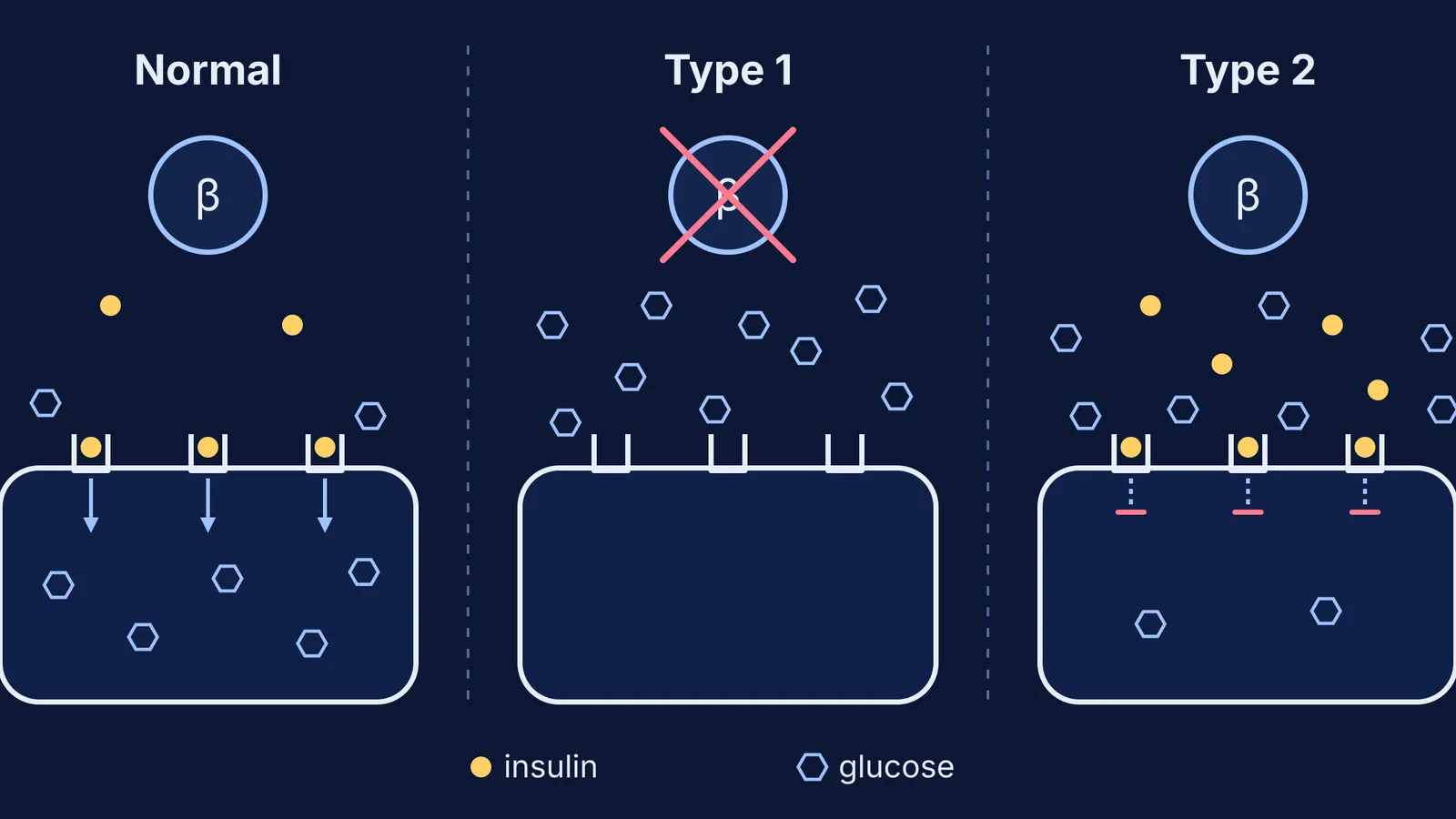
"Type 1 vs type 2 diabetes" looks like an easy question in chemical coordination and still catches people out. Both raise blood glucose. The difference is where the chain breaks: in type 1 almost no insulin is made; in type 2 it is made but cells respond poorly. Here is the biology, with a memory hook for each.
What does insulin normally do?
Insulin is a hormone made by the beta cells of the pancreas. The US National Institute of Diabetes and Digestive and Kidney Diseases puts it simply: insulin "helps glucose get into your cells to be used for energy" (NIDDK).
Think of it as a three-step chain:
Blood glucose rises after a meal.
Beta cells release insulin into the blood.
Insulin binds to receptors on body cells, the cells take in the glucose, and blood glucose falls back.
If glucagon and glycogen keep sneaking in, our explainer on glucagon vs glycogen vs glucose sorts them out.
Diabetes means step 2 or step 3 has failed. ICMR's guidelines define diabetes mellitus as chronic high blood glucose "resulting from defects in insulin secretion, insulin action or both" (ICMR Guidelines for Management of Type 2 Diabetes 2018). Type 1 is a failure of secretion. Type 2 is mainly a failure of action.
What goes wrong in type 1 diabetes?
In type 1, the body's own immune system destroys the beta cells. ICMR's guidelines say type 1 diabetes "is primarily due to autoimmune-mediated destruction of pancreatic beta cells, resulting in absolute insulin deficiency and thus requiring insulin for good health and survival" (ICMR 2018). The American Diabetes Association's 2025 classification describes the same autoimmune destruction (Diabetes Care, 2025).
The receptors still work; almost no insulin reaches them. That is why the ICMR-DHR treatment workflow for type 1 lists "continuous requirement of insulin since diagnosis" as a feature (ICMR-DHR Standard Treatment Workflow, 2022). Type 1 usually starts in childhood or adolescence, though ICMR notes it can begin in adults too.
Memory hook for type 1: the key factory has been shut down.
What goes wrong in type 2 diabetes?
In type 2, the pancreas still makes insulin, but body cells respond to it weakly. This is called insulin resistance. ICMR describes type 2 as "characterized by predominant insulin resistance with varying degrees of insulin secretory defect" and calls it "a progressive disease" (ICMR 2018). The ADA describes it as "a nonautoimmune progressive loss of adequate β-cell insulin secretion, frequently on the background of insulin resistance" (Diabetes Care, 2025). Put together: the locks get stiff, and over time the factory cannot keep up.
ICMR says type 2 "accounts for over 90-95% of all people with diabetes" and links the epidemic to "changing lifestyles, urbanization, demography and increased longevity" (ICMR 2018). The same guidelines describe an "Asian Indian phenotype": at any given body-mass index, south Asians tend to carry more body fat, more visceral fat and more insulin resistance than white Caucasians.
The numbers are large. The ICMR-INDIAB survey covered 113,043 people aged 20 and over in urban and rural India between 2008 and 2020, and found an overall weighted prevalence of diabetes of 11.4% (Anjana et al., Lancet Diabetes & Endocrinology, 2023).
Memory hook for type 2: the keys are made, but the locks are stiff.
How do you tell type 1 and type 2 apart in an exam?
This checklist uses the definitions above and Table 1.1 of the ICMR 2018 guidelines:
Main cause: type 1, autoimmune destruction of beta cells; type 2, insulin resistance with falling insulin secretion.
Insulin made: type 1, almost none; type 2, yes, at least early on.
Pancreatic autoantibodies: present in type 1, absent in type 2.
Markers of insulin resistance: absent in type 1, present in type 2.
C-peptide test of beta-cell reserve: no reserve in type 1, reserve preserved in type 2.
Usual age at diagnosis: childhood and adolescence for type 1; middle to later age for type 2.
Diabetes in a first-degree relative (parent, sibling or child): unusual in type 1, common in type 2.
Try a worked example. Question: a person has high blood glucose, pancreatic autoantibodies and no beta-cell reserve on a C-peptide test. Which type is this, and why wouldn't more sensitive cells help?
Answer in three steps:
Name the step that fails: secretion, because there is no beta-cell reserve.
Name the cause: the autoantibodies point to an autoimmune attack, so this is type 1.
State the consequence: absolute insulin deficiency. Sensitive locks are no use when no keys arrive.
Swap the clues (no autoantibodies, markers of insulin resistance) and the same steps give type 2: keys present, locks stiff.
What should you revise next?
Next, read why insulin is injected, not swallowed and diabetes insipidus vs mellitus.
If the hormone chain still feels shaky, the Fermi Concept Library gives every biology concept its own lesson and its place in the map, so you can see how the ideas connect. If you don't know where to start with the chapter, Fermi's AI tutor can work out what you already know and build a plan for the session.


