

On this page
Tin is one of the two metals the JEE Advanced syllabus names under carbon reduction, the other being iron. Iron gets most of the attention because of the blast furnace. Tin is simpler: one oxide ore, a magnet to remove a stubborn impurity, a roast, a smelt with carbon, and a refining step that works because tin melts at only 232 °C. This post walks through each step, with two worked numericals, one on mass and one on the temperature at which carbon can reduce SnO₂.
One note on syllabus first. Metallurgy has been removed from the rationalised NCERT Class 12 book, so CBSE boards and NEET-UG no longer test it. It is still in the JEE Advanced syllabus, which is why tin extraction keeps appearing in JEE preparation material.
What is the ore of tin and how is it concentrated?
The ore is cassiterite, also called tinstone, which is tin(IV) oxide, SnO₂. Indian reference books often call the concentrated ore "black tin". The main impurities are silica and other rock, sulphides and arsenides such as pyrites and arsenopyrite, and a tungsten mineral called wolframite, (Fe,Mn)WO₄.
Concentration happens in two stages.
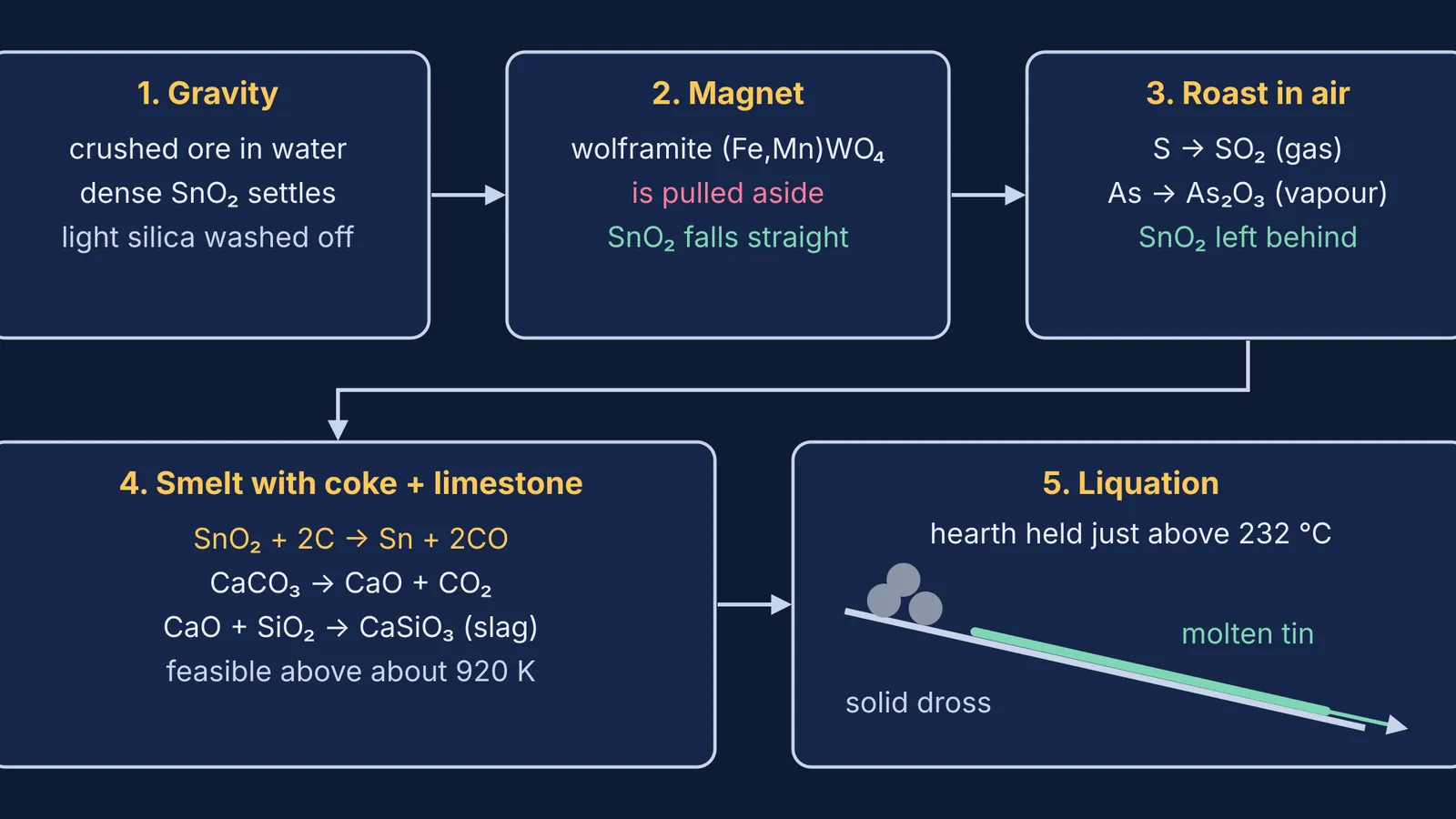
Gravity separation. The crushed ore is washed with a stream of water. Cassiterite is very dense, close to 7 g cm⁻³, while silica is about 2.65 g cm⁻³. The heavy oxide settles and the light rock is carried away.
Magnetic separation. Gravity cannot remove wolframite, because it is just as dense as cassiterite. But wolframite contains iron and manganese, so it is attracted to a strong magnet, while cassiterite is not. The ore is passed over a magnetic roller: wolframite is held and carried aside, and cassiterite falls straight off.
The direction matters. The impurity is the magnetic one, and the tin ore is what drops off. An answer that says "cassiterite is separated because it is magnetic" loses the mark.
Why is the tin ore roasted before smelting?
After concentration, the ore still holds sulphur and arsenic, mostly as sulphides and arsenides of iron. Heating it in air, below its melting point, oxidises these. Sulphur leaves as SO₂ and arsenic as volatile As₂O₃:
4FeS₂ + 11O₂ → 2Fe₂O₃ + 8SO₂
2FeAsS + 5O₂ → Fe₂O₃ + As₂O₃ + 2SO₂
SnO₂ is already an oxide, so roasting does not change it. If sulphur and arsenic were left in, they would end up in the tin and make it brittle.
How is tin oxide reduced with carbon?
The roasted ore is mixed with powdered coke (carbon) and limestone and heated strongly in a reverberatory furnace.
Reduction: SnO₂ + 2C → Sn + 2CO
Flux: limestone decomposes, CaCO₃ → CaO + CO₂, and the CaO combines with the remaining silica: CaO + SiO₂ → CaSiO₃. This calcium silicate is the slag, which floats on the molten tin and is run off.
Two details are worth getting right. First, the gas formed is mainly CO, not CO₂. Above about 980 K (calculated from 298 K data), the reaction C + CO₂ → 2CO is favourable, so in a furnace packed with hot carbon any CO₂ that forms is turned back into CO. That is why the balanced equation has 2C and 2CO. Second, CO itself also reduces SnO₂, so the carbon works both directly and through the gas, much as it does in the zones of a blast furnace for iron.
At what temperature can carbon reduce SnO₂?
This is the Ellingham idea applied to tin. A reduction is feasible when ΔG° = ΔH° − TΔS° is negative. Using standard 298 K data (values differ slightly between tables, so treat them as approximate):
ΔfH°: SnO₂ = −577.6 kJ mol⁻¹, CO = −110.5 kJ mol⁻¹
S°: SnO₂ = 49.0, Sn = 51.2, C (graphite) = 5.7, CO = 197.7, all in J K⁻¹ mol⁻¹
Worked example, for SnO₂ + 2C → Sn + 2CO:
ΔH° = 2(−110.5) − (−577.6) = +356.6 kJ. The reaction is endothermic.
ΔS° = [51.2 + 2(197.7)] − [49.0 + 2(5.7)] = +386 J K⁻¹. It is large and positive because two moles of gas form from solids.
At 298 K: ΔG° = 356.6 − 298 × 0.386 = +242 kJ. Not feasible.
Crossover: ΔG° = 0 when T = ΔH°/ΔS° = 356 600 / 386 ≈ 924 K, about 650 °C.
Above that: at 1200 K, ΔG° = 356.6 − 1200 × 0.386 = −107 kJ. Feasible.
So carbon can reduce SnO₂ above roughly 920 K. This is an estimate, because ΔH° and ΔS° change a little with temperature and tin melts on the way, but it is the answer the method gives. On an Ellingham diagram, it is the temperature where the C → CO line falls below the Sn → SnO₂ line. For how to read those lines in general, see how to read an Ellingham diagram.
How much tin and carbon do you get from a tonne of ore?
Worked example: 1.00 t of concentrated ore contains 70% SnO₂ by mass. What is the maximum mass of tin, and the minimum mass of carbon needed?
Mass of SnO₂: 0.70 × 1000 kg = 700 kg.
Fraction of Sn in SnO₂: molar masses Sn = 118.7 and SnO₂ = 118.7 + 2(16.0) = 150.7 g mol⁻¹. Sn is 118.7/150.7 = 78.8% of SnO₂.
Maximum tin: 700 × 0.788 = 551 kg, or 0.552 t.
Moles of SnO₂: 700 000 g ÷ 150.7 g mol⁻¹ = 4645 mol.
Carbon needed: the equation uses 2 mol C per mol SnO₂, so 2 × 4645 = 9290 mol, and 9290 × 12.0 g = 111 kg.
Real furnaces use more, partly to supply heat, but 111 kg is the stoichiometric minimum.
How is the crude tin refined?
The tin from the furnace still contains iron and other metals with higher melting points. It is refined by liquation: the crude metal is placed on a sloping hearth and heated just above 232 °C. Tin melts and runs down the slope, and the higher-melting impurities stay behind as solid dross. Any SnO₂ left in the metal can then be reduced by poling, stirring the molten tin with green wood. Both methods, and the property each depends on, are explained in liquation, poling and distillation: which metal gets which.
Electrolytic refining of tin exists, but the expected JEE answer is liquation, then poling.
If the thermodynamics behind step 4 is the weak spot, the Concept Library covers Gibbs energy and Ellingham diagrams as separate concepts, each with its own lesson.
Quick checklist
Ore: cassiterite, SnO₂. Syllabus: JEE Advanced (removed from rationalised NCERT Class 12).
Gravity separation removes light silica; magnetic separation removes wolframite, which is the magnetic one.
Roasting drives off S as SO₂ and As as As₂O₃.
Smelting: SnO₂ + 2C → Sn + 2CO, with limestone as flux giving CaSiO₃ slag.
CO, not CO₂, is the main gas at smelting temperatures.
Carbon reduction becomes feasible above roughly 920 K (ΔH° ≈ +357 kJ, ΔS° ≈ +386 J K⁻¹).
SnO₂ is 78.8% Sn: 1 t of 70% concentrate gives at most 0.552 t of tin and needs at least 111 kg of carbon.
Refine by liquation (tin melts at 232 °C), then poling.


