

On this page
Sulfamic acid is a white crystalline acid used to descale boilers and heat exchangers. The Bureau of Indian Standards checks its purity with a reaction you meet in Class 12 Amines: nitrous acid attacks the –NH₂ group and nitrogen gas comes off. The same compound is also a good test of Class 11 bonding, because the solid is not really H₂N–SO₂–OH but the zwitterion H₃N⁺–SO₃⁻. This post works through the assay in IS 14932:2001, where its factor of 9.7 comes from, and how strong the acid really is.
What is sulfamic acid, and what does IS 14932 require?
The standard's foreword gives the formula as H₂NSO₂OH, molecular mass 97.1. It lists uses in dyes, pulp and paper, as a chlorine stabiliser in swimming pools, in electroplating salts, and above all in "Sulfamic Descalants" for boilers, condensers and cooling towers. It notes that India makes more than 5,000 tonnes a year.
There are two grades: technical (dyes, paper, descalants) and pure (electroplating). Both must contain at least 99.5% sulfamic acid. Table 1 also limits sulphate (0.1% and 0.05%), iron (0.001% and 0.0005%), lead, insoluble matter and moisture.
How does the BIS assay with sodium nitrite work?
Annex D is a direct titration. About 1.0 g of sample is dissolved in roughly 150 mL of water, 5 mL of 1:1 sulphuric acid is added, and the solution is titrated with 0.5 N sodium nitrite, itself standardised against AR-grade sulfamic acid. The nitrite goes in slowly with stirring, and the temperature "should preferably be below 20°C to avoid decomposition of nitrous acid".
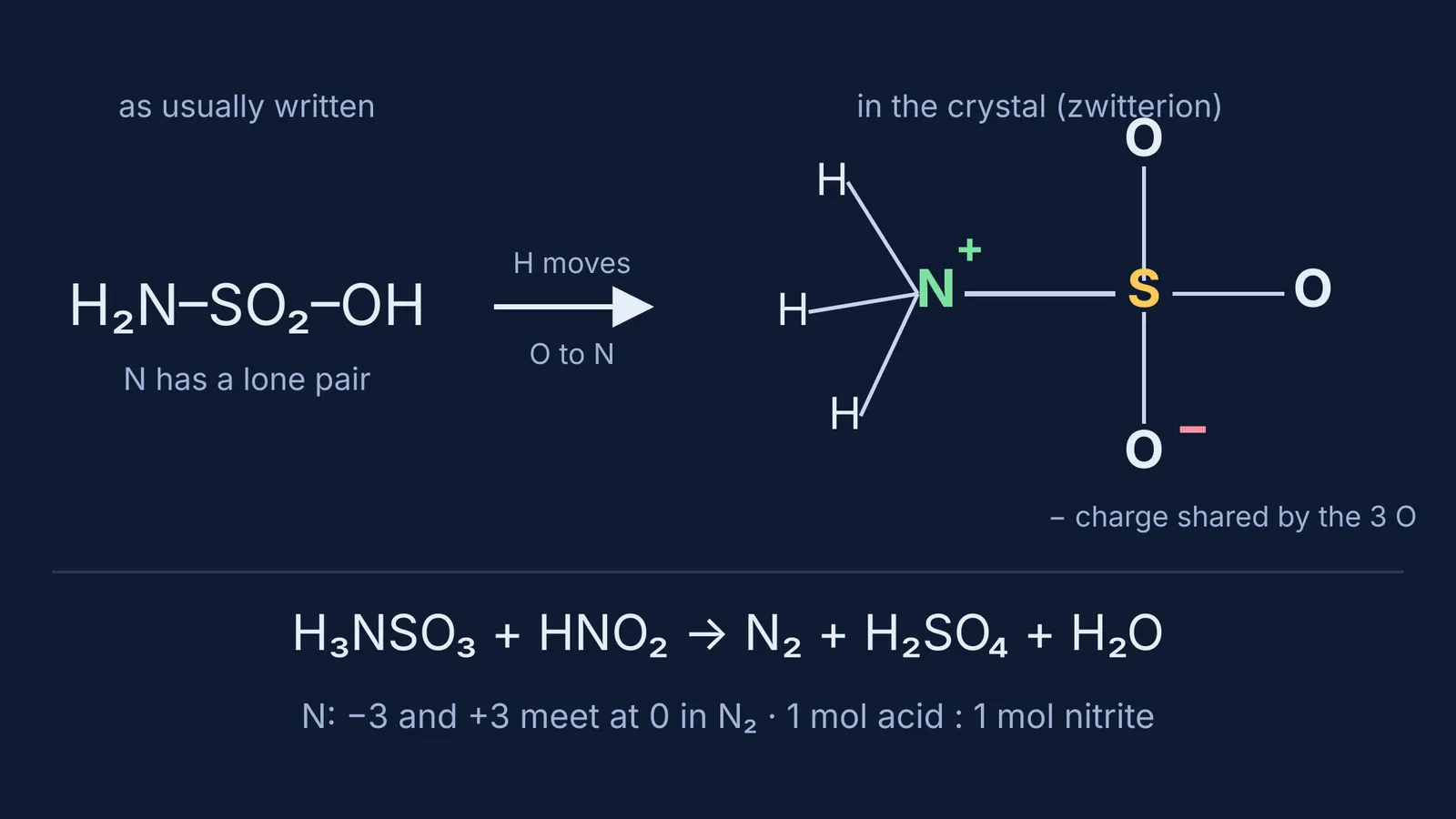
In the acid, nitrite becomes nitrous acid, and nitrous acid reacts with sulfamic acid:
H₃NSO₃ + HNO₂ → N₂ + H₂SO₄ + H₂O
Check it: H 4 = 4, N 2 = 2, S 1 = 1, O 5 = 5. Written with nitrite ion, H₃NSO₃ + NO₂⁻ → N₂ + HSO₄⁻ + H₂O, the charge is −1 on both sides.
This is a comproportionation. Nitrogen in sulfamic acid is −3 and nitrogen in nitrous acid is +3. They meet at 0 in N₂, each nitrogen moving 3 electrons. It is the same pattern as a primary aliphatic amine with nitrous acid, which also gives off N₂; see how nitrous acid distinguishes amines.
The end point uses starch–iodide paper as an external indicator. While sulfamic acid is left, every drop of nitrite is used up. The first excess of nitrous acid oxidises iodide on the paper to iodine, which turns starch blue: 2HNO₂ + 2I⁻ + 2H⁺ → I₂ + 2NO + 2H₂O. Pharmacopoeias use the same end point for sulpha drugs, described in the sodium nitrite titration of sulpha drugs.
One detail to read carefully: clauses D-1 and D-4 of the printed standard say "sodium nitrate". The reagent list (D-2.2) and the procedure both say sodium nitrite, and the chemistry needs nitrite, so read "nitrate" there as nitrite.
Worked example: where does the factor 9.7 come from?
D-4 gives: sulfamic acid, % by mass = 9.7 NV / M, where N is the normality of the nitrite, V the volume in mL and M the sample mass in g.
Molar mass. H₃NSO₃ = 3(1.008) + 14.007 + 32.06 + 3(15.999) = 97.09 g mol⁻¹.
Ratio. One mole of acid uses one mole of HNO₂.
Mass titrated. N × V mmol of nitrite reacts with N × V mmol of acid, which is 97.09 × NV mg, or 0.09709 NV g.
Percentage. % = 0.09709 NV / M × 100 = 9.709 NV / M, rounded in the standard to 9.7.
Now a sample. Suppose 1.000 g needs 20.50 mL of 0.4990 N nitrite. Purity = 9.709 × 0.4990 × 20.50 / 1.000 = 99.32%. That is below 99.5%, so the sample fails. A perfectly pure 1.000 g sample contains 1000 / 97.09 = 10.30 mmol and needs 20.60 mL of 0.5000 N nitrite.
It also releases 10.30 mmol of N₂, about 234 mL at 273.15 K and 1 bar (or 231 mL at 1 atm).
Is solid sulfamic acid really a zwitterion?
Yes. In the crystal, the proton sits on nitrogen, not on oxygen, so the solid is H₃N⁺–SO₃⁻. A 1960 neutron-diffraction study by R. L. Sass (Acta Crystallographica 13, 320) is reported to place all three hydrogens on nitrogen, and a later study measured an S–N bond of about 1.77 Å, long enough to be a single bond.
What this means for bonding:
Nitrogen has four bonds (three H, one S), no lone pair, a formal charge of +1, and a tetrahedral shape, like NH₄⁺.
Sulfur is tetrahedral, bonded to N and three O.
The negative charge is shared over the three oxygens by resonance.
It is the same internal acid–base transfer that makes sulphanilic acid a high-melting solid, covered in why sulphanilic acid exists as a zwitterion. The –SO₃H group is a strong acid and –NH₂ is a base, so the proton moves.
Is sulfamic acid as strong as hydrochloric acid?
The foreword calls it "a strong monobasic acid, comparable in strength to hydrochloric acid and nitric acid". Monobasic is right: it gives one proton, from –NH₃⁺, leaving the sulfamate ion H₂N–SO₃⁻. "Comparable" needs a check.
The PubChem record, citing the Kirk-Othmer Encyclopedia, gives a dissociation constant of 0.101 at 25 °C, so pKa ≈ 1.0. For 0.1 M sulfamic acid, solve x² / (0.1 − x) = 0.101: x = 0.0620 M. That is about 62% ionised, pH ≈ 1.21. The same record lists a measured pH of 1.18 for 0.1 N solution, which agrees. A 0.1 M HCl solution, fully ionised, has pH 1.00.
So sulfamic acid is much stronger than acetic acid, and in dilute solution close to HCl (at 0.01 M it is about 92% ionised, pH 2.04 against 2.00). But it is not completely ionised the way HCl is. For the method, see finding Ka from the pH of a weak acid.
Where does this fit in JEE, NEET and boards?
Class 12 Amines. Nitrous acid with –NH₂ gives N₂; HNO₂ must be kept cold; starch–iodide detects excess nitrite.
Class 11 Chemical Bonding. Formal charges, zwitterion versus neutral form, VSEPR at N and S.
Class 11 Some Basic Concepts and Redox. Titration factors, oxidation numbers, n-factors.
Class 11 Equilibrium. Ka, degree of ionisation and pH.
If assay factors are where you lose marks, the Fermi Problem Library has worked problems with a step-by-step solver that explains the reasoning. For JEE Main and Advanced practice across these chapters, Fermi Test Prep pairs exam preparation with an AI tutor.
Quick checklist
H₃NSO₃ + HNO₂ → N₂ + H₂SO₄ + H₂O: balanced, 1 : 1, nitrogen −3 and +3 go to 0.
IS 14932: both grades ≥ 99.5%; % = 9.7 NV/M because 97.09 mg per mmol.
The standard prints "sodium nitrate" in D-1 and D-4; the reagent is sodium nitrite.
End point: first excess HNO₂ turns starch–iodide paper blue.
Solid is H₃N⁺–SO₃⁻: N has four bonds, no lone pair, +1 formal charge.
Ka ≈ 0.10: strong, but 0.1 M is only about 62% ionised (pH ≈ 1.2, not 1.0).


