

On this page
A 14.5 kg mass hangs from a steel wire 1.0 m long and is whirled in a vertical circle. At the bottom of the circle it turns at 2 rev/s. How much does the wire stretch? This is exercise 8.11 in the Mechanical Properties of Solids chapter of the NCERT Class 11 physics textbook, and it joins two chapters: circular motion gives you the tension, and Young's modulus turns that tension into a stretch. The answer is 1.87 mm, and the steps below show where every part of it comes from.
What does the question give you?
The data, with SI units:
Mass m = 14.5 kg.
Unstretched length of the wire L = 1.0 m. NCERT takes this as the radius of the circle too.
Angular speed at the bottom = 2 rev/s.
Cross-sectional area A = 0.065 cm².
Young's modulus of steel Y = 2.0 × 10¹¹ Pa. The question does not print it; it is the value for structural steel used in Example 8.1 of the same NCERT chapter.
g = 9.8 m/s².
Two conversions decide whether you get the right answer. Revolutions per second must become radians per second, and square centimetres must become square metres. Since 1 cm² = 10⁻⁴ m², the area is 0.065 × 10⁻⁴ = 6.5 × 10⁻⁶ m².
Why is the tension largest at the bottom of the circle?
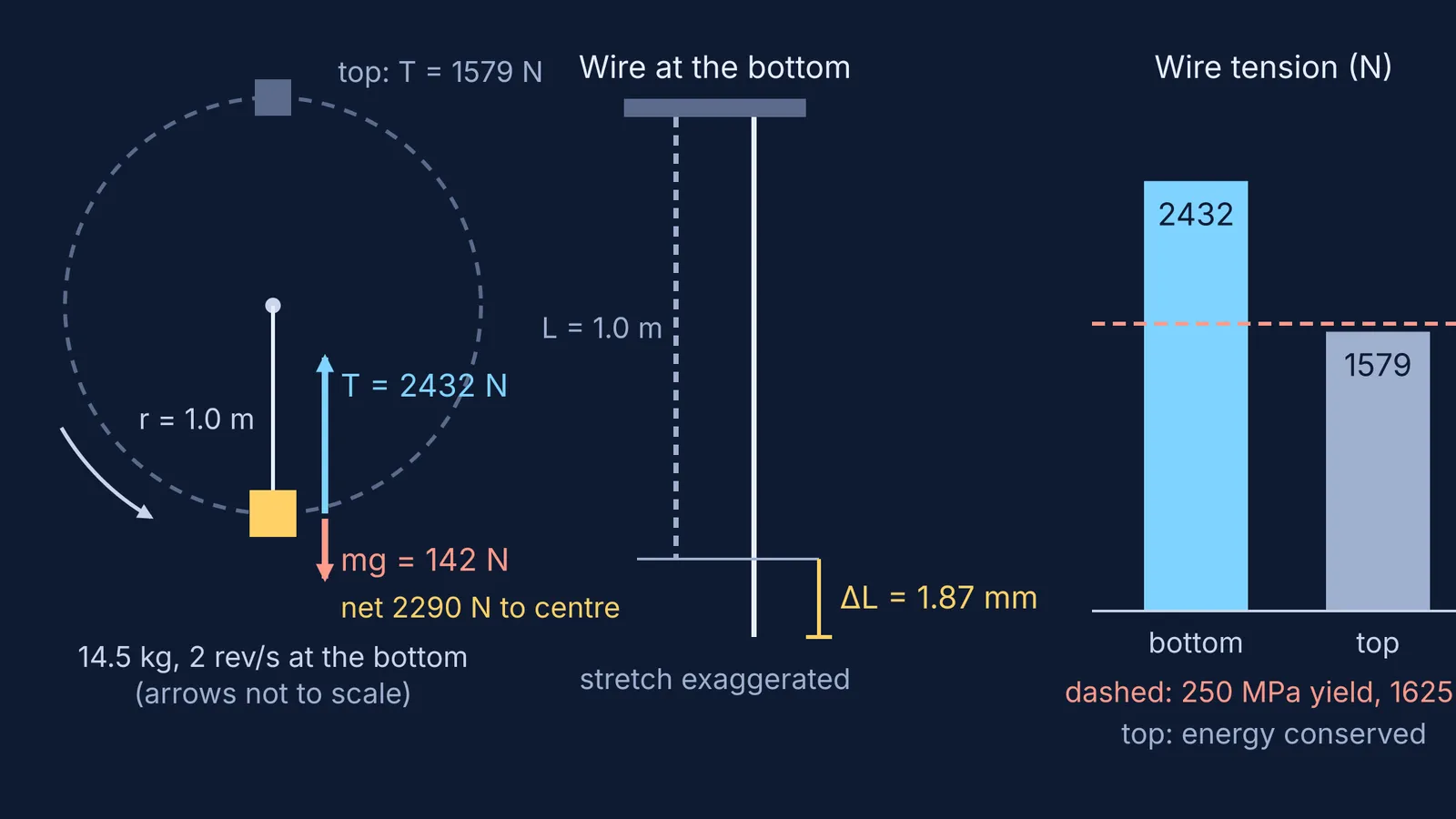
At the lowest point two forces act on the mass: the tension T pulling up toward the centre, and the weight mg pulling down, away from the centre. The net force must point toward the centre and equal mω²r. So:
T − mg = mω²r, which gives T = mg + mω²r.
The wire holds up the weight and supplies the centripetal force on top of that. At every other point on the circle, part of the weight acts toward the centre and helps, so the tension is smaller. The bottom is where the wire is pulled hardest, and so it is where the stretch is largest.
How the tension changes around the circle, including the famous 6mg difference between top and bottom, is derived in the tension difference between the top and bottom of a vertical circle. Here we only need the bottom.
How do you calculate the elongation at the lowest point?
Angular speed. ω = 2π × 2 = 12.57 rad/s.
Weight. mg = 14.5 × 9.8 = 142.1 N.
Centripetal force. mω²r = 14.5 × 12.57² × 1.0 = 2289.7 N.
Tension at the bottom. T = 142.1 + 2289.7 = 2431.8 N, about 2430 N. The centripetal part is 16 times the weight.
Stress. T/A = 2431.8 / (6.5 × 10⁻⁶) = 3.74 × 10⁸ Pa, or 374 MPa.
Strain. stress/Y = 3.74 × 10⁸ / (2.0 × 10¹¹) = 1.87 × 10⁻³.
Elongation. ΔL = strain × L = 1.87 × 10⁻³ × 1.0 m = 1.87 × 10⁻³ m = 1.87 mm.
Check the units: N divided by m² gives Pa, Pa divided by Pa gives a pure number for strain, and a number times metres gives metres. In one line, ΔL = TL/(AY) = 2431.8 × 1.0 / (6.5 × 10⁻⁶ × 2.0 × 10¹¹) = 1.87 × 10⁻³ m.
The stretch makes the radius 0.19% larger, which changes the tension by a similar, negligible fraction, so r = 1.0 m is fine.
How much does the wire stretch at the top of the circle?
Here the textbook wording needs care. A mass cannot keep a constant 2 rev/s all the way round a vertical circle under gravity alone. It slows down as it climbs, because kinetic energy turns into potential energy. That is why the question says "2 rev/s at the bottom".
If nothing drives the mass, energy conservation gives the speed at the top:
Speed at the bottom: v = ωr = 12.57 m/s.
The mass rises 2r = 2.0 m, so v²(top) = v² − 4gr = 157.9 − 39.2 = 118.7 m²/s², and v(top) = 10.90 m/s.
At the top both tension and weight point toward the centre: T + mg = mv²/r, so T = 14.5 × 118.7 − 142.1 = 1579 N.
Stretch at the top: 1579 / (6.5 × 10⁻⁶ × 2.0 × 10¹¹) = 1.21 mm.
The bottom tension is larger by 2431.8 − 1579.2 = 852.6 N, which is exactly 6mg, and the wire is 0.66 mm longer at the bottom than at the top.
Some solutions assume a motor keeps the rate at 2 rev/s all the way round. Then the top tension is mω²r − mg = 2147.6 N and the top stretch is 1.65 mm, 0.22 mm less than at the bottom. Say which assumption you are using. The bottom answer, 1.87 mm, is the same either way, and that is all the question asks for.
Would an ordinary steel wire survive this?
The calculation assumes the wire obeys Hooke's law, so the stress must stay below the yield strength. Is 374 MPa safe?
In its crane example, the same NCERT chapter takes the yield strength of mild steel as about 300 × 10⁶ Pa.
The common structural steel grade ASTM A36 has a minimum yield strength of 250 MPa.
Both are below 374 MPa. An ordinary mild steel wire would stretch permanently at the bottom of the circle, and the formula ΔL = TL/(AY) would no longer hold. The question works only for a high-tensile steel wire, the kind used in wire ropes. With a 250 MPa limit, the wire could carry at most 250 × 10⁶ × 6.5 × 10⁻⁶ = 1625 N, which allows only about 1.6 rev/s at the bottom.
Why does doubling the speed make the problem so much worse? The centripetal force grows as ω², so the tension rises fast with speed. That idea is covered in why string tension quadruples when you whirl a stone twice as fast. For static wire problems with loads and Young's modulus, see stress, strain and Young's modulus problems solved.
What should you remember for JEE and NEET?
This question type tests whether you can link two chapters. The pattern is always the same: find the force from the dynamics, then feed it into the elasticity formula. It turns up with a conical pendulum, a rotating rod, or a lift accelerating upward, where the tension is m(g + a) instead of mg.
If you get stuck on which forces point toward the centre, the Fermi Problem Library has a step-by-step solver that explains the reasoning, so you can check your free-body diagram before you plug in numbers.
Quick checklist
At the bottom of a vertical circle, T = mg + mω²r.
Convert rev/s to rad/s (× 2π) and cm² to m² (× 10⁻⁴).
ΔL = TL/(AY): 2431.8 N gives 1.87 mm for this wire.
The speed is 2 rev/s at the bottom only; at the top, energy conservation gives T = 1579 N and a 1.21 mm stretch.
374 MPa is above the yield strength of mild steel, so this needs a high-tensile wire.
Check that the stress stays below the yield strength before you trust Hooke's law.


