

On this page
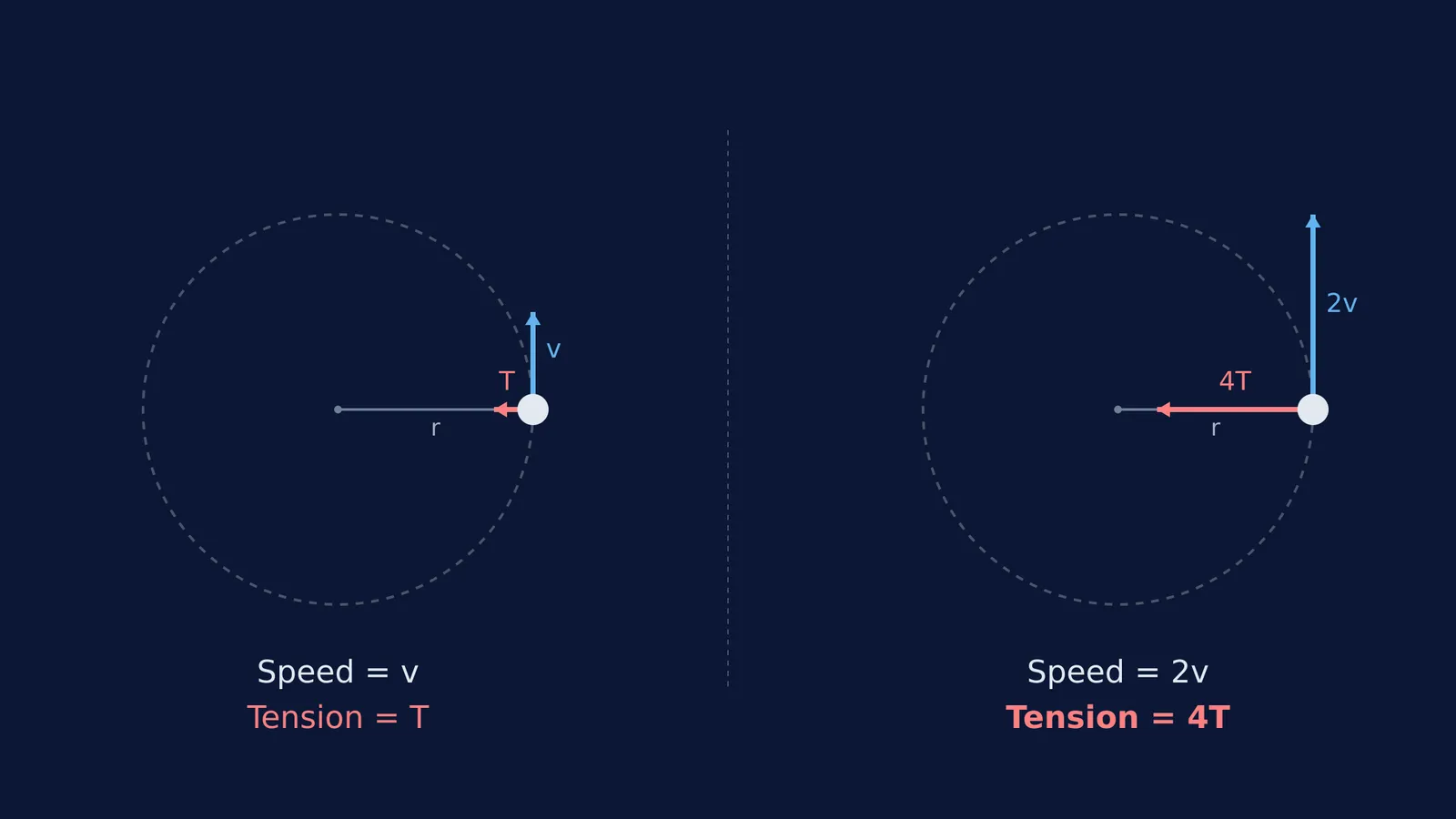
Imagine swinging a stone on a cord in a horizontal circle overhead. If you suddenly whirl the stone twice as fast, what happens to string tension? Most people guess that doubling speed doubles the pull. Yet the tension does not double—it increases fourfold. According to classical mechanics documented in OpenStax University Physics, circular motion requires an inward centripetal force given by T = m v² / r, where m is the stone's mass, v is its tangential speed, and r is the circle's radius. Because speed is squared, multiplying v by 2 multiplies tension by 2², or 4 times the initial value.
Using the formula from OpenStax University Physics, consider a 0.5 kg stone whirled on a 1.0 m string at an initial speed of 3 m/s. The required inward tension is T₁ = (0.5 kg × (3 m/s)²) / 1.0 m = 4.5 N. Whirling the stone twice as fast at 6 m/s raises the tension to T₂ = (0.5 kg × (6 m/s)²) / 1.0 m = 18.0 N. Doubling the speed quadruples the tension from 4.5 N to 18.0 N.
Why does centripetal force scale with the square of speed?
Why does speed enter the centripetal force formula twice? Doubling tangential speed alters two aspects of circular motion simultaneously. First, the stone completes the circle in half the time, doubling its turning rate. Second, because each velocity vector is twice as long, the vector difference Δv across any fixed angle is twice as large.
Centripetal acceleration is the rate of change of velocity, a = Δv / Δt. When the velocity change Δv doubles and the time interval Δt halves, acceleration increases by 2 / 0.5 = 4 times. OpenStax University Physics derives the final formula a = v² / r which confirms this quadratic scaling. By Newton's second law (T = m a), the string must pull four times as hard to keep the faster stone on the same circular path.
Why do students intuitively predict tension only doubles?
The expectation that doubling speed doubles tension is a widespread misconception. In research published in Educational Studies in Mathematics, Dirk De Bock and colleagues identified the "illusion of linearity"—a tendency where learners apply proportional models (if x doubles, y doubles) to non-linear phenomena. In tests on secondary students, researchers found they routinely defaulted to linear predictions for non-linear relations.
This habit is reinforced by intuitive physics. Studies by Michael McCloskey in Scientific American and by Ibrahim Abou Halloun and David Hestenes in the American Journal of Physics showed that students often associate force with velocity rather than acceleration. Under this intuitive view, keeping an object moving twice as fast seems to require twice the pulling effort.
How can you test the tension increase with active learning?
Simply stating that tension quadruples rarely dislodges an ingrained linear bias. To achieve conceptual change, learning science recommends the Predict-Observe-Explain (POE) framework established by Richard Gunstone and Richard White in Science Education. The method uses three steps:
Predict: Commit to an explicit prediction and state the reasoning behind it.
Observe: Test the system with a force sensor or dynamic model, measuring how tension changes when speed doubles.
Explain: Reconcile any difference between the initial prediction and the measured outcome.
When physical lab apparatus is unavailable, interactive models provide immediate feedback. For concepts that are easier to see than read, the Fermi Simulation Lab provides interactive simulations. Research comparing simulations versus static diagrams shows that testing variables interactively helps students overcome proportional errors faster than reading textbook diagrams alone.
What changes when the stone is whirled in a vertical circle?
In a horizontal plane, string tension provides the entire centripetal force if we ignore gravity. In a vertical circle, gravity adds a constant downward force mg, as derived in OpenStax University Physics and discussed in simple pendulum string tension and conical pendulum problems. At the bottom of the loop, tension must support the stone's weight and provide the centripetal acceleration: T_bottom = mg + m v² / r. At the top, gravity assists the inward pull: T_top = m v² / r - mg.
Because weight mg stays constant while m v² / r quadruples, total tension at the bottom does not quadruple exactly. For a 0.5 kg stone with g = 9.8 m/s² and r = 1.0 m, the weight is 4.9 N. At 3 m/s, bottom tension is 4.9 N + 4.5 N = 9.4 N. At 6 m/s, bottom tension becomes 4.9 N + 18.0 N = 22.9 N—an increase of roughly 2.4 times. For problems with competing forces, the Fermi Problem Library provides worked problems with a step-by-step solver that explains the reasoning rather than printing an answer.


