

On this page
A snake has no legs, yet NCERT puts cobras, kraits and vipers in Class Reptilia, under the super class Tetrapoda. That looks like a contradiction until you see what the word actually names. Tetrapod is a family name, not a description of today's body. Once that clicks, the “all tetrapods have four limbs” trap in NEET-UG biology stops working on you.
Why are snakes called tetrapods if they have no legs?
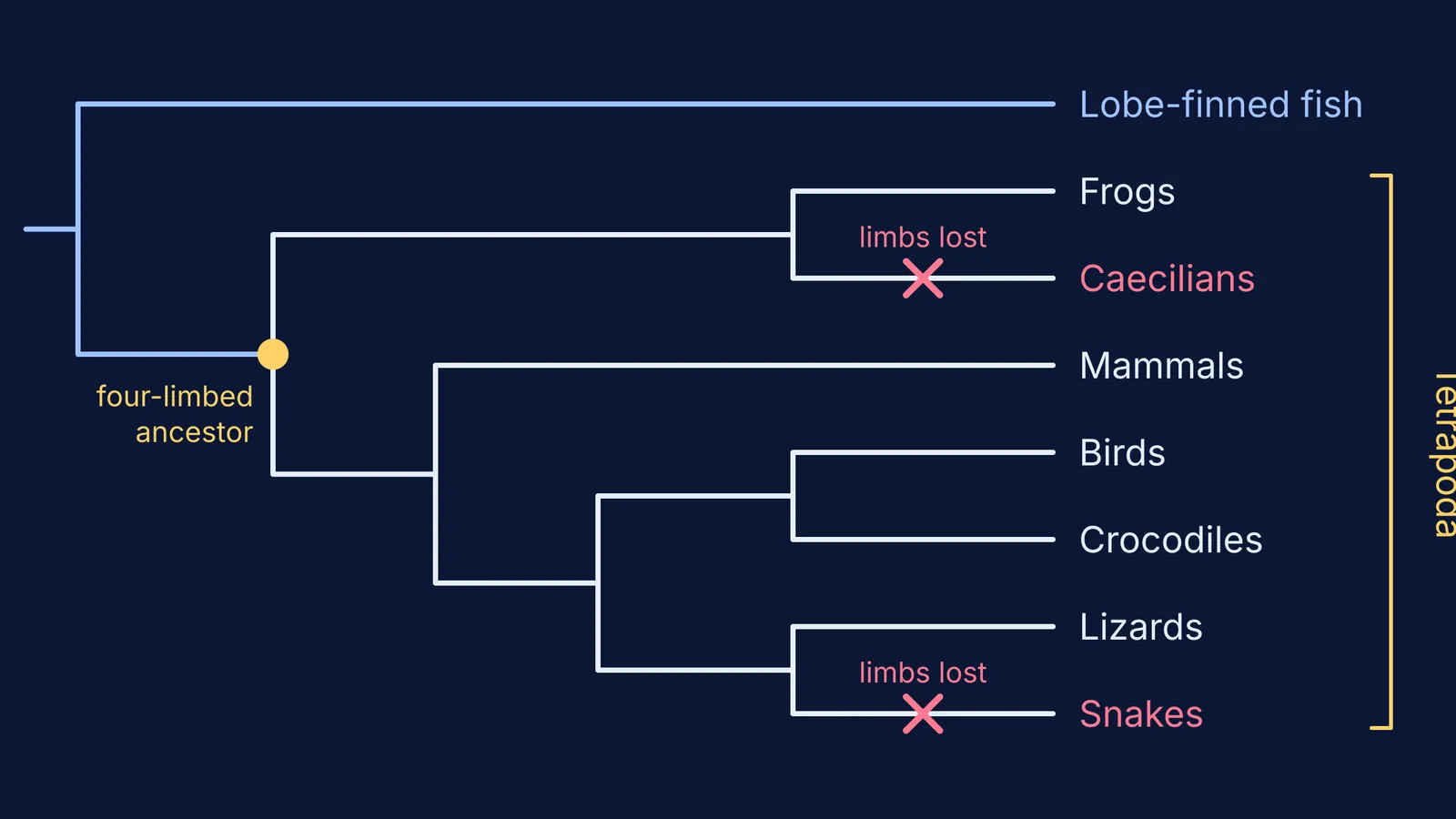
In the NCERT Class 11 chapter Animal Kingdom, jawed vertebrates split into two super classes: Pisces “(bear fins)” and Tetrapoda “(bear limbs)”. Tetrapoda holds Amphibia, Reptilia, Aves and Mammals. The same chapter lists *Naja* (cobra), *Bangarus* (krait) and *Vipera* (viper) as reptiles, and says of reptiles: “Limbs, when present, are two pairs.”
That phrase “when present” is the whole answer. Tetrapoda is a lineage: every animal descended from the first four-limbed vertebrates, whether or not it still has four limbs. OpenStax Biology 2e says it in one line: limbless reptiles “are classified as tetrapods because they are descended from four-limbed ancestors.” The same textbook says snakes are thought to have descended from burrowing or aquatic lizards over 100 million years ago.
Think of a surname. You keep your family name even if you look nothing like your great-grandparents. Snakes kept the family name and lost the legs.
What does a python's hip spur prove?
If snakes really came from four-legged ancestors, some should still carry leftovers. Pythons do.
A 2016 study in Current Biology notes that “basal and intermediate snakes retain pelvic girdles and small rudiments of the femur”, while advanced snakes are completely limbless (Leal and Cohn, 2016). Python embryos go further: they grow hindlimb buds and form short-lived early outlines of the tibia, fibula and footplate before development stops. The University of Florida's report on that study sums it up: by hatching, “all that remains is a tiny rudiment of the femur”.
Earlier, a 1999 Nature paper found that python hindlimb buds are started, but the signalling pathways normally needed for limb growth are not switched on (Cohn and Tickle, 1999). A 2016 Cell study then traced part of the switch: giving mice the snake version of a limb enhancer for the gene Sonic hedgehog “caused severe limb reduction” (Kvon and colleagues, 2016).
From the outside, the leftover shows as small pelvic spurs. OpenStax describes boids, such as boa constrictors, as having vestigial hindlimbs in the form of pelvic spurs. The South Australian Museum archive holds a photograph of African python skin “showing external vestiges of the hind-limb”. Phil Senter, writing for the NCSE, argues that if python spurs come from full hindlimbs in python ancestors, they can be considered vestigial hindlimbs, even though they have a job in dominance contests. Fossils close the gap: a snake from the Upper Cretaceous of Patagonia had a sacrum, a pelvic girdle and “robust, functional legs” (Apesteguía and Zaher, 2006).
How can a NEET question turn this into a trap?
A classification statement can set a body-shape clue against a lineage answer. Here are three practice statements we wrote in that style (not past-paper questions):
“All tetrapods have four limbs.” False. Snakes and *Ichthyophis* are tetrapods without limbs.
“Snakes are not tetrapods because they lack limbs.” False. They are reptiles, and NCERT places Reptilia under Tetrapoda.
“*Ichthyophis* is a snake.” False. NCERT lists it under Amphibia as a limbless amphibian. We unpack this one in why Ichthyophis is a limbless amphibian, not a snake.
Caecilians like *Ichthyophis* tell the same story as snakes: OpenStax notes they “have no limbs, although they evolved from a legged vertebrate ancestor.”
How do you classify an odd-looking animal by its family tree?
Use this four-step check whenever an option says “limbless”, “legless” or “finless”:
Name the class first: snake, Reptilia; *Ichthyophis*, Amphibia; whale (*Balaenoptera*), Mammalia; flying fish (*Exocoetus*), Osteichthyes.
Map the class to its super class using the NCERT chart: Amphibia, Reptilia, Aves and Mammals are Tetrapoda; the two fish classes are Pisces.
Ignore what the body looks like now. Lost legs, wings in place of forelimbs or flippers do not move an animal off its branch.
Read the qualifiers: “all”, “always”, “when present”. NCERT chose “when present” for a reason.
If the family-tree idea still feels shaky, the Fermi Concept Library has every concept in biology with its own lesson and its place in the map, so you can see how classification and evolution connect. And if you keep missing classification MCQs without knowing why, the Fermi Problem Library has worked problems with a step-by-step solver that explains the reasoning rather than printing an answer.
For memory hooks on the classes, try our animal kingdom mnemonics for NEET, and for the evolution side, these evolution mnemonics from NCERT.
Next time you see a python, remember the spurs: a tetrapod's leftover legs, and the answer to the trap.


