

On this page
Fill a bucket to the brim, start walking, and within a few steps water slaps over the rim. Walking more carefully barely helps. The cause is resonance. Water in any container has a natural sloshing frequency, and for a full bucket it sits close to the rate at which you take steps. This post shows how to calculate that frequency for a shallow tank and a deep round container, and how to use it.
What is sloshing in a container?
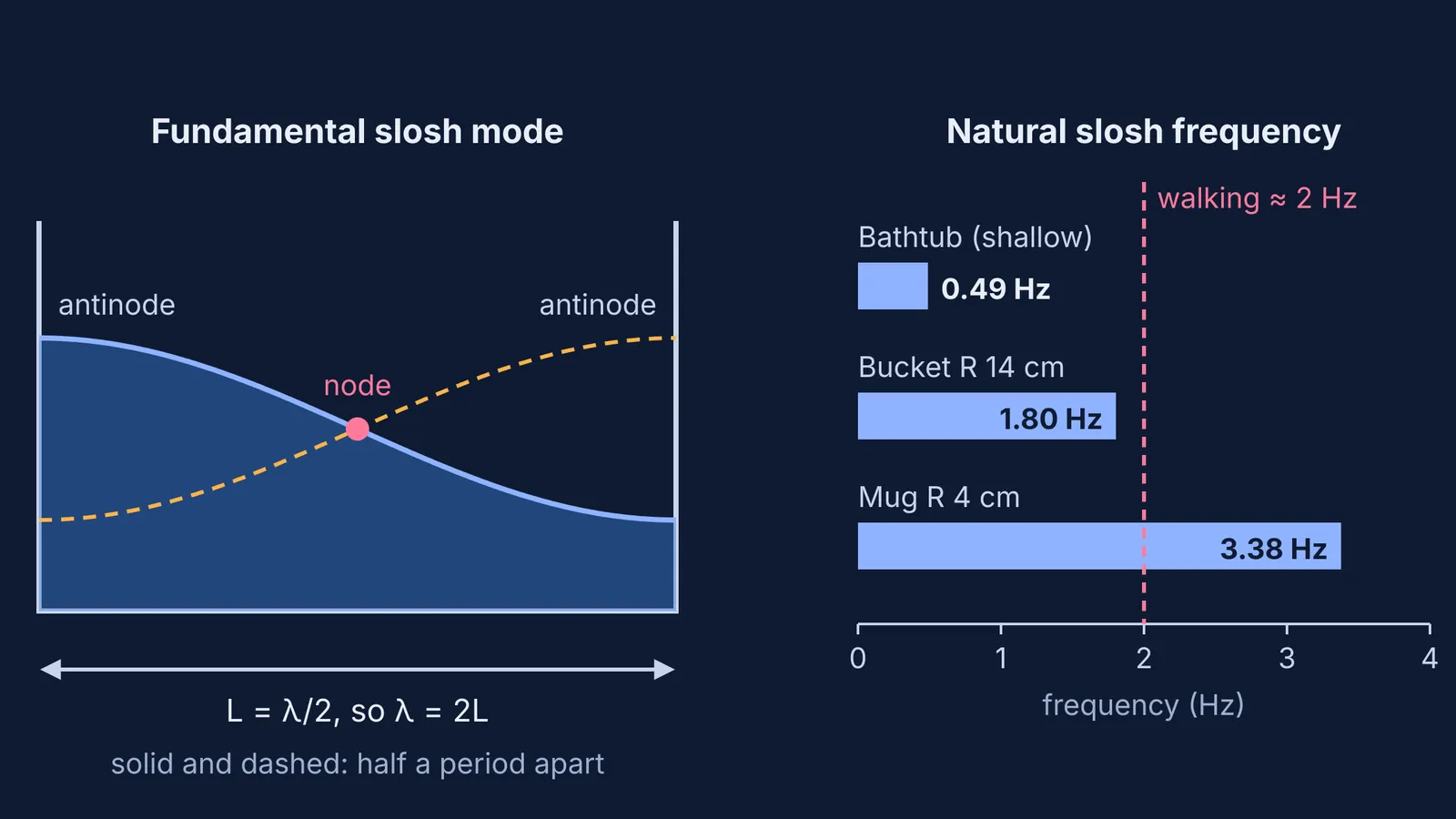
Sloshing is a standing wave on the water surface. In the lowest mode the water rises at one wall while it falls at the other, then the reverse, rocking about a line across the middle where the level hardly changes.
Height antinodes at both walls. The surface moves up and down most at the ends.
A height node in the middle. The level there stays almost fixed, but the water flows sideways fastest through that point.
Half a wavelength across. From one antinode to the next is λ/2, so for a tank of length L, λ = 2L.
The walls stop sideways flow, so the walls are flow nodes and height antinodes. This is the same pairing as displacement and pressure in an organ pipe. Unlike a pipe closed at one end, though, a container has the same condition at both walls, so the fundamental is half a wavelength, not a quarter. Harmonics in strings and air columns are covered in standing waves in strings and pipes; here we apply the idea to a water surface.
How do you find the sloshing frequency of a shallow tank?
When the water is shallow compared with the wavelength, surface waves travel at v = √(gh), where h is the depth. It is the same speed that explains why tsunami waves grow taller near the coast. There the wave travels; in a tank it reflects off both walls and forms a standing wave. With λ = 2L:
f = v/λ = √(gh)/2L
Worked example: a bathtub
A bathtub is 1.6 m long with 0.25 m of water. Take g = 9.8 m/s².
Wave speed. v = √(9.8 × 0.25) = 1.57 m/s.
Wavelength. λ = 2L = 2 × 1.6 = 3.2 m.
Frequency. f = 1.57/3.2 = 0.49 Hz.
Period. T = 1/f = 2.0 s.
Units check. √(m/s² × m) = m/s, and (m/s)/m = 1/s = Hz.
The formula that holds at any depth for a rectangular tank is ω² = (gπ/L) tanh(πh/L). Here πh/L = 0.49 and tanh(0.49) = 0.455, which gives T = 2.1 s. The shallow-water answer is within 5%.
A child rocking back and forth once every 2 s pushes in step with the wave. Each push adds a little energy, the slosh grows, and water goes over the end of the tub.
What changes for a deep container like a bucket or a mug?
When the depth is similar to the width or larger, √(gh) fails. Water far below the surface hardly moves in a surface wave, so adding more depth stops speeding the wave up. For a round container of radius R, the standard result for the lowest sloshing mode is:
ω² = (1.841g/R) tanh(1.841h/R)
The 1.841 is a constant that comes from the mathematics of circular tanks. Take it as given; you do not need to derive it.
Worked example: a bucket and a mug
A bucket has radius 14 cm and is filled 25 cm deep.
Depth term. 1.841h/R = 1.841 × 0.25/0.14 = 3.29, and tanh(3.29) = 0.997. That is almost exactly 1, so the bucket counts as deep.
ω². ω² = (1.841 × 9.8/0.14) × 0.997 = 128.5 s⁻².
ω. ω = 11.3 rad/s.
Frequency. f = ω/2π = 1.80 Hz, a period of 0.55 s.
A coffee mug of radius 4 cm filled 8 cm deep gives 1.841h/R = 3.68, tanh = 0.999 and f = 3.38 Hz.
Once tanh is close to 1, f ≈ (1/2π)√(1.841g/R). Depth drops out and only the radius matters: a smaller container sloshes faster.
Why does a full bucket spill when you walk?
Standard walking is about 2 steps per second, a step frequency of about 2 Hz, the value used in footbridge vibration studies. Every step jolts the bucket a little. The bucket's slosh frequency of 1.8 Hz is close to that, so the jolts arrive nearly in step with the wave and keep adding to it. This is forced vibration close to resonance, the same effect described for swings and marching soldiers in forced vibration vs resonance. A full bucket has almost no gap between the water and the rim, so even a modest slosh spills.
Researchers have studied the coffee version of this problem. H. C. Mayer and R. Krechetnikov's 2012 paper Walking with coffee: why does it spill? (Physical Review E 85, 046117) tested different walking speeds and fill levels and linked spilling to the cup's size, the liquid and the way people walk.
The physics suggests three fixes:
Move the natural frequency. In a deep bucket, pouring out a little water barely changes f. Only when the depth falls below about the radius does f drop: the same bucket filled 7 cm deep gives 1.54 Hz. Changing the container's width has a bigger effect.
Leave a gap. Water slops over only when the slosh height exceeds the gap to the rim.
Break up the wave. Tanker lorries and ships fit baffles, plates that split a tank into shorter sections. A shorter L raises the natural frequency, and the plates also damp the flow.
To see a standing wave build up as the driving frequency approaches the natural one, try the Simulation Lab, which has interactive simulations for ideas that are easier to see than read.
Do lakes slosh too?
Yes. A slosh in a lake or bay is called a seiche, set going by wind or a change in air pressure. Take a lake 70 km long with a mean depth of 150 m. These are illustrative round values, not a particular lake.
Is it shallow? λ = 2L = 140 km, and 150 m is far below a twentieth of that, so v = √(gh) applies.
Wave speed. v = √(9.8 × 150) = 38.3 m/s.
Period. T = 2L/v = 140 000/38.3 = 3650 s, about 61 minutes.
Real lakes have uneven depth and irregular shores, so measured seiche periods differ from this simple estimate.
Quick checklist
The lowest slosh mode has height antinodes at both walls and a node in the middle, so λ = 2L.
Shallow tank: f = √(gh)/2L, valid when h is below about L/10.
Any depth, rectangular tank: ω² = (gπ/L) tanh(πh/L).
Round container: ω² = (1.841g/R) tanh(1.841h/R); for deep containers only R matters.
Bathtub 0.49 Hz, bucket 1.8 Hz, mug 3.4 Hz; walking is about 2 Hz.
Spilling is resonance: forcing near the natural frequency keeps adding energy.


