

On this page
These eight new questions follow the JEE Main numerical format: no options, just a number to type. They run easy to hard and stay inside Unit 19 (Electronic Devices) of the NTA syllabus for JEE (Main) 2027, which lists diodes, rectifiers, the LED, photodiode, solar cell, Zener regulator and logic gates, but not transistors. For theory first, see how to prepare semiconductors for JEE Main.
What is a JEE Main numerical-value question?
In Paper 1 of JEE (Main) 2027, each subject has Section A with 20 multiple-choice questions and Section B with 5 questions whose answer is a numerical value, according to the NTA Information Bulletin for JEE (Main) 2027. Section B has negative marking: +4 for a correct answer, −1 for a wrong one, 0 if blank. You enter the answer on an on-screen keypad, rounded off to the nearest integer.
So every answer below is an integer. Carrier densities use the law nₑnₕ = nᵢ² from the NCERT Semiconductor Electronics chapter; Zener power uses Pd = Vz × Iz from the NIOS lesson on semiconductor device applications. Take hc = 1240 eV nm.
Easy: carriers, LEDs and colour
Q1 (easy). A silicon sample has nᵢ = 1.6 × 10¹⁶ m⁻³. It is doped with 3.2 × 10²² acceptor atoms per m³, all ionised. Find the ratio of hole density to electron density, in units of 10¹².
Answer: 4. Holes ≈ acceptor density, so nₑ = nᵢ²/nₕ = (2.56 × 10³²)/(3.2 × 10²²) = 8.0 × 10⁹ m⁻³, and nₕ/nₑ = (3.2 × 10²²)/(8.0 × 10⁹) = 4.0 × 10¹².
Trap: 0, from nₕ/nᵢ = 2 × 10⁶, which forgets that doping pushes the electron density below nᵢ.
Q2 (easy). Three identical red LEDs, each with a 1.8 V drop when lit, are in series with a 440 Ω resistor across a 12.0 V battery. Find the current, in mA.
Answer: 15. I = (12.0 − 3 × 1.8)/440 = 6.6/440 = 0.015 A, or 15 mA.
Trap: 23 subtracts the drop of only one LED: 10.2/440 = 23.2 mA.
Q3 (easy). LEDs are made from six materials with band gaps 0.7, 1.4, 2.1, 2.3, 2.8 and 3.4 eV. Each photon carries the band-gap energy. Taking visible light as 400 nm to 700 nm, how many of these LEDs emit visible light?
Answer: 3. λ = 1240/Eg gives 1771, 886, 590, 539, 443 and 365 nm. Only 2.1, 2.3 and 2.8 eV fall inside 400 to 700 nm.
Trap: 4 counts the 3.4 eV material; 365 nm is ultraviolet.
Medium: which formula does each device need?
Q4 (medium). A reverse-biased photodiode receives 3.2 mW of 775 nm light. Only 40% of the photons each send one electron round the circuit. Find the photocurrent, in μA.
Answer: 800. Each photon carries 1240/775 = 1.6 eV. Current = 0.40 × (3.2 × 10⁻³ W)/(1.6 V) = 8.0 × 10⁻⁴ A, or 800 μA. The charge e cancels when the photon energy is in eV.
Trap: 2000 ignores the 40%.
Q5 (medium). A 6.0 V Zener rated at 0.30 W is fed through a 180 Ω series resistor and drives a 300 Ω load, which may be unplugged at any time. Find the highest supply voltage, in volts, that keeps the Zener within its rating.
Answer: 15. The Zener may carry 0.30/6.0 = 50 mA. The worst case is no load, when all of Is flows through it: Vin = 6.0 + 0.050 × 180 = 15.0 V.
Trap: 19 assumes the load always takes its 20 mA, so Is could reach 70 mA and Vin = 18.6 V.
Q6 (medium). A centre-tap full-wave rectifier with ideal diodes uses a transformer whose each half-secondary gives 10.0 V rms. Find the largest reverse voltage across a diode, in volts, to the nearest integer.
Answer: 28. Vm = 10.0√2 = 14.1 V. While one diode conducts, the load sits at +Vm and the off diode's anode is at −Vm, so it holds 2Vm = 28.3 V.
Trap: 14, the half-wave answer, which forgets the load voltage on the other side.
Hard: can you find which diode conducts?
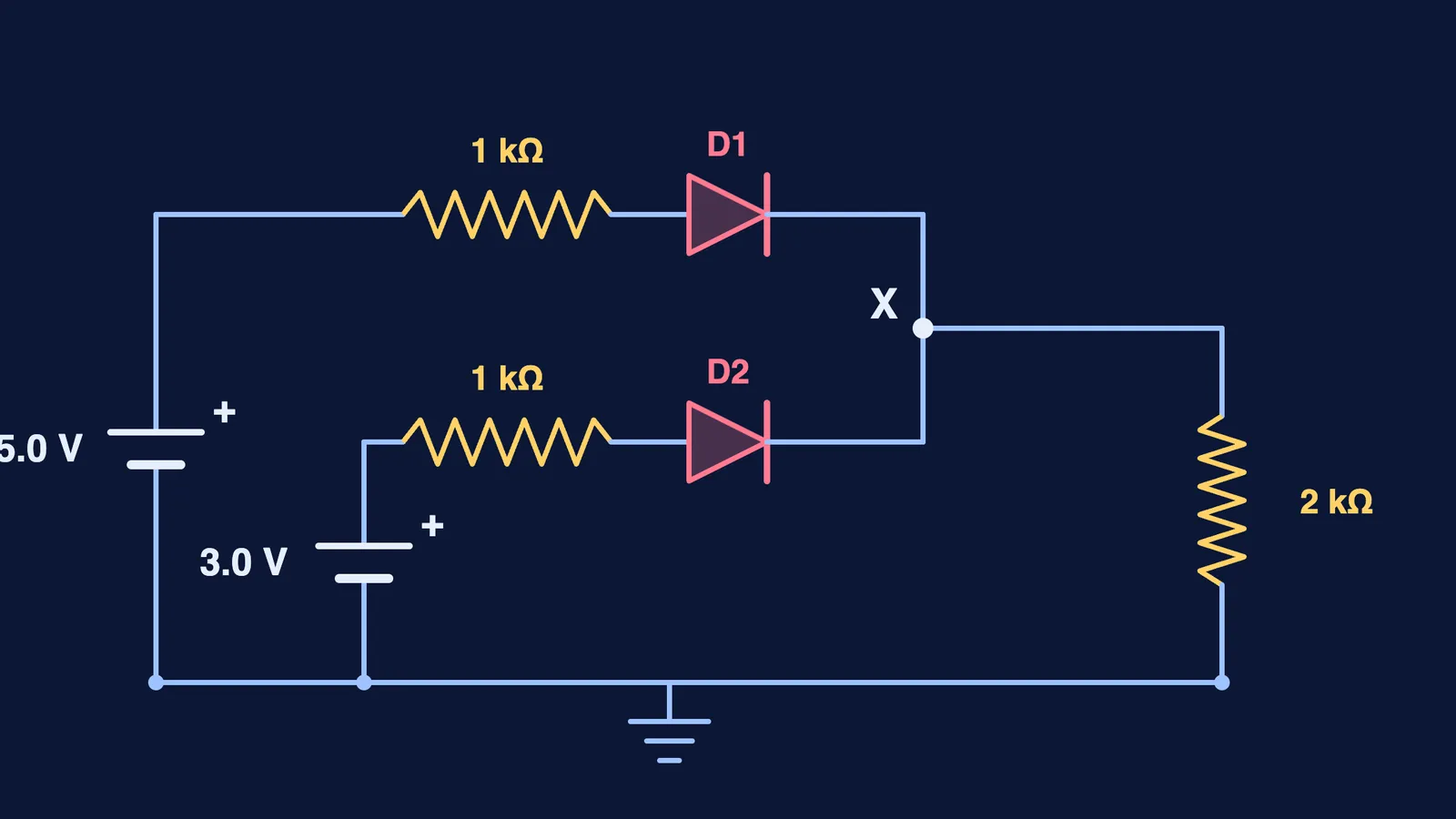
Q7 (hard). A 5.0 V battery drives a 1.0 kΩ resistor and silicon diode D1 to point X. A 3.0 V battery drives another 1.0 kΩ resistor and silicon diode D2 to X. Both diodes point towards X, and a 2.0 kΩ resistor joins X to the common negative terminal. Taking 0.7 V across a diode that conducts, find the current through D1, in μA, to the nearest integer.
Answer: 1433. Assume both conduct: (4.3 − V)/1 + (2.3 − V)/1 = V/2 gives V = 2.64 V, and D2's current (2.3 − 2.64)/1 is negative. So D2 is off. With D1 alone, the current is 4.3 V/3.0 kΩ = 1.433 mA and X sits at 2.87 V. Check: D2 conducts only if X is below 3.0 − 0.7 = 2.3 V, so it stays off.
Trap: 1660, the both-on solution.
Q8 (hard). A and B feed a NAND gate (output P). B and C feed a NOR gate (output Q). P and Q feed a second NOR gate, whose output is Y. Read ABC as a three-bit binary number with A as the highest bit. Find the sum of the numbers for which Y = 1.
Answer: 13. Y = NOT(P + Q) = (NOT P)·(NOT Q) = AB·(B + C) = AB. So Y = 1 only for ABC = 110 and 111, that is 6 + 7 = 13.
Trap: 10 reads C as the highest bit (011 and 111 become 3 and 7).
How to get the number right
Convert to the asked unit last: a ratio of 4.0 × 10¹² "in units of 10¹²" is typed as 4.
Keep hc = 1240 eV nm and powers in watts; then current = efficiency × power ÷ photon energy in eV.
For a Zener, check the worst case: highest supply and no load.
Check the sign: a negative diode current means that diode is off.
Stuck on which diode conducts in Q7? The Fermi Problem Library has worked problems with a step-by-step solver that explains the reasoning rather than printing an answer.
For multiple-choice practice, try our semiconductors JEE Main practice questions with solutions.


