

On this page
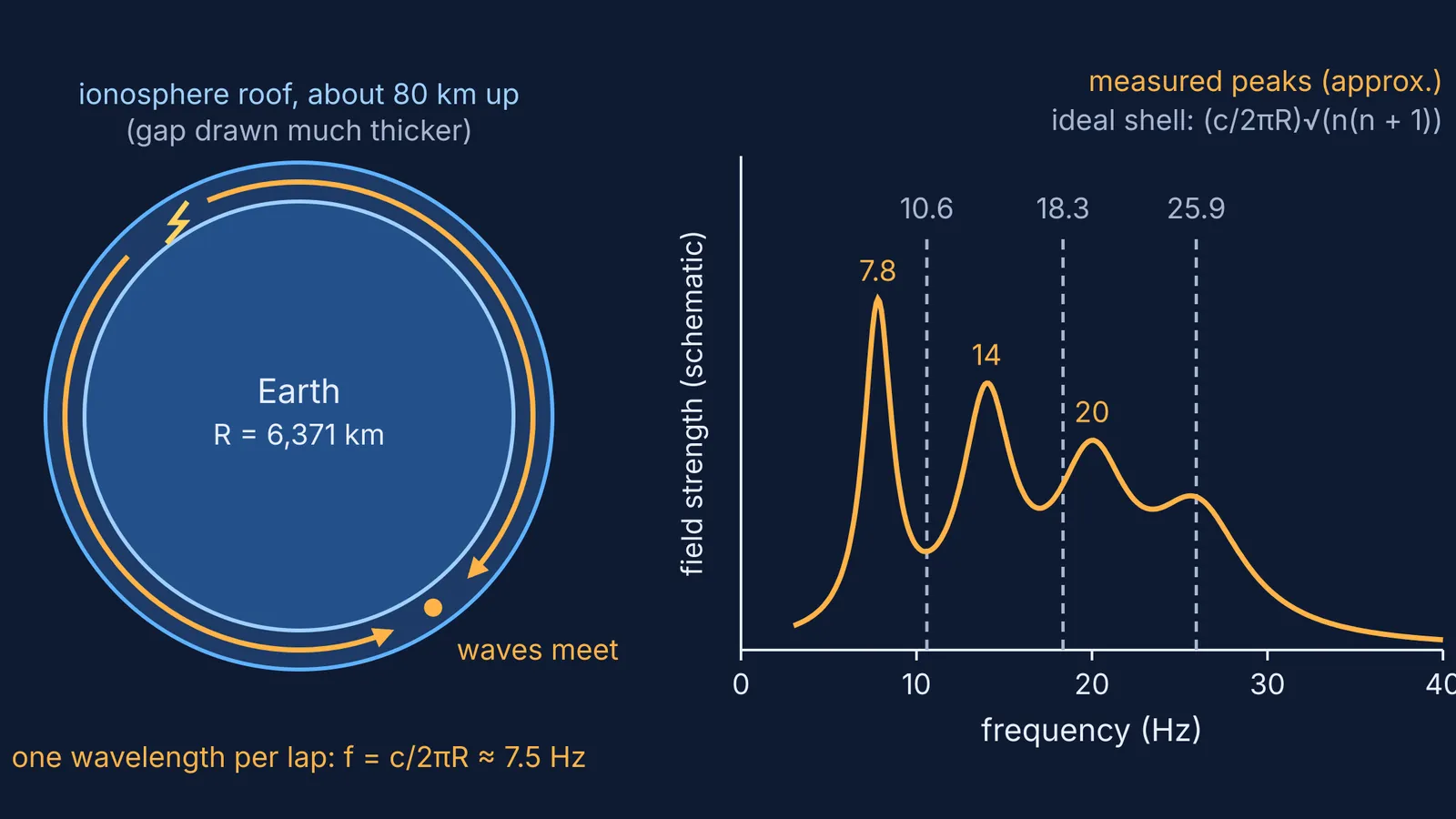
The space between the ground and the bottom of the ionosphere is a giant resonator. Lightning strikes somewhere on Earth every second, and each stroke sends out radio waves at very low frequencies that travel all the way round the planet. Waves that fit the round trip reinforce each other, and the whole shell rings at about 8 Hz, with weaker overtones above it. These are the Schumann resonances, and you can estimate the first one with nothing more than c, the radius of the Earth and the idea of a standing wave.
What are the Schumann resonances?
They are the natural frequencies of the cavity between two conductors: the Earth's surface (moist ground and salty sea conduct well at these frequencies) and the lower ionosphere, the layer of charged gas that reflects radio waves. The physics of that reflecting roof, and how it was found, is told in Edward Appleton and the layers of the ionosphere.
Winfried Otto Schumann predicted the resonances in the early 1950s. A review by Colin Price describes them as global resonances excited at about 8 Hz, 14 Hz, 20 Hz and so on (Atmosphere, 2016). Radio waves at these frequencies are called ELF, extremely low frequency, and their wavelengths run to tens of thousands of kilometres.
How thin is the gap between the ground and the ionosphere?
Very thin compared with the Earth. NOAA's Space Weather Prediction Center puts the ionosphere's lowest layer, the D region, at about 50 to 90 km altitude (NOAA SWPC). Take a round 80 km for the effective height of the roof. The Earth's radius is 6,371 km, so the gap is about 80/6,371 ≈ 1.3% of the radius.
So the cavity is like the space between two nested balls, one only slightly larger than the other. A wave launched inside it cannot escape up or down, but it can travel sideways, all the way round. That is what makes a round-the-world standing wave possible.
What keeps the Earth–ionosphere cavity ringing?
Lightning. A paper by Z. K. Silagadze summarising the field notes that storms, mostly in the tropics, produce about 50 of the relevant cloud-to-ground discharges every second, and that ELF waves lose very little energy as they travel, about 0.5 to 1 dB per thousand kilometres between 5 and 60 Hz (Modern Physics Letters A, 2018). So each stroke's waves can circle the globe several times before fading, and new strokes keep topping them up.
The same paper gives the size of the signal: magnetic fields of the order of a picotesla, with a background spectral density of about 1 pT/√Hz at the first peak. The Earth's steady field is roughly 50 µT, tens of millions of times larger, so it takes very sensitive magnetometers at quiet sites to record the resonances. The resonances are also broad. The same source quotes a quality factor of only about 2 to 6, because the ionosphere is a poor, lossy conductor compared with metal.
Worked example: why one wavelength round the Earth gives about 8 Hz
Question. Estimate the lowest resonant frequency by assuming exactly one wavelength fits round the Earth's circumference. Take c = 3.00 × 10⁸ m/s and R = 6,371 km. Then find the wavelength of a 7.8 Hz wave.
Circumference. L = 2πR = 2π × 6,371 km = 40,030 km = 4.003 × 10⁷ m.
Time for one lap. t = L/c = 4.003 × 10⁷ / 2.998 × 10⁸ = 0.134 s.
One wavelength per lap. If λ = L, then f = c/L = 1/t = 7.49 Hz.
Wavelength at 7.8 Hz. λ = c/f = 2.998 × 10⁸ / 7.8 = 3.84 × 10⁷ m, about 38,400 km, a little less than the circumference.
Check the units. (m/s)/m = 1/s = Hz.
Compare that with radio you know. An FM station near 100 MHz has a wavelength of about 3 m, as worked in wavelengths of FM and AM radio waves. A Schumann wave is about thirteen million times longer.
Why are the higher Schumann peaks not 15, 22 and 30 Hz?
If the cavity were a simple ring, like a wave on a loop of string, the modes would be whole-number multiples: 7.5, 15.0, 22.5 Hz and so on, the same pattern as the harmonics in standing waves on strings and in pipes. But the cavity is a spherical shell, not a ring. Waves spread out from the lightning over the whole sphere and focus again on the opposite side, and the allowed patterns are those of a sphere.
For a thin shell between two perfect conductors, Schumann's result, quoted in the Silagadze paper above, is
f_n = (c/2πR)√(n(n + 1)), with n = 1, 2, 3 …
With c/2πR = 7.49 Hz, this gives:
n = 1: 7.49 × √2 = 10.6 Hz
n = 2: 7.49 × √6 = 18.3 Hz
n = 3: 7.49 × √12 = 25.9 Hz
n = 4: 7.49 × √20 = 33.5 Hz
The gaps between these ideal modes shrink towards 7.5 Hz as n grows, but the first is 10.6 Hz, not 7.5.
Why are the measured peaks lower than the ideal formula?
The measured peaks sit near 7.8, 14, 20 and 26 Hz; published values differ by about half a hertz between sources and between day and night. Divide them by the ideal values: 7.8/10.6 = 0.74, 14/18.3 = 0.76, 20/25.9 = 0.77. Each real peak is about three quarters of the ideal one.
The reason is that the ionosphere is not a perfect conductor. Its resistance lets the fields leak into it, which slows the wave. The Silagadze paper gives an approximate formula for the ELF phase speed. At 7.8 Hz it gives about 0.74c, the same factor as the ratio above. Use 0.74c in place of c and the first ideal mode becomes 0.74 × 10.6 ≈ 7.9 Hz.
So the simple "one wavelength round the Earth" estimate of 7.5 Hz lands close to the real 7.8 Hz partly by luck. It misses the factor √2 from the spherical geometry and also misses the slow-down factor of about 0.74. Since √2 × 0.74 ≈ 1.05, the two errors almost cancel.
If standing waves are easier for you to see than read, the Simulation Lab has interactive simulations for ideas like these.
Is the Schumann resonance the Earth's heartbeat?
No. You may see claims online that 7.83 Hz is a "heartbeat of the Earth", that it is rising, or that it affects health or mood. These claims are not supported. The resonance is a property of the cavity's size and the ionosphere's conductivity, it shifts slightly between day and night, and its fields are around a picotesla.
Quick checklist
Cavity: the ground and the lower ionosphere, roughly 50 to 90 km up, a thin shell round the Earth.
Source: about 50 lightning discharges every second worldwide.
Estimate: one wavelength round the Earth, f = c/2πR ≈ 7.5 Hz.
Ideal sphere: f_n = (c/2πR)√(n(n + 1)) = 10.6, 18.3, 25.9 Hz.
Measured: near 7.8, 14, 20, 26 Hz, about 0.74 to 0.77 of ideal, because the lossy ionosphere slows the wave.
Loop rule: L = nλ; string with fixed ends: L = nλ/2.


