

On this page
Have you ever wondered why your car's radio antenna is so short, but AM radio stations transmit from towers that scrape the sky? The answer lies in the relationship between frequency, the speed of light, and wavelength. Understanding this connection is not just a practical curiosity, but a fundamental concept in physics that appears frequently in competitive exams.
How do you calculate the wavelength of a radio wave?
All electromagnetic waves, including radio waves, travel at the speed of light in a vacuum, denoted by c, which is exactly 299,792,458 m/s, or approximately 3 × 10⁸ m/s (Wikipedia). The formula linking a wave's physical length (λ) and its frequency (f) is λ = c/f.
When you tune into a radio station, the number displayed on the dial is its frequency. Using this core equation, you can find the exact distance of one complete wave cycle—the distance from one peak of the electromagnetic wave to the next. Because the speed of light remains completely constant, frequency and wavelength are inversely proportional. A higher frequency always results in a shorter wavelength, while a lower frequency results in a longer wavelength. This relationship forms a core part of the Electromagnetic waves: the spectrum, E and B, and board questions chapter for Class 12 physics.
What is the wavelength of FM radio waves?
FM (Frequency Modulation) radio operates in the Very High Frequency (VHF) band. In most of the world, the standard FM broadcast band ranges from 87.5 MHz to 108.0 MHz (Wikipedia).
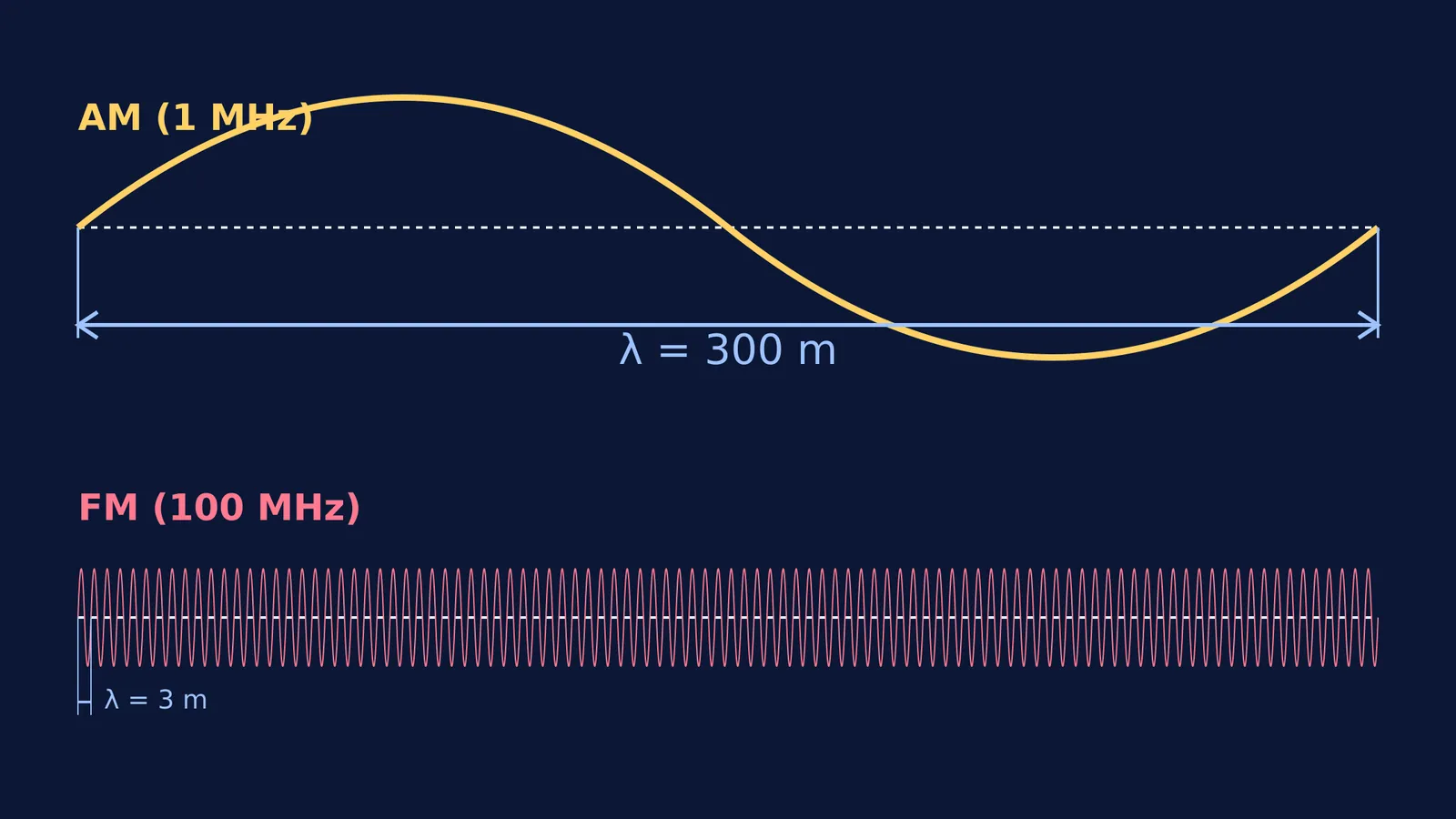
Let us take a typical station broadcasting right in the middle of this band at 100 MHz, which is equivalent to 100 × 10⁶ Hz. Using our wave formula λ = c/f, we calculate λ = (3 × 10⁸ m/s) / (100 × 10⁶ Hz), which equals exactly 3 metres. Therefore, the wavelength of a typical FM radio wave is roughly 3 metres.
We can also check the extremes of the FM band. For a station at the lower end (87.5 MHz), the wavelength is about 3.43 metres. For a station at the upper end (108.0 MHz), the wavelength drops to about 2.78 metres. Across the entire dial, an FM radio wave is always around three metres long, which is roughly the height of a single-storey room.
What is the wavelength of AM radio waves?
AM (Amplitude Modulation) radio uses the Medium Wave (MW) band, which operates at much lower frequencies than FM. Depending on the region, these frequencies are allocated from 531 kHz to 1700 kHz (Wikipedia).
If an AM station broadcasts at 1000 kHz, which is 10⁶ Hz, the calculation becomes λ = (3 × 10⁸ m/s) / (10⁶ Hz). This division gives us a wavelength of 300 metres. So, the wavelength of a typical AM radio wave is 300 metres—the length of several football fields laid end to end.
Because AM frequencies are so much lower, their wavelengths are vastly larger. At the lower end of the AM dial (531 kHz), the wavelength stretches out to approximately 565 metres. Even at the highest end of the expanded band (1700 kHz), the wavelength is still roughly 176 metres. For more practice with converting between these units, see our guide on Wavelength, frequency and wavenumber: Class 11 sums solved.
Why does wavelength dictate antenna size?
For an antenna to transmit or receive electromagnetic signals efficiently, its physical length must resonate with the radio wave. The most common lengths used for these resonant antennas are exactly half of a wavelength (λ/2) or a quarter of a wavelength (λ/4) (Wikipedia).
With a wavelength of 3 metres, a quarter-wave FM antenna needs to be about 0.75 metres (75 cm) long. This is why a short telescopic rod, or a small wire mounted on your car roof, is perfectly sized to pick up FM signals. The physical rod resonates cleanly with the three-metre wave.
At a wavelength of 300 metres, however, a quarter-wave AM antenna must be 75 metres tall. To transmit efficiently, AM radio stations require massive, towering masts. A simple metal rod on a car is far too short to resonate with a 300-metre wave. Instead, your portable radio picks up AM signals using a tightly coiled ferrite rod hidden inside the plastic casing, which acts as a magnetic antenna rather than a straight wire.
How to master electromagnetic waves for your exams?
Questions about the electromagnetic spectrum, frequency bands, and wavelength calculations are absolutely guaranteed to appear in major competitive exams like JEE and NEET. The most important key to solving these numerical problems quickly is to remember your powers of ten. You must ensure you never mix up kilohertz (10³ Hz) with megahertz (10⁶ Hz), as defined by the standard International System of Units (Wikipedia). Getting the exponent wrong by a factor of a thousand is the most common pitfall for students.
If you have concept gaps about how electromagnetic waves travel or how they interact with antennas, the Concept Library has a lesson for every concept in physics and its place in the map. Instead of memorising the formulas in isolation, you can explore exactly how changing the frequency stretches or compresses the wave, building an intuition that will serve you far better than rote learning.


