

On this page
A solar panel or a computer chip starts as sand. The silicon inside it must be so pure that the impurities are counted in parts per billion. Heating sand with carbon gets you silicon, but nowhere near that purity. The rest of the job is done by a short chain of Class 11 p-block reactions: turn silicon into a volatile liquid, distil the liquid, then turn it back into silicon. This post walks through that chain, the Siemens process, and works out the numbers.
How is silicon made from sand?
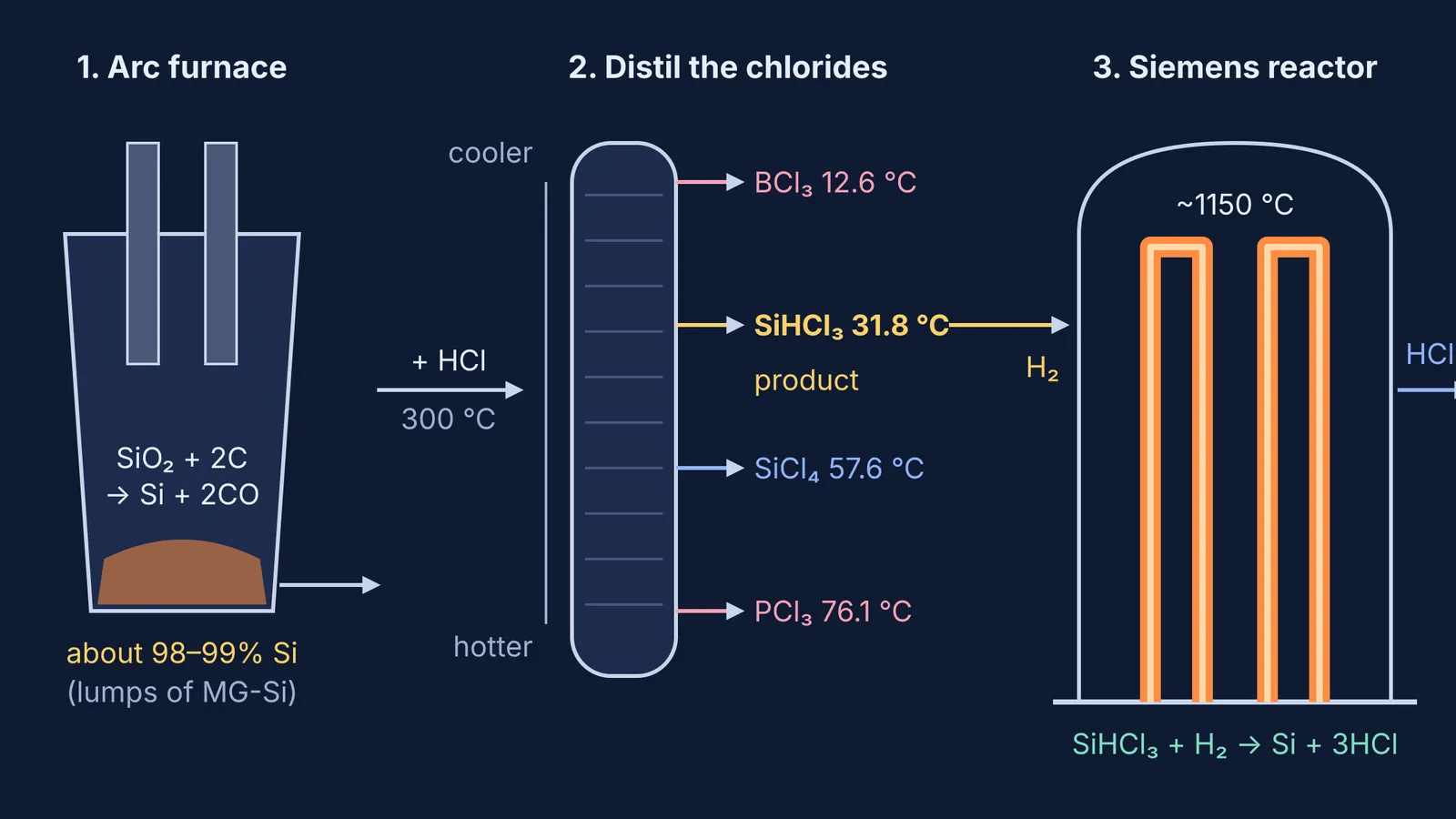
The first step is carbon reduction of silica (quartz) in an electric arc furnace:
SiO₂ + 2C → Si + 2CO
Check it: 1 Si, 2 O and 2 C on each side. The furnace runs extremely hot. The headline equation hides the route: silicon monoxide gas (SiO) and silicon carbide (SiC) form along the way and react further. So treat the equation as the overall change, not the only reaction.
The product is metallurgical-grade silicon, about 98–99% pure. That is fine for alloys and silicones, but far too dirty for a solar cell.
Why can't you just refine the silicon as a solid?
Physical methods help, but they fail on the impurity that matters most. William Pfann's zone refining works because most impurities prefer the melt to the solid. Their segregation coefficient k is much less than 1. Boron in silicon has k of about 0.8, so the freezing solid takes in almost as much boron as the melt holds and a moving molten zone barely moves it. Phosphorus (k about 0.35) is not much better.
Boron and phosphorus are exactly the elements used to make p-type and n-type silicon. Unwanted boron or phosphorus means the wafer is already doped before anyone has chosen how. The answer is to change the problem from a solid one into a liquid one.
How does trichlorosilane purify silicon?
Powdered metallurgical silicon is treated with hydrogen chloride gas at about 300 °C:
Si + 3HCl → SiHCl₃ + H₂
Check it: 1 Si, 3 H and 3 Cl on each side. The product, trichlorosilane, is a colourless liquid that boils at 31.8 °C. The reaction is not perfectly selective. According to the trichlorosilane entry on Wikipedia, yields of 80–90% are reached, with silicon tetrachloride (SiCl₄) and dichlorosilane among the by-products.
Here is the useful part. Most metal impurities either do not form volatile chlorides or form ones with very different boiling points, so they stay behind. Boron and phosphorus do form volatile chlorides, but their boiling points differ from that of SiHCl₃:
BCl₃: 12.6 °C
SiHCl₃: 31.8 °C
SiCl₄: 57.6 °C
PCl₃: 76.1 °C
These are approximate literature values; tables differ by a few tenths of a degree. Fractional distillation separates them. A boron impurity that a melt could not shake off can be separated from a liquid boiling about 19 °C away. Real plants use several columns, but the principle is the same.
Chlorosilanes must be kept dry. SiHCl₃ reacts with moisture in air, giving off HCl, for the reason explained in why SiCl₄ hydrolyses but CCl₄ does not: silicon can accept a lone pair from water. This is not a demonstration for a school lab.
What happens inside a Siemens reactor?
The purified SiHCl₃ is mixed with excess hydrogen and passed into a bell-jar reactor holding thin silicon rods. An electric current heats the rods to about 1150 °C, according to the Wikipedia article on polycrystalline silicon. Silicon deposits on the hot rods:
SiHCl₃ + H₂ → Si + 3HCl
This is the reverse of the chlorination reaction. Chlorination runs forward at about 300 °C; the Siemens reactor runs it backwards at about 1150 °C. Le Chatelier's principle tells you how:
The forward chlorination is strongly exothermic, so the reverse reaction is endothermic and is favoured by high temperature.
Excess H₂ pushes the equilibrium towards silicon.
The gas moles rise from 2 to 3, and removing HCl and other gases in the exhaust keeps the reaction going.
The rods thicken over days into polysilicon, which is broken into chunks. Those chunks are what goes into the crucible in the Czochralski crystal-pulling method to grow single-crystal ingots. The same "make a volatile compound, purify it, decompose it" logic appears in the van Arkel method for zirconium and titanium and in the Mond process for nickel.
HCl and H₂ are recycled. Add the two reactions and you get Si (impure) → Si (pure). In principle no HCl or H₂ is used up, although real plants lose some and must also deal with the SiCl₄ by-product.
To see how a shift in conditions moves an equilibrium like this one, try the Fermi Simulation Lab, which has interactive simulations for ideas easier to see than read.
Worked example: how much SiHCl₃ per kilogram of silicon?
Use M(Si) = 28.09, M(H) = 1.008 and M(Cl) = 35.45 g mol⁻¹.
Molar mass of SiHCl₃. 28.09 + 1.008 + 3 × 35.45 = 135.45 g mol⁻¹.
Mass fraction of Si. 28.09 ÷ 135.45 = 0.207, so SiHCl₃ is 20.7% silicon by mass.
Minimum SiHCl₃ per kg of Si. 1 ÷ 0.207 = 4.82 kg. This assumes every molecule that enters the reactor deposits its silicon. Real reactors convert only part of the feed per pass, so the actual flow is larger and the rest is recycled.
HCl needed for chlorination. 3 mol HCl per mol Si: 3 × 36.46 ÷ 28.09 = 3.89 kg of HCl per kg of Si, which the Siemens step gives back.
The furnace step. SiO₂ + 2C → Si + 2CO needs 60.08 ÷ 28.09 = 2.14 kg of silica and 24.02 ÷ 28.09 = 0.86 kg of carbon per kg of silicon, at 100% yield.
How pure is "nine nines"?
Silicon has a diamond-cubic lattice with 8 atoms in a cubic cell of edge 5.431 Å. So the number of atoms per cm³ is 8 ÷ (5.431 × 10⁻⁸ cm)³ = 5.0 × 10²² cm⁻³.
Nine nines (99.9999999%, by atoms): an impurity fraction of 10⁻⁹ leaves 5.0 × 10²² × 10⁻⁹ = 5 × 10¹³ impurity atoms per cm³.
Six nines: 5 × 10¹⁶ per cm³.
NCERT gives the intrinsic carrier concentration of silicon at room temperature as about 1.5 × 10¹⁰ cm⁻³. Even at nine nines, impurity atoms outnumber intrinsic carriers by about 3,300 to 1.
That is why the electronics industry aims for impurity levels below about one part per billion, while solar-grade silicon is generally allowed to be somewhat less pure. Grades are quoted in different ways by different producers, so always say which one you mean. And it is why boron has to be distilled out before doping puts a measured amount back in on purpose.
Quick checklist
SiO₂ + 2C → Si + 2CO gives metallurgical silicon, about 98–99% pure.
Si + 3HCl → SiHCl₃ + H₂ at about 300 °C makes a volatile liquid (b.p. 31.8 °C).
Fractional distillation separates BCl₃ (12.6 °C), SiCl₄ (57.6 °C) and PCl₃ (76.1 °C).
SiHCl₃ + H₂ → Si + 3HCl on rods at about 1150 °C is the reverse reaction, driven by heat and excess H₂.
SiHCl₃ is 20.7% Si by mass: at least 4.82 kg per kg of silicon.
Nine nines still leaves about 5 × 10¹³ impurity atoms per cm³.


