

On this page
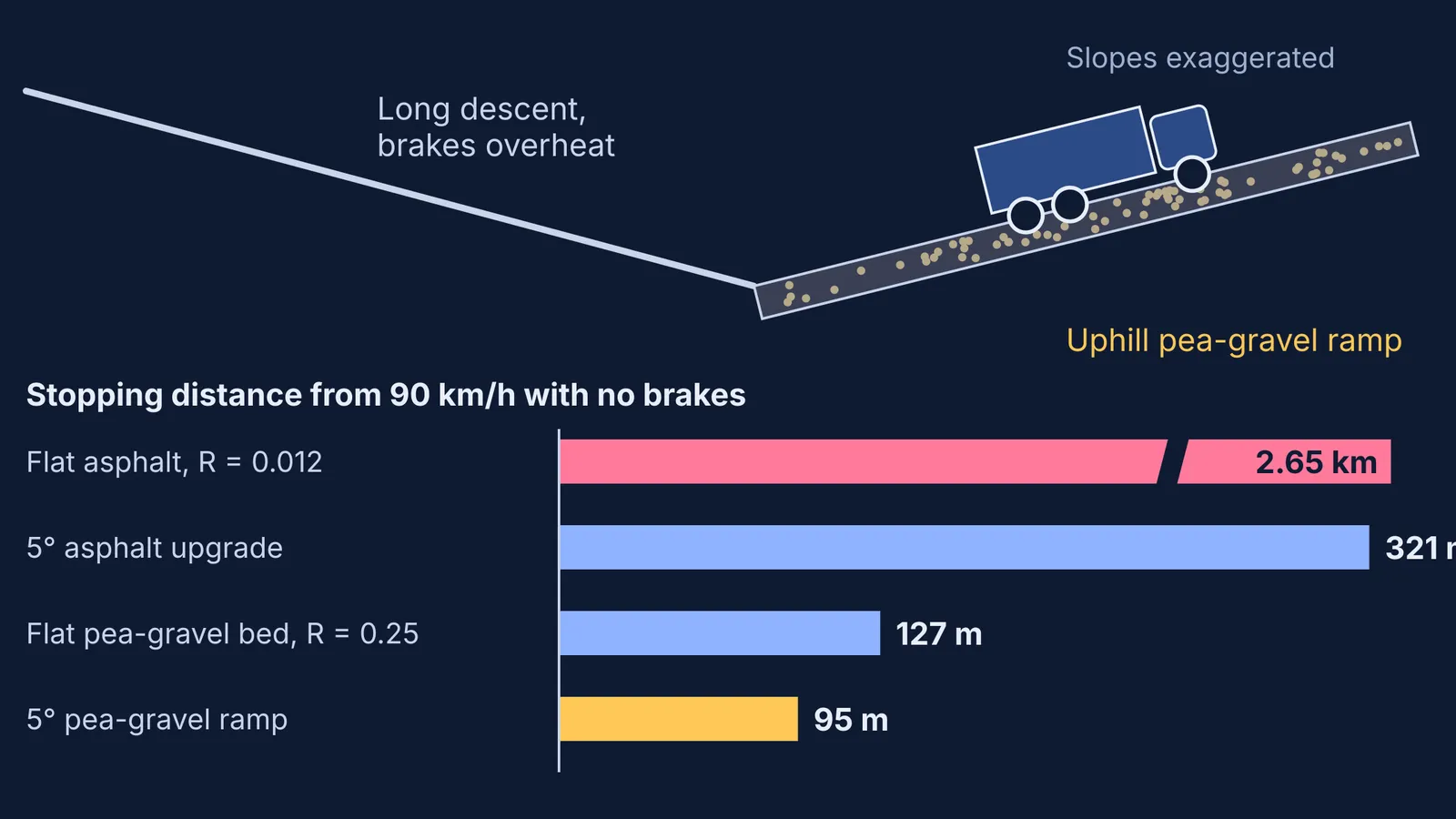
On a long mountain descent, a loaded truck's brakes can get so hot that they stop working. With no brakes, a 40-tonne truck at 90 km/h would roll for kilometres. Highways in hilly country give drivers a way out: an escape ramp, a lane of deep loose gravel that often runs uphill. It stops the truck in under 100 m without the brakes doing anything. This post works out why, using nothing more than the work–energy theorem, and shows where the brake heat comes from in the first place.
Why do truck brakes fail on long descents?
Going down a slope at steady speed, the brakes must turn the truck's lost gravitational potential energy into heat. The rate is power: P = m·g·v·sin θ.
Take a 40-tonne truck crawling down a 6% grade (a rise of 6 m per 100 m, so tan θ = 0.06 and sin θ ≈ 0.0599) at 40 km/h (11.1 m/s):
P = 40,000 × 9.81 × 11.1 × 0.0599 ≈ 261 kW, about 2.6 times what a 100 kW car engine delivers at full power, all going into the brakes.
Over 1 km of road the truck drops 59.9 m, so the energy is m·g·h = 40,000 × 9.81 × 59.9 ≈ 23.5 MJ.
If that heat went into 400 kg of brake metal (an illustrative figure) with specific heat about 460 J/(kg·K), the temperature would rise by ΔT = 23.5 × 10⁶ / (400 × 460) ≈ 128 K, for every kilometre.
Brakes lose some heat to the air, but on a long descent they gain it faster. Hot brakes grip less (drivers call it brake fade), so the truck speeds up, which makes them hotter still. That is why truck drivers are taught to descend in a low gear and let the engine hold the speed, instead of riding the brakes.
If the brakes go completely, the numbers get frightening. Starting at 40 km/h with only road rolling resistance (0.012) holding it back, the truck would reach about 117 km/h after just one more kilometre of the 6% grade. Air drag would trim that a little.
How does a gravel escape ramp stop a truck?
The gravel is deep, loose and rounded, so the tyres sink into it. To keep moving, the wheels have to push gravel aside continuously. That is rolling resistance: a force opposing the motion, written as R × (normal force), where R is a dimensionless coefficient.
The wheels are still rolling. The tyres are not skidding, and the brakes are not needed. So the coefficient you use is not the tyre–road μ from friction problems. It is a rolling-resistance coefficient for the surface.
Design guides list values for R. The California Department of Transportation's design guide for truck escape ramps, quoting the 1984 AASHTO geometric design policy, gives:
Portland cement concrete: 0.010
Asphalt concrete: 0.012
Loose gravel: 0.100
Sand: 0.150
Pea gravel: 0.250
Pea gravel resists rolling about 20 times more than asphalt. Real beds vary with gravel size, depth and how packed it has become, so treat 0.25 as a design value, not a measurement for every ramp.
How far does a runaway truck go on a gravel ramp?
On a slope of angle θ going uphill, two forces slow the truck along the ramp: the component of gravity mg sin θ and the rolling resistance R·mg cos θ. Using the work–energy theorem:
½mv² = m·g·(sin θ + R cos θ)·d, so d = v² / [2g(sin θ + R cos θ)]
Mass cancels. A 40-tonne truck and a 10-tonne truck at the same speed need the same ramp length. (Mass does not cancel in the brake heating above, which is why heavy trucks are the ones that need ramps.)
Worked example: 40-tonne truck, 90 km/h = 25 m/s, so ½mv² = ½ × 40,000 × 25² = 12.5 MJ of kinetic energy to get rid of.
Flat asphalt, no brakes. sin θ = 0, R = 0.012. d = 625 / (2 × 9.81 × 0.012) ≈ 2.65 km.
5° asphalt upgrade. sin 5° = 0.0872, cos 5° = 0.9962. sin θ + R cos θ = 0.0991. d = 625 / (2 × 9.81 × 0.0991) ≈ 321 m.
Flat pea-gravel bed. R = 0.25. d = 625 / (2 × 9.81 × 0.25) ≈ 127 m.
5° pea-gravel ramp. sin θ + R cos θ = 0.0872 + 0.249 = 0.336. d = 625 / (2 × 9.81 × 0.336) ≈ 95 m.
The deceleration on the last ramp is 0.336g ≈ 3.3 m/s², and the stop takes 25 / 3.3 ≈ 7.6 s. That is firm but not violent, roughly like hard braking in a car, so the load does not shift dangerously. Dimension check: (m²/s²) / (m/s²) = m.
The AASHTO formula in the design guide is the same equation in US units: L = V² / [30(R + G)], with L in feet, V in mph and G the grade as a decimal. Feeding in 55.9 mph, R = 0.25 and G = tan 5° gives 309 ft = 94 m, which agrees.
Why is the ramp built uphill?
Look at the four answers. Going uphill on asphalt alone (321 m) already beats the flat gravel bed by a long way, but it is far too long to build beside a mountain road. Gravel alone on the flat (127 m) is better. Both together give 95 m, a quarter less again. Uphill ramps also have a second benefit: once the truck stops, the downslope pull is only tan 5° ≈ 0.087 of its weight, well below the 0.25 resistance of the gravel the wheels have sunk into, so the truck stays put instead of rolling back onto the highway.
Where the ground does not allow an uphill ramp, a flat or even downhill gravel bed still works; it just has to be longer.
How is this different from normal stopping distance?
Normal braking uses the tyre–road friction coefficient, and the reaction distance comes first. That is covered in stopping distance and reaction time, and the question of whether mass changes braking distance in does a heavier car take longer to stop?. The ramp is different because no brakes are involved at all. For the mg sin θ term itself, see work done pulling a body up an incline slowly.
Escape ramps are for emergencies. A truck that enters one has to be towed out, and the gravel then has to be raked back to its loose state, so drivers use them only when the brakes have actually gone. If you want to practise more work–energy problems on slopes with resistance, the Fermi Problem Library has a step-by-step solver that explains the reasoning.
Quick checklist
Brake power on a descent: P = mgv sin θ. 40 t at 40 km/h on 6% is about 261 kW.
Gravel ramps work by rolling resistance, not sliding friction.
Stopping distance: d = v² / [2g(sin θ + R cos θ)]. Mass cancels.
Pea gravel R ≈ 0.25 against 0.012 for asphalt (design-guide values).
From 90 km/h: 2.65 km on flat asphalt, 95 m on a 5° pea-gravel ramp.
Normal force on a slope is mg cos θ.
Uphill ramps are shorter and stop the truck rolling back.


