

On this page
When you see the word "slowly" in a physics problem about pulling a block up an incline, it is not just setting the scene. It is a mathematical clue that changes how you calculate the work done.
Many students mistakenly calculate the net work when asked for the work done *by the applied force*. Here is how to decode the physics vocabulary, identify the forces, and calculate the work done without losing marks.
What does "pulling slowly" mean in physics?
In textbook problems, pulling an object "slowly" or "steadily" means it is moving at a constant speed.
When speed is constant, acceleration is zero. By Newton's second law, this means the net force acting on the block is zero. More importantly, because there is zero change in kinetic energy, the total net work done on the block must be zero, as stated in the work-energy theorem (OpenStax University Physics, Chapter 7.3).
This is the key to the problem: the positive work you do pulling the block must exactly cancel out the negative work done by the forces opposing you.
What are the forces at play on an incline?
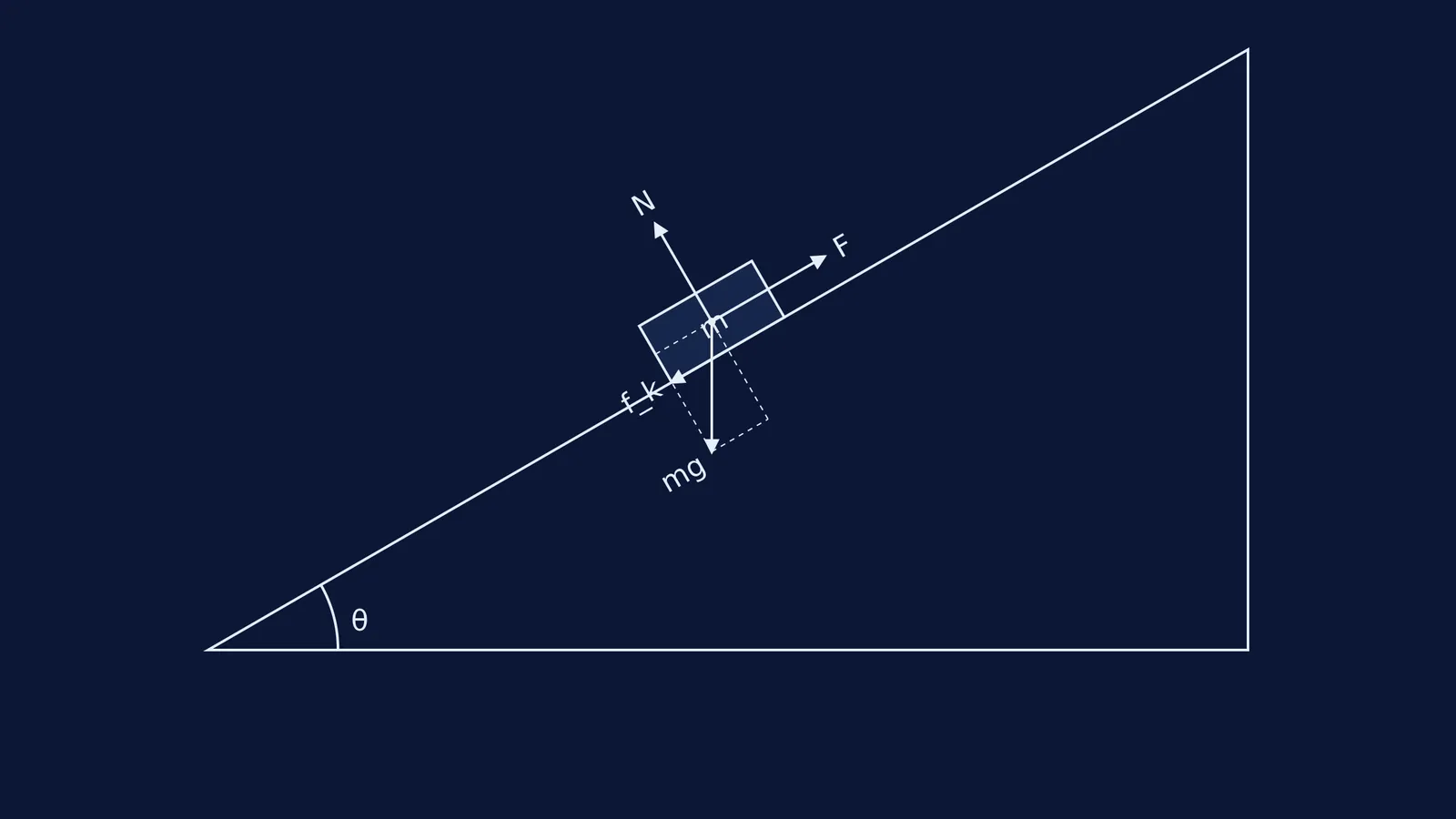
When you pull a block of mass m up a ramp with an angle θ, four forces are involved:
Gravity (mg): Pulls straight down. Its component acting down the slope is mg sin θ.
Normal force (N): Pushes perpendicular to the surface. It does zero work because it is at a 90-degree angle to the movement.
Kinetic friction (f_k): Opposes your pull, acting down the slope.
Applied force (F): Your pull acting up the slope.
Because the block moves slowly (zero net force), your applied force must be exactly strong enough to overcome both the downward pull of gravity and the drag of friction: F = mg sin θ + f_k
If you are struggling to remember how these force components align, the Fermi Concept Library holds every concept in physics, chemistry, biology, mathematics and computing, each with its own lesson and its place in the map.
How do you calculate the work done on an incline?
Work is force multiplied by distance. If you pull the block a distance d along the ramp, the work you do is: W = F × d W = (mg sin θ + f_k) × d
We can expand this to see where your energy goes: W = (mg sin θ)d + f_k d
Notice that d sin θ is simply the vertical height (h) you have lifted the block. Therefore, the work against gravity is mgh. To lift or pull an object up, you must do positive work against gravity (OpenStax University Physics, Chapter 7.1).
The total work done by your applied force is the work done against gravity plus the work done against friction.
How do you solve a worked example?
Let's say you pull a 10 kg block 5 metres up a 30° incline slowly. The coefficient of kinetic friction (μ_k) is 0.2. (We will use g = 9.8 m/s²).
Work against gravity:
This is mgh. The height h = d sin 30° = 5 × 0.5 = 2.5 m. W_gravity = 10 × 9.8 × 2.5 = 245 J.
Work against friction:
The friction force is μ_k mg cos θ. f_k = 0.2 × 10 × 9.8 × cos 30° ≈ 16.97 N. W_friction = f_k × d ≈ 16.974 × 5 = 84.87 J.
Total work done:
Add them together. 245 J + 84.87 J = 329.87 J.
If the problem states the ramp is "smooth" or "frictionless", the friction term disappears. In that case, the work done to pull the block up the incline is exactly mgh — the same amount of work it would take to lift it straight up into the air.
Whenever a physics problem feels like a wall of text, break it down step by step. If you get stuck on questions like this, try reading how to solve physics problems step by step or look at when to use energy conservation instead of Newton's laws for a faster way to the answer.


