

On this page
Put your hand flat on a table, fold your middle finger underneath, and try to lift your ring finger. It barely moves. Your other fingers lift easily, so this is not about strength. It is about wiring: the ring finger is tied to its neighbours by shared muscles and tendons, and the trick puts exactly those ties under strain.
How do you do the ring finger trick?
Rest your palm on a table with your fingertips touching the surface.
Fold your middle finger under so its middle knuckle presses flat on the table.
Keep the other fingertips and your palm on the table.
Lift your thumb, then your index finger, then your little finger, one at a time.
Now try to lift your ring finger.
In the classic version, the thumb, index and little fingers come up and the ring finger stays down. Do not force it.
Why can't I lift my ring finger?
The muscles that straighten your fingers are not in your hand. They sit in your forearm and reach the fingers through long tendons.
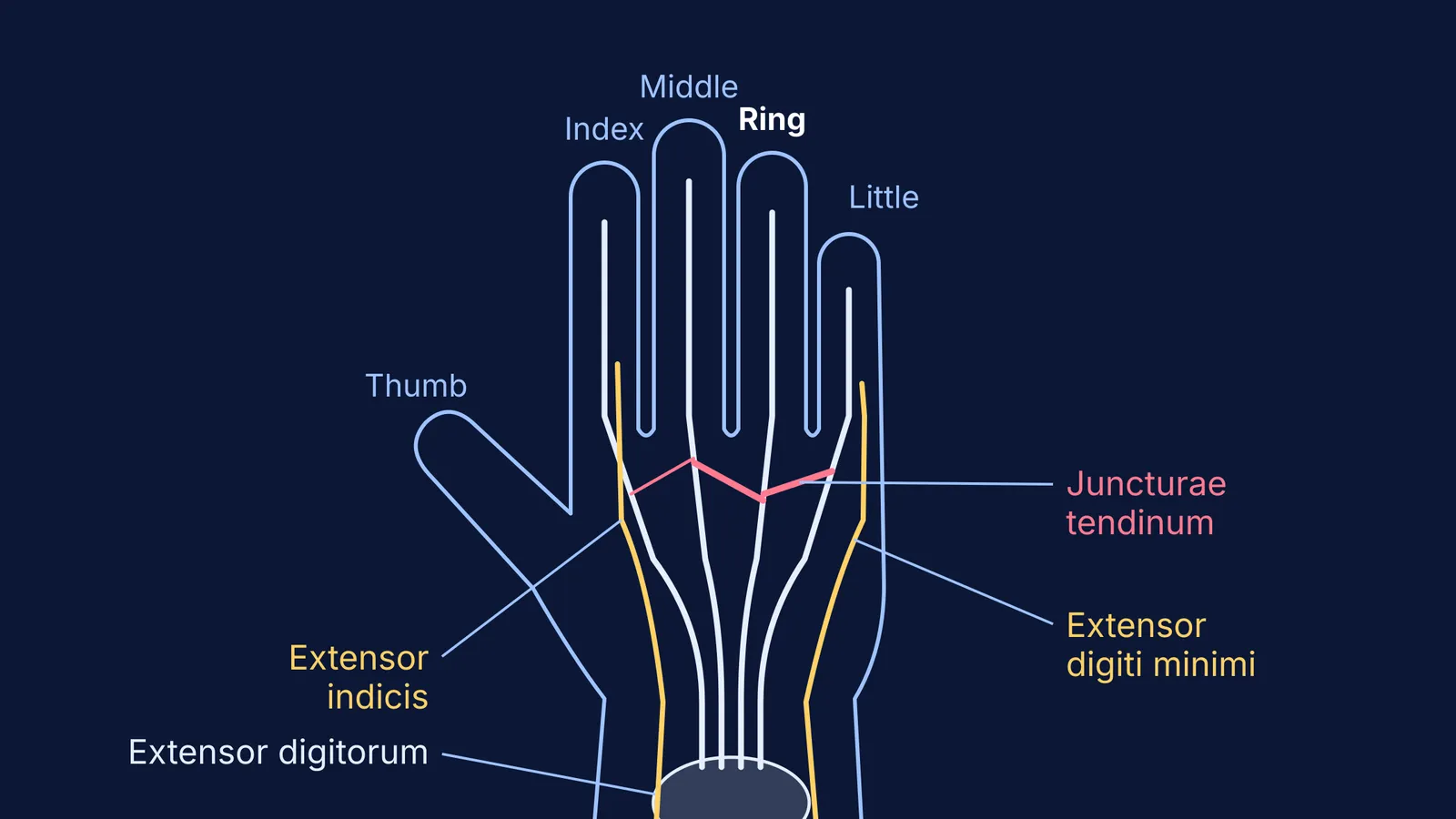
The main finger-straightening muscle, the extensor digitorum, arises from the outer bony bump at your elbow and divides into four tendons, one each for the index, middle, ring and little fingers (extensor digitorum anatomy). One muscle, four tendons: when it contracts, it pulls on all of them.
Two fingers get extra help. The index finger has its own muscle, the extensor indicis, and the little finger has the extensor digiti minimi; because these two fingers have separate extensors, they can move more independently than the others (extensor indicis; extensor digiti minimi). The ring finger has no private extensor. It depends on its share of the extensor digitorum.
On the back of your hand, the tendons are also tied sideways. Juncturae tendinum are bands of connective tissue that link the extensor digitorum tendons just before the knuckles, and a 1990 study in The Journal of Hand Surgery described their anatomy (von Schroeder, Botte and Gellman, 199090021-1)). Their presence may make it harder to extend each finger on its own (juncturae tendinum overview).
Put the pieces together. Folding the middle finger pulls its extensor tendon tight over the knuckle and holds it there. The ring finger's tendon comes from the same muscle and is strapped to the middle finger's tendon by a junctura, so it cannot slide up on its own. Anatomy papers describe the parts rather than this exact party trick, but the parts explain it well.
The bending side is shared too: in the deep finger flexor, the three fingers on the little-finger side share a common muscle belly, with the ring and little fingers especially entwined (2017 finger stiffness study in Hand).
Are some fingers really less independent than others?
Yes. In a 2000 study, 10 right-handed people tried to move one finger at a time while their hand motion was recorded; movements of the thumb, index and little fingers were more individuated than movements of the middle or ring fingers (Häger-Ross and Schieber, 2000). Fingers of the dominant hand were not more independent than those of the other hand.
The authors suggested three causes for the unwanted movement: passive mechanical connections between the digits, muscles that send tendons to several fingers, and the way the brain controls the hand. A 2004 follow-up separated passive mechanical coupling from active neuromuscular control. Mechanical coupling limited the index, middle and ring fingers most, while neuromuscular control mainly limited the ring and little fingers during large movements (Lang and Schieber, 2004). So the ring finger was limited both by tissue and by control.
Try it yourself: a prediction worksheet
Predict before you test.
Fold the middle finger, lift the index. Prediction: lifts, because the index has the extensor indicis.
Fold the middle finger, lift the little finger. Prediction: lifts, because it has the extensor digiti minimi, though its junctura with the ring finger may make it feel stiffer.
Fold the middle finger, lift the ring finger. Prediction: stuck, because it has no private extensor and is tied to the folded tendon.
Fold the ring finger, lift the middle finger. Write your own prediction and reason, then test it.
Repeat with your other hand. In the 2000 study, the dominant hand was no more independent.
Write one sentence per row naming the muscle or tendon responsible: structure, then function.
Studying muscles for Class 11? Pair this with our explainer on how antagonistic muscles like the biceps and triceps work in pairs and the Class 11 Locomotion and Movement chapter guide.
If a structure like the juncturae is hard to picture from text, the Fermi Concept Library gives each biology concept its own lesson and shows where it sits in the map, and Fermi's AI tutor can draw the figure and check your understanding as you go.


