

On this page
When a peanut goes down the wrong way, it more often ends up on the right. Your windpipe, the trachea, splits at a ridge called the carina into two main bronchi, one for each lung. They are not mirror images, and the usual explanation sits just left of centre: the heart.
Why is the right main bronchus wider, shorter and more vertical?
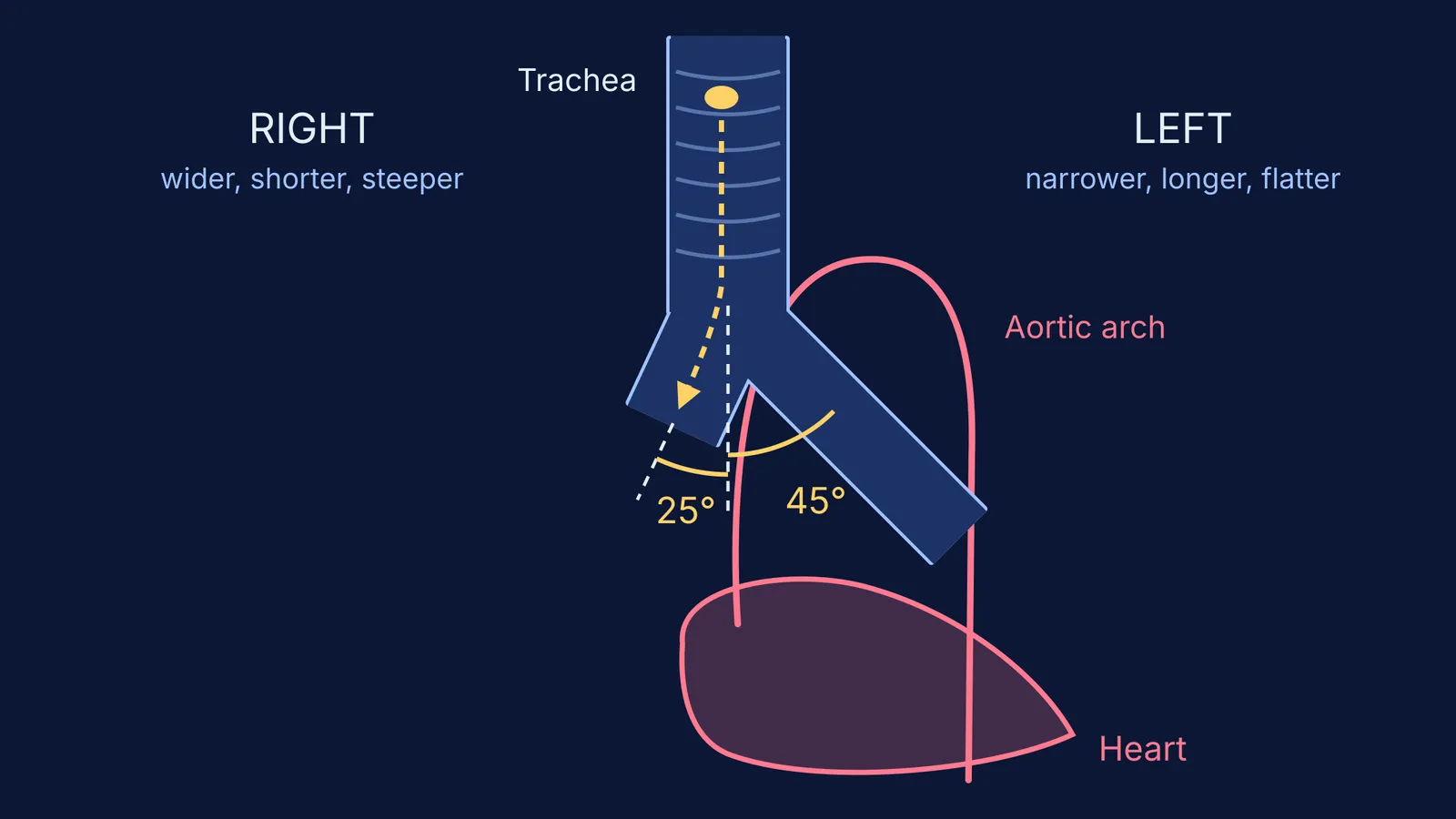
A review of airway anatomy by Ryan and colleagues in the Journal of Thoracic Disease (2017) reports that the right main bronchus branches at an angle of about 25 degrees and the left at about 45 degrees. So the right side carries on almost straight down.
The same review reports that the left main bronchus is almost twice as long as the right, averaging 5.0 cm in men and 4.5 cm in women. The right runs only about 2.0 cm in men and 1.5 cm in women before its first branch, to the upper lobe. Kenhub's anatomy page on the bronchi gives the same pattern: the right main bronchus is wider, shorter and more vertical, about 2 to 3 cm long against roughly 5 cm on the left.
What does the heart have to do with it?
The heart projects to the left, and the left lung has a dent in its border, the cardiac notch, to make room for it, as Wikipedia's overview of the lung notes.
The left bronchus also has to get past the great artery leaving the heart. TeachMeAnatomy describes the left main bronchus passing below the arch of the aorta to reach the root of the left lung. The right main bronchus enters its lung at about the level of the fifth thoracic vertebra and the left opposite the sixth, according to Wikipedia's bronchus article.
Anatomy teaching usually puts this together as follows: with the heart taking room on the left and the aortic arch above, the left bronchus travels further out and slightly lower, so it leaves at a flatter angle and runs longer. The right bronchus has nothing that size in its way, so it drops more directly into its lung.
Why do inhaled objects go into the right bronchus?
Normally the epiglottis keeps food out (how the epiglottis guards the windpipe). Imagine a peanut that slips past anyway and falls to the fork at the carina. The right branch is the wider opening and lies closer to the straight-down line, so the object is more likely to carry on into it than to turn the sharper corner on the left. The AMBOSS anatomy summary states it plainly: because the right main bronchus is wider, shorter and more vertical, aspiration of foreign bodies is more likely in the right lung.
Real cases show the tilt, and its limits. A study of 1,328 children treated in Chongqing, China between 2018 and 2021 found the object in the right bronchus in 49.70% of cases, the left bronchus in 38.63% and the trachea in 6.85%. In that study 92.09% of the children were under 3 years old, and nuts made up 81.17% of objects, with peanuts alone at 43.15%. So the right side is more likely, not certain: in more than a third of these children, the object went left.
How do you draw and explain this in an exam?
Here is a labelled sketch you can draw in about a minute.
Draw the trachea as two parallel vertical lines and mark the carina where it splits.
Draw the right bronchus as a short, wide tube tilted about 25 degrees off the vertical.
Draw the left bronchus narrower and roughly twice as long, tilted about 45 degrees.
Add a curved line over the left bronchus for the aortic arch, and the heart below it, towards the person's left.
Draw a dotted arrow from the top of the trachea straight into the right bronchus.
Then write the three-line answer:
The right main bronchus is wider, shorter and more vertical than the left, at about 25 degrees against 45 degrees.
The left bronchus is longer and flatter, and passes under the aortic arch to reach a left lung that shares space with the heart.
So an inhaled object falling down the trachea more often enters the right bronchus.
Where does this fit in your biology revision?
For the air path above the trachea, read why breathing through your nose matters, and for the rest of the chapter, try these breathing and exchange of gases mnemonics from NCERT.
If the anatomy around it still feels patchy, the Fermi Concept Library has a lesson for every concept in biology, each with its place in the map, so you can see how the bronchi connect to breathing and circulation.


