

On this page
Restorers clean rusty spanners and old locks with a plastic tub, washing soda and a battery charger. The rusty object goes on the negative terminal, a scrap steel plate on the positive, and after a few hours the rust lifts off. It makes a good supervised school project and a clean exercise in predicting electrolysis products.
How does electrolysis remove rust?
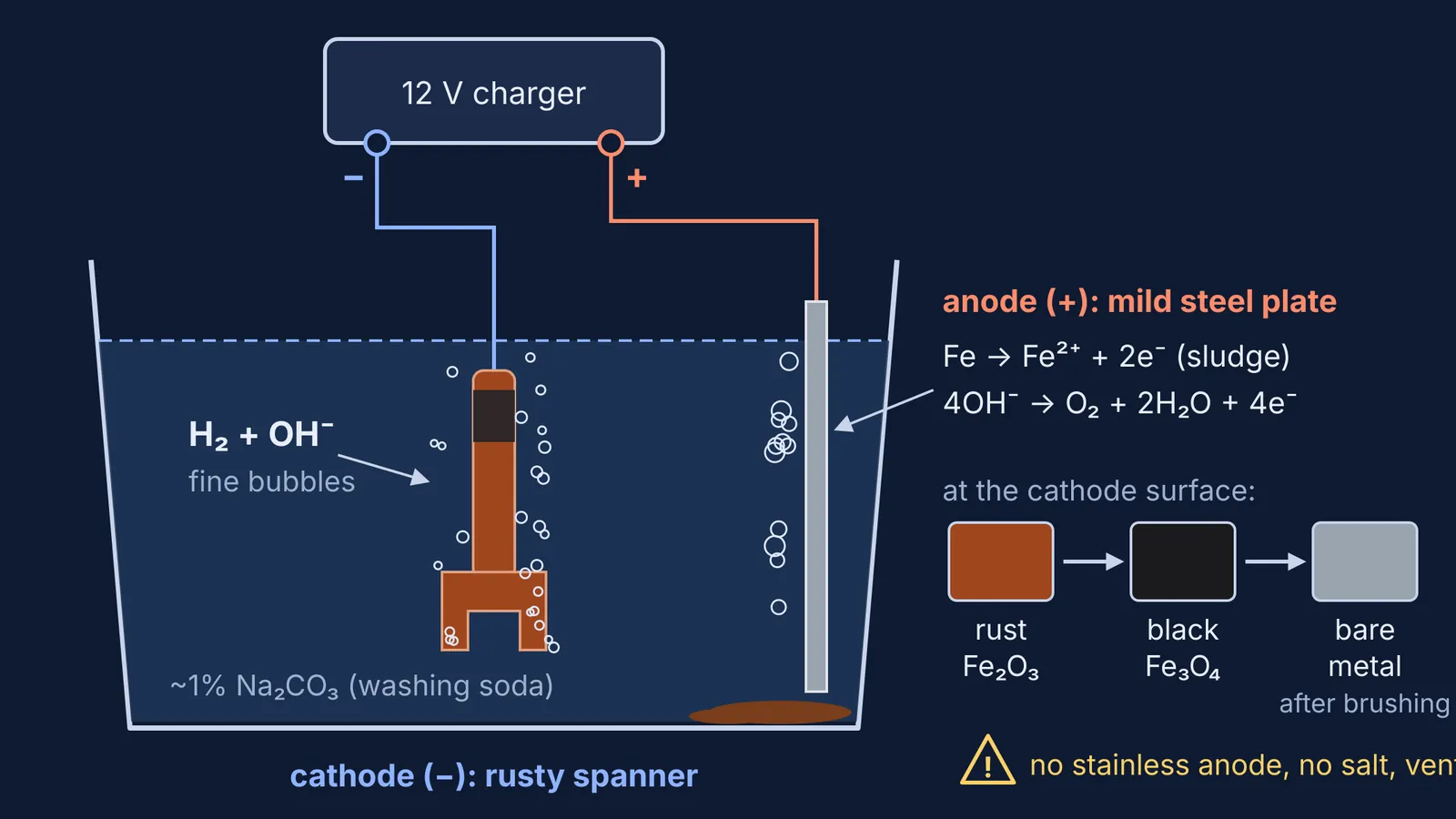
The usual set-up looks like this:
A plastic tub of dilute washing-soda solution, roughly 1% by mass (about 10 g per litre).
The rusty object hanging in the middle, connected to the negative (−) lead. It becomes the cathode.
A plate of scrap mild steel near the side, connected to the positive (+) lead. It becomes the anode. It must not touch the object.
A 12 V battery charger or bench power supply, switched on last.
Electrons flow into the rusty object, so reduction happens there. Gas bubbles form under the loose rust and push it away, and part of the red rust is reduced to a black, firmer oxide. Afterwards the loose layers brush off under a tap.
Which reactions happen at the cathode and the anode?
At the cathode (the rusty object), the main reaction is the reduction of water:
2H₂O + 2e⁻ → H₂ + 2OH⁻
This makes fine hydrogen bubbles and extra alkali next to the object. Some of the electrons go into the rust itself. Red-brown iron(III) oxide can be reduced to black magnetite, Fe₃O₄, which contains both Fe²⁺ and Fe³⁺:
3Fe₂O₃ + H₂O + 2e⁻ → 2Fe₃O₄ + 2OH⁻
Check the balance: 6 Fe on each side, 10 O on each side, 2 H on each side, and a charge of −2 on each side. Conservators who treat iron from shipwrecks describe the same thing. In Donny Hamilton's guide to electrolytic cleaning of archaeological iron, published by the Electrochemical Society, he notes that a low current can reduce enough of the iron corrosion products to magnetite to stabilise the original surface. Do not overstate this: not all rust becomes magnetite, and none of it turns back into iron.
At the anode (the steel plate), two oxidations compete:
The steel itself dissolves: Fe → Fe²⁺ + 2e⁻. The Fe²⁺ quickly forms iron hydroxides, which appear as brown sludge.
Hydroxide ions are oxidised to oxygen: 4OH⁻ → O₂ + 2H₂O + 4e⁻.
So the plate slowly corrodes away and needs scraping or replacing after a few runs.
Why is sodium not deposited, and why must salt be kept out?
This is where the preferential discharge rules do the work.
At the cathode, the candidates are Na⁺ and water. Na⁺ + e⁻ → Na has E° = −2.71 V. Water reduction in alkaline solution has E° = −0.83 V, and is even easier at the pH of washing soda. The species with the higher reduction potential is reduced first, so water wins easily and sodium stays in solution as Na⁺.
At the anode, the candidates are carbonate, hydroxide (water) and the steel. Carbon in CO₃²⁻ is already in its highest oxidation state, +4, so carbonate cannot be oxidised. That leaves iron and OH⁻, which give the sludge and the oxygen above.
Now suppose someone uses common salt instead. Chloride is oxidised at the anode:
2Cl⁻ → Cl₂ + 2e⁻
Chlorine is a toxic gas. In the alkaline tub much of it becomes hypochlorite (Cl₂ + 2OH⁻ → Cl⁻ + OCl⁻ + H₂O), but you cannot count on all of it being captured. The rule is simple: never use salt or any chloride as the electrolyte.
Washing soda is chosen because it is cheap, conducts well enough, keeps the solution alkaline (a 1% solution has a pH of roughly 11.5), and gives no toxic gas at the anode. And while current flows, the object is the cathode, so it cannot rust in the tub.
How much hydrogen does the tub make? A worked example
Suppose the charger delivers a steady 3.0 A for 2.0 hours. Take F = 96 485 C mol⁻¹ and the molar volume of a gas at 273 K and 1 bar as 22.7 L mol⁻¹.
Charge passed. Q = It = 3.0 A × (2.0 × 3600 s) = 21 600 C.
Moles of electrons. 21 600 ÷ 96 485 = 0.224 mol e⁻.
Maximum hydrogen. Two electrons make one H₂, so at most 0.224 ÷ 2 = 0.112 mol H₂.
Volume. 0.112 × 22.7 = 2.5 L at 273 K and 1 bar. At room temperature (298 K) it is about 2.8 L.
Maximum rust converted. If every electron went into the magnetite reaction instead, two electrons would convert three Fe₂O₃. That is 0.224 × 3/2 = 0.336 mol Fe₂O₃, or 0.336 × 159.7 g mol⁻¹ = 54 g of rust.
Steps 4 and 5 cannot both be true, because the electrons are shared. At several amps most of the current makes hydrogen; Hamilton notes that only at low current density do the electrons go mainly into reduction. So the real amount of rust converted is far less than 54 g. This is a current-efficiency question, and our post on why actual mass falls short of Faraday's law shows how to put a percentage on it.
The anode makes oxygen at the same time, up to 0.224 ÷ 4 = 0.056 mol (about 1.3 L at 273 K). Hydrogen and oxygen together are an explosive mixture, which leads to the safety rules.
What safety rules apply if you try this as a project?
Do this only under supervision, with a teacher or a parent who knows the set-up.
Hydrogen is flammable. Work outdoors or in a well-ventilated space, never a closed room. Keep flames and sparks away.
Avoid sparks at the clips. Attach both clips first, then switch on at the wall. Switch off at the wall before touching or removing any clip.
Correct polarity. Rusty object to negative, scrap plate to positive, and the two must never touch (that is a short circuit).
No salt, no chloride. Washing soda only, to avoid chlorine.
Mild steel anode only. Do not use a stainless-steel plate. Its chromium can be oxidised to chromate, Cr(VI), which is toxic and carcinogenic.
Protect skin and eyes. Washing soda is an irritant. Wear gloves and goggles, and dispose of the sludgy solution as your teacher directs.
Some restorers use caustic soda (NaOH), but it is corrosive. Washing soda is the safer school choice.
Does electrolysis restore metal lost to rust?
No. It removes and converts rust, but pits stay as pits. After cleaning, dry the object at once and oil or paint it, because bare steel rusts again in damp air, as explained in corrosion as electrochemistry.
To practise the Faraday and gas-volume steps on other set-ups, the Fermi Problem Library has a step-by-step solver that explains the reasoning at each stage.
Quick checklist
Rusty object is the cathode (−); scrap mild steel is the anode (+).
Cathode: 2H₂O + 2e⁻ → H₂ + 2OH⁻, with some Fe₂O₃ reduced to black Fe₃O₄.
Anode: the steel corrodes and O₂ forms; Na⁺ and CO₃²⁻ are untouched.
No chloride (chlorine), no stainless anode (chromate).
3.0 A for 2.0 h passes 0.224 mol e⁻: at most 2.5 L of H₂ at 273 K and 1 bar.
Ventilate, no sparks, clips on before power on, adult supervision.


