

On this page
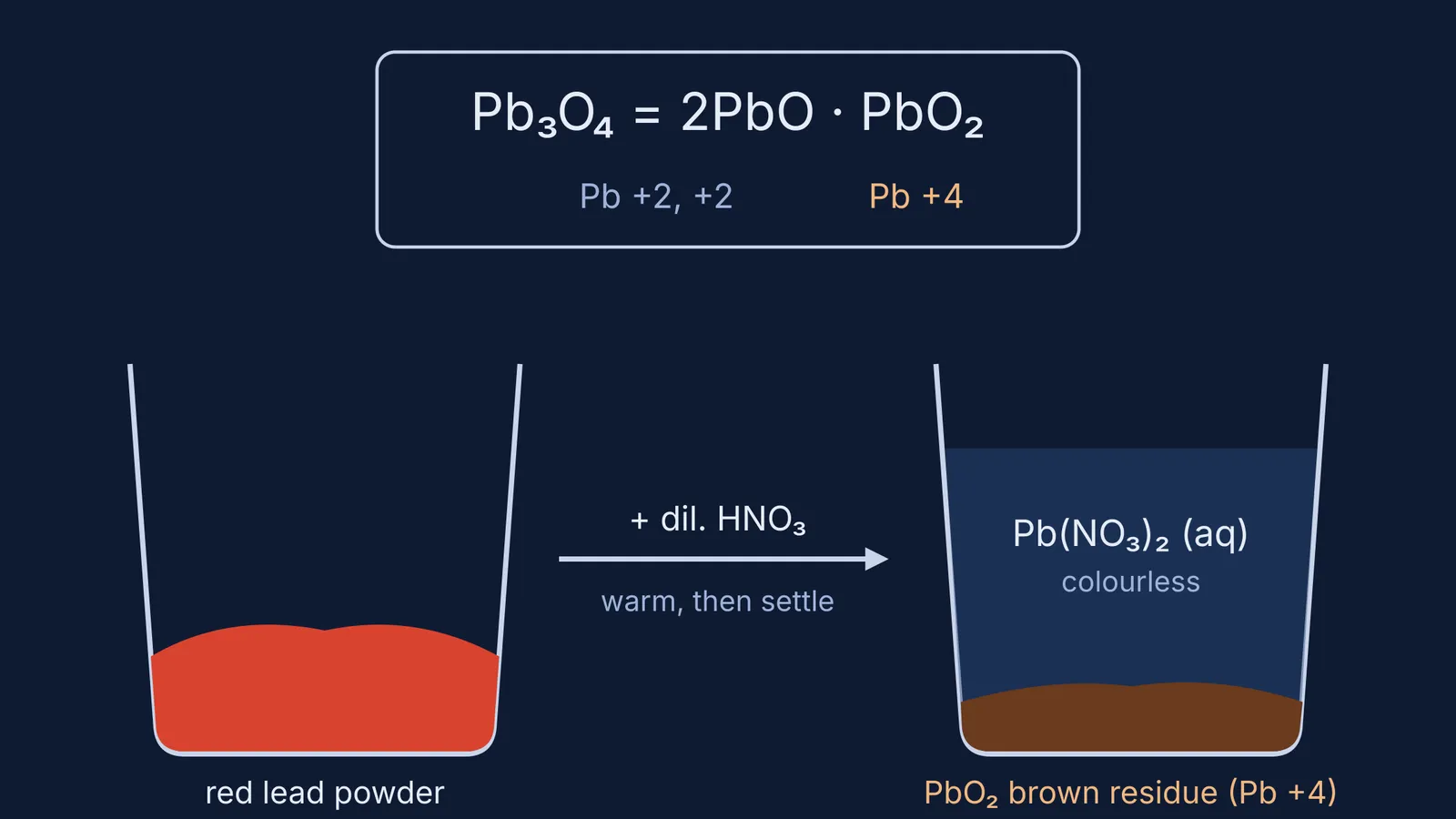
Red lead, Pb₃O₄, is the bright red-orange powder once used in primer paints for iron. Its formula suggests lead in an odd oxidation state of +8/3. That number is only an average. Red lead actually contains two lead(II) ions and one lead(IV) ion per formula unit, so it is properly written 2PbO·PbO₂. You can prove this in a test tube: warm it with dilute nitric acid and it splits into a colourless solution of Pb(NO₃)₂ and a brown solid, PbO₂.
Why is the oxidation state of lead in Pb₃O₄ not really +8/3?
Set the oxidation state of lead as x. Then 3x + 4(−2) = 0, so x = +8/3, or about +2.67. No single atom can carry a fractional charge like that. A fractional answer is a signal that the compound contains the same element in two different states, and you are looking at the average.
For Pb₃O₄ the split is two Pb(II) and one Pb(IV): (2 × 2 + 1 × 4)/3 = 8/3. The same logic gives Fe₃O₄ as FeO·Fe₂O₃, which is worked through in how to find oxidation numbers from structure. The difference with lead is the ratio. Iron has one +2 and two +3 ions, while lead has two +2 and one +4.
A more exact way to write red lead is Pb₂[PbO₄], lead(II) orthoplumbate. In the crystal, each Pb(IV) sits in an octahedron of oxygen atoms, and these octahedra share edges to form chains. The Pb(II) ions sit between the chains in a different, lopsided environment. The two kinds of lead are different sites in one compound. Red lead is not a physical mixture of PbO and PbO₂ powders.
Why does lead show both +2 and +4 here?
Lead is at the bottom of group 14. Its 6s² electrons are held tightly and are reluctant to take part in bonding, so +2 is its more stable state. This is the inert pair effect, which makes Pb(IV) a strong oxidising agent. Pb(IV) still exists in oxides such as PbO₂, but it is always ready to gain two electrons and drop to Pb(II).
That explains how the two parts of red lead behave:
The PbO part is a basic oxide of a stable ion. It dissolves in acids as ordinary Pb²⁺ salts.
The PbO₂ part is not basic enough to dissolve in dilute nitric acid. It is also a strong oxidiser, so it reacts with any acid whose anion can be oxidised.
What happens when red lead is treated with dilute nitric acid?
The basic PbO part dissolves and the PbO₂ part is left behind:
Pb₃O₄ + 4HNO₃ → 2Pb(NO₃)₂ + PbO₂ + 2H₂O
Check the balance. Pb: 3 = 2 + 1. N: 4 = 4. H: 4 = 4. O: 4 + 12 = 16 on the left, and 12 + 2 + 2 = 16 on the right.
This is the proof. If all three lead atoms were alike, they would all dissolve the same way. Instead, exactly two thirds of the lead goes into solution as Pb²⁺, and one third stays as a dark brown solid. That solid is PbO₂, with lead in +4.
Why does nitric acid leave PbO₂ alone? Nitrogen in HNO₃ is already at +5, its highest state, so PbO₂ has nothing to oxidise. There is also no stable lead(IV) nitrate to form. You can confirm the residue is PbO₂ by its oxidising power. Filter it, wash it, and use it in the lead dioxide test that turns Mn²⁺ purple.
How does red lead react with concentrated HCl?
Here the Pb(IV) part has something to oxidise: chloride. Chlorine gas is given off.
Pb₃O₄ + 8HCl → 3PbCl₂ + Cl₂ + 4H₂O
Balance it by counting electrons, which is quicker than trial and error:
Find what changes. One Pb goes from +4 to +2 and gains 2e⁻. The other two Pb stay at +2. Cl goes from −1 in HCl to 0 in Cl₂.
Match electrons. 2e⁻ gained by one Pb(IV) must equal 2e⁻ lost, so 2Cl⁻ become one Cl₂.
Count lead. 3 Pb on the left gives 3PbCl₂ on the right. That needs 6 Cl, plus 2 Cl in Cl₂, so 8HCl.
Finish with O and H. 4 O from Pb₃O₄ go into 4H₂O, which uses 8 H. That matches the 8 H in 8HCl.
Final check. Pb: 3 = 3. O: 4 = 4. H: 8 = 8. Cl: 8 = 6 + 2.
Only one of the three lead atoms does any oxidising, so one Pb₃O₄ gives only one Cl₂. With hot concentrated sulfuric acid, the sulfate cannot be oxidised, so the Pb(IV) releases oxygen instead: 2PbO₂ + 2H₂SO₄ → 2PbSO₄ + O₂ + 2H₂O.
Worked example: how much PbO₂ is left from 6.856 g of red lead?
Question. 6.856 g of Pb₃O₄ is warmed with excess dilute HNO₃. What mass of brown residue is left? What mass of Pb(NO₃)₂ is in the filtrate? Take Pb = 207.2, N = 14.01, O = 16.00.
Molar mass of Pb₃O₄. 3 × 207.2 + 4 × 16.00 = 685.6 g mol⁻¹.
Moles taken. 6.856 / 685.6 = 0.0100 mol.
Moles of products. From the equation, 1 mol Pb₃O₄ gives 1 mol PbO₂ and 2 mol Pb(NO₃)₂. So you get 0.0100 mol PbO₂ and 0.0200 mol Pb(NO₃)₂.
Mass of residue. M(PbO₂) = 207.2 + 32.00 = 239.2 g mol⁻¹, so 0.0100 × 239.2 = 2.392 g.
Mass in solution. M(Pb(NO₃)₂) = 207.2 + 2 × (14.01 + 48.00) = 331.2 g mol⁻¹, so 0.0200 × 331.2 = 6.624 g.
Answer. 2.392 g of PbO₂ is left, about 34.9% of the original mass. The filtrate holds 6.624 g of Pb(NO₃)₂.
Follow-up. The same 0.0100 mol of Pb₃O₄ with excess concentrated HCl gives 0.0100 mol Cl₂, about 0.224 L at STP (using 22.4 L mol⁻¹). It does not give 0.0300 mol, because only the Pb(IV) is an oxidiser.
Stoichiometry questions built on mixed oxides are a good place to check each step. The Fermi Problem Library has a step-by-step solver that explains the reasoning behind each line.
How is red lead made, and where does it show up in exams?
Red lead is made by heating PbO (litharge) in air at about 450–500 °C: 6PbO + O₂ → 2Pb₃O₄. On stronger heating it loses oxygen again and goes back to PbO. Questions usually test one of these points:
the formula 2PbO·PbO₂ and the 2 : 1 ratio of Pb(II) to Pb(IV)
the HNO₃ reaction and the identity of the brown residue
the HCl reaction giving Cl₂, and its balancing
the dioxide versus peroxide distinction
Quick checklist
Average oxidation state of Pb in Pb₃O₄ is +8/3; actual states are +2, +2 and +4.
Write it as 2PbO·PbO₂, or Pb₂[PbO₄].
Dilute HNO₃: Pb₃O₄ + 4HNO₃ → 2Pb(NO₃)₂ + PbO₂ + 2H₂O. Two thirds of the lead dissolves; brown PbO₂ stays.
Conc. HCl: Pb₃O₄ + 8HCl → 3PbCl₂ + Cl₂ + 4H₂O. One Cl₂ per formula unit.
PbO₂ is a dioxide, not a peroxide: no H₂O₂ with acid.
1 mol Pb₃O₄ (685.6 g) leaves 1 mol PbO₂ (239.2 g).


