

On this page
You have a flesh-coloured precipitate in Group IV and a hunch that it is manganese. The lead dioxide test settles it with a short boil, a short wait and a purple liquid. Here is how to run it, write the equation and avoid failures.
What is the confirmatory test for manganese ion?
In the NCERT Class 11 chemistry laboratory manual, manganese appears in Group IV as a flesh-coloured sulphide. The manual dissolves it in dilute HCl by boiling, adds excess sodium hydroxide, and looks for a white precipitate of Mn(OH)₂ that turns brown on keeping, as air oxidises it to hydrated manganese dioxide.
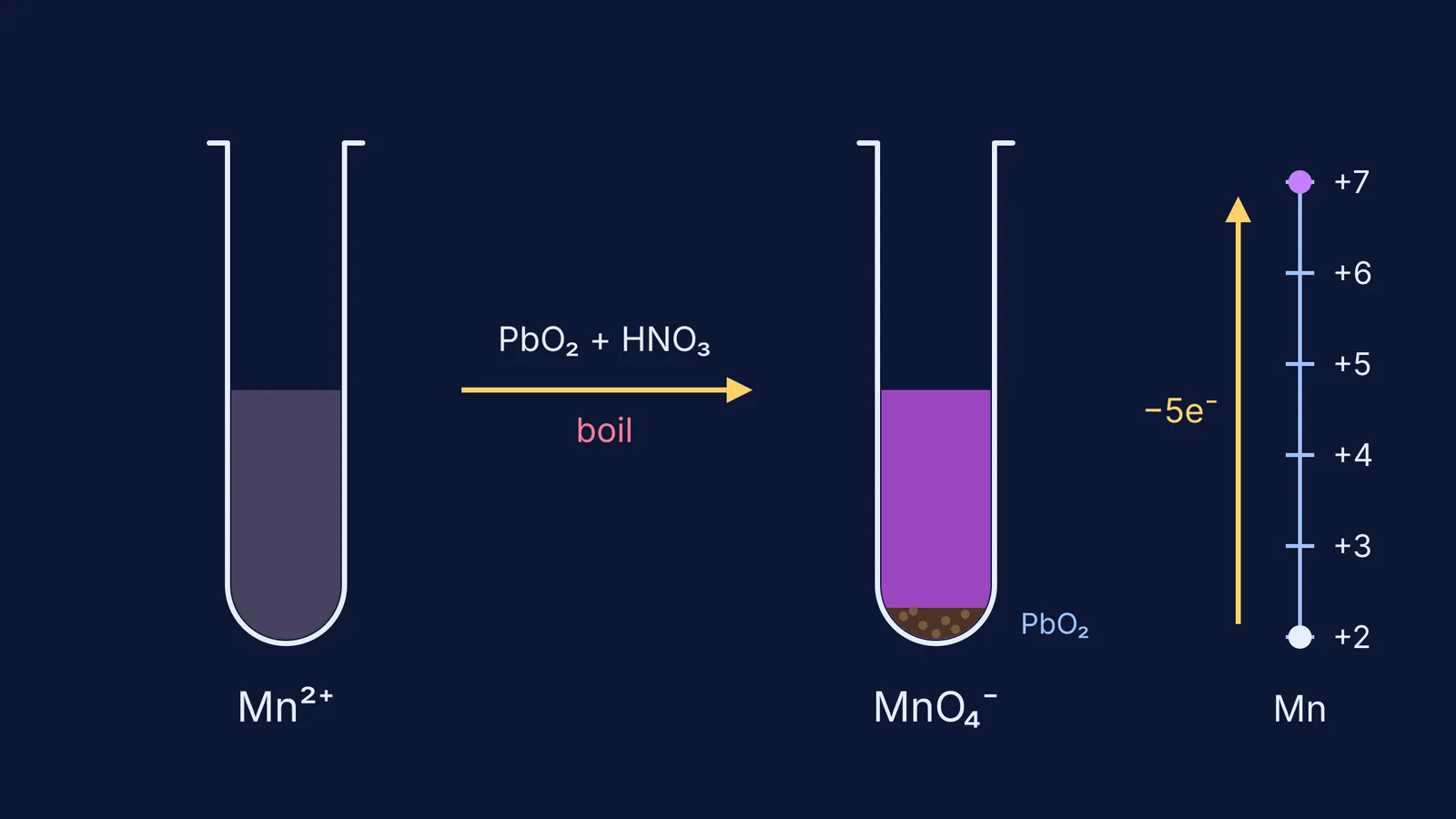
That is a good hint; the lead dioxide test adds a colour that is harder to mistake. Permanganate can be made by treating a solution of Mn²⁺ ions with strong oxidants such as lead dioxide, and tests for the presence of manganese exploit the vivid violet colour of permanganate produced by these reagents.
The jump is large. In permanganate, the manganese atom has a +7 oxidation state, while Mn²⁺ is pale pink and sits at +2. So you start with an almost colourless solution and end with a deep purple one.
How do you do the lead dioxide test step by step?
Do this only in a school lab, with your teacher's go-ahead, in a fume cupboard if you have one. Concentrated nitric acid is corrosive and lead compounds are toxic, so wear goggles and gloves and dispose of the residue the way your lab tells you to.
Take a few drops of solution or a pinch of precipitate in a clean test tube.
Add concentrated nitric acid, a little more than the sample.
Add a small spatula tip of lead dioxide powder.
Boil gently for a short time, keeping the mouth of the tube pointed away from everyone.
Dilute with some distilled water and stand the tube in the rack so the solid settles.
Look at the clear liquid above the solid against a white background. A pink to purple colour confirms Mn²⁺.
Why wait in step 5? Lead dioxide is a dark-brown or black solid that is insoluble in water, so while it is stirred up it hides the colour.
What is the equation for Mn²⁺ with lead dioxide?
You may be asked to write this, and balancing it with half-equations takes four lines. The permanganate half-equation in acid is 8H⁺ + MnO₄⁻ + 5e⁻ → Mn²⁺ + 4H₂O; our test runs it backwards.
Oxidation: Mn²⁺ + 4H₂O → MnO₄⁻ + 8H⁺ + 5e⁻
Reduction: PbO₂ + 4H⁺ + 2e⁻ → Pb²⁺ + 2H₂O
Multiply the first by 2 and the second by 5, so 10 electrons are lost and 10 gained.
Add and cancel the water and H⁺ on both sides: 2Mn²⁺ + 5PbO₂ + 4H⁺ → 2MnO₄⁻ + 5Pb²⁺ + 2H₂O
Check the charge: 4+ and 4+ on the left make 8+; 2− and 10+ on the right also make 8+. If your paper wants a molecular equation, the lead dioxide entry gives 2MnSO₄ + 5PbO₂ + 6HNO₃ → 2HMnO₄ + 2PbSO₄ + 3Pb(NO₃)₂ + 2H₂O, with the same 2 : 5 ratio of manganese to lead.
Why does the manganese test sometimes fail?
Most failures come from one of three slips.
Chloride in the tube. Permanganate reacts with concentrated hydrochloric acid to give chlorine and manganese(II), so the purple can disappear as fast as it forms. That is why the test uses nitric acid. If your precipitate was dissolved in HCl, ask your teacher about using a fresh portion.
Too much manganese. A large sample can give a brown precipitate instead of a clear purple. In a related steel-analysis method, where manganese is oxidised to permanganic acid with persulphate, a Bureau of Standards paper by H. A. Bright and C. P. Larrabee cites the chemist Mathevet's observation that manganese dioxide precipitates in nitric acid solution when the manganese exceeds 8 to 10 mg. Keep your sample tiny.
Looking too soon. The dark solid masks the colour until it settles, so wait for the clear layer.
How do you remember the manganese tests for your practical?
Learn them as one chain: flesh-coloured sulphide, then white hydroxide that browns in air, then purple with lead dioxide. For where this sits in the whole scheme, read our systematic approach to salt analysis in the chemistry practical. To see why the same element gives so many colours, try colours of manganese compounds: permanganate, manganate and MnO₂, and for the reason the final colour is purple at all, see why KMnO₄ is purple when manganese has no d electrons.
If balancing redox equations is where you drop marks, the Fermi Problem Library has worked problems with a step-by-step solver that explains the reasoning rather than printing an answer. If oxidation states themselves feel shaky, the Fermi Concept Library gives each chemistry concept its own lesson and its place in the map.
Next time the purple layer appears, write the four-line equation beside it in your record book.


