

On this page
Eight original ray optics questions for the JEE Main numerical section, easy to hard. Use the Cartesian sign convention.
What does the JEE Main numerical section look like?
The Information Bulletin for JEE (Main) 2027 from NTA says each subject in Paper 1 has Section A (MCQs) and Section B, with numerical-value answers. Physics has 5 Section B questions, marked +4 for a correct answer and −1 for an incorrect one. You type an integer on an on-screen keypad, rounded off to the nearest integer.
All eight sit inside Unit 16, Optics, of the Syllabus for JEE (Main) 2027 and NCERT Class 12 Chapter 9, Ray Optics and Optical Instruments. For a study plan, see how to prepare ray optics for JEE Main.
Easy: can you get these right first time?
Q1 (easy). A concave mirror throws a real image of a candle flame, three times its height, onto a wall 2.4 m from the mirror. What is the magnitude of its focal length, in cm?
Answer: 60. A real image is inverted: m = −v/u = −3, so with v = −240 cm, u = −80 cm. Then 1/f = −1/240 − 1/80 = −1/60, so f = −60 cm.
Trap: 120, from the lens formula 1/v − 1/u.
Q2 (easy). A thin biconvex lens is made of glass with n = 1.5. Its faces have radii of curvature 12 cm and 60 cm. What is its power, in dioptres?
Answer: 5. With R₁ = +12 cm and R₂ = −60 cm, 1/f = 0.5 × (1/12 + 1/60) = 1/20 per cm, so f = 0.20 m and P = +5 D.
Trap: 3, from taking both radii as positive (0.5 × (1/12 − 1/60) gives 3.3 D).
Q3 (easy). A concave lens of focal length 24 cm forms an image one-third the size of an object. How far is the object from the lens, in cm?
Answer: 48. The image is erect: m = v/u = +1/3, so v = u/3. Then 3/u − 1/u = 2/u = −1/24, giving u = −48 cm.
Trap: 96, from the mirror formula.
Medium: where do the signs slip?
Q4 (medium). A goldfish swims in a thin-walled spherical bowl of radius 20 cm, filled with water (n = 4/3). Seen along a diameter from outside, it is 16 cm from the near wall. How far behind the wall does it appear, in cm? Ignore the glass.
Answer: 15. Water to air: n₁ = 4/3, n₂ = 1, u = −16 cm, and the centre lies on the incoming side, R = −20 cm. From n₂/v − n₁/u = (n₂ − n₁)/R: 1/v + 1/12 = 1/60, so 1/v = −1/15 and v = −15 cm.
Trap: 12, the flat-surface rule 16 ÷ (4/3).
Q5 (medium). An optical fibre in air has a core of refractive index 1.60. It must carry light entering its end face at up to 30° to the axis. What is the largest allowed cladding index n₂? Enter 100 n₂, to the nearest integer.
Answer: 152. A ray at angle θ outside bends to angle r inside, with sin θ = 1.60 sin r, and meets the side wall at 90° − r. Total reflection needs 1.60 cos r ≥ n₂, so n₂ ≤ √(1.60² − sin²30°) = √2.31 ≈ 1.520, and 100 n₂ ≈ 152.0.
Trap: 139, from 1.60 × cos 30°, which forgets the bending at the end face.
Q6 (medium). An object stands 24 cm in front of a convex lens of focal length 16 cm. A coaxial convex mirror of radius of curvature 18 cm behind the lens makes the final image fall exactly on the object. How far apart are the lens and the mirror, in cm?
Answer: 30. The lens alone images the object 48 cm behind it (1/v = 1/16 − 1/24 = 1/48). Light retraces its path only if it heads for the mirror's centre of curvature, so that centre sits at 48 cm and the mirror is 48 − 18 = 30 cm from the lens.
Trap: 39, from placing the lens image at the mirror's focus (48 − 9).
Hard: can you handle two surfaces or two elements?
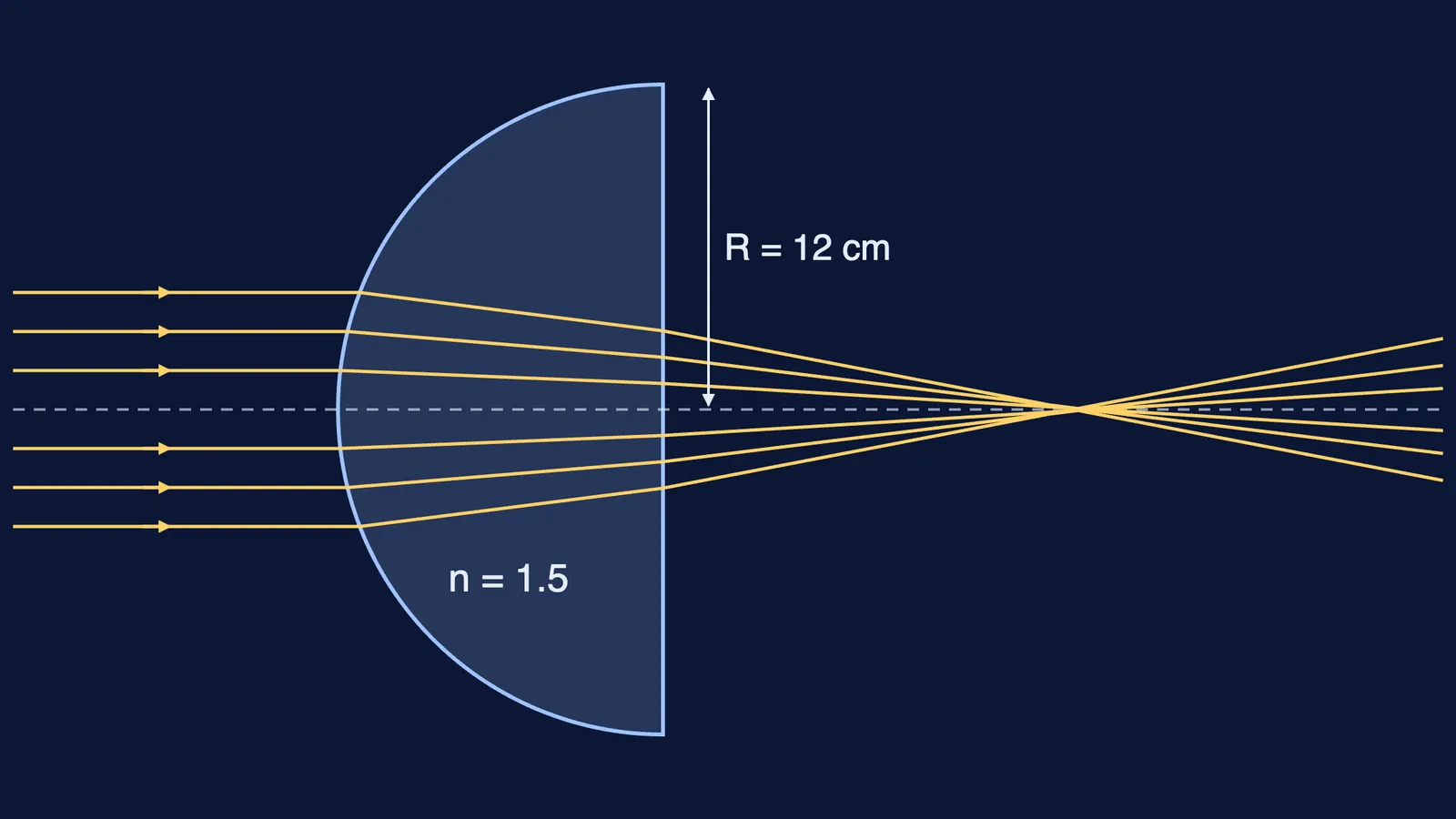
Q7 (hard). A glass hemisphere (n = 1.5) has a radius of 12 cm. A parallel beam along its axis falls on the curved face. How far beyond the flat face does the beam come to a focus, in cm?
Answer: 16. Curved face (R = +12 cm): 1.5/v = 0.5/12, so v = 36 cm. That point is 24 cm beyond the flat face, a virtual object, u = +24 cm. Flat face: 1/v − 1.5/24 = 0, so v = 24/1.5 = 16 cm.
Trap: 24, the thin-lens f = R/(n − 1) for a 12 cm thick block.
Q8 (hard). A parallel beam falls on a convex lens of focal length 30 cm. A concave lens of focal length 12 cm stands 20 cm behind it, on the same axis. How far behind the concave lens does the beam come to a focus, in cm?
Answer: 60. The convex lens alone would focus the beam 30 cm behind it, 10 cm beyond the concave lens. The light is still converging there, so this is a virtual object: u = +10 cm, f = −12 cm. Then 1/v = −1/12 + 1/10 = 1/60, so v = +60 cm, a real focus.
Trap: 5, from taking that point as a real object (u = −10 cm), giving v ≈ −5.5 cm.
For multiple-choice practice, try our ray optics JEE Main practice questions with full solutions.
How do you get the number right in ray optics?
Put f in metres before finding power in dioptres (Q2).
Mirror 1/v + 1/u, lens 1/v − 1/u: choose first (Q1, Q3).
For a curved surface, use n₂/v − n₁/u = (n₂ − n₁)/R, R signed by where the centre lies (Q4, Q7).
Trace multi-element systems one element at a time, marking each image real or virtual (Q6, Q8).
Keep unrounded values and round only the final answer.
Can't find the flipped sign? The Fermi Problem Library has worked problems with a step-by-step solver that explains the reasoning rather than printing an answer.


