

On this page
A railgun has no explosive charge: just two parallel metal rails, a conducting slider (the armature) bridging them, and a current pulse of about a million amperes. The current runs out along one rail, across the armature and back along the other. The rails' own magnetic field then pushes the armature, and the projectile in front of it, down the barrel. Here is how big that push is, why the infinite-wire formula gives twice the right answer, and what it means for the projectile and the rails.
How does a railgun push the armature?
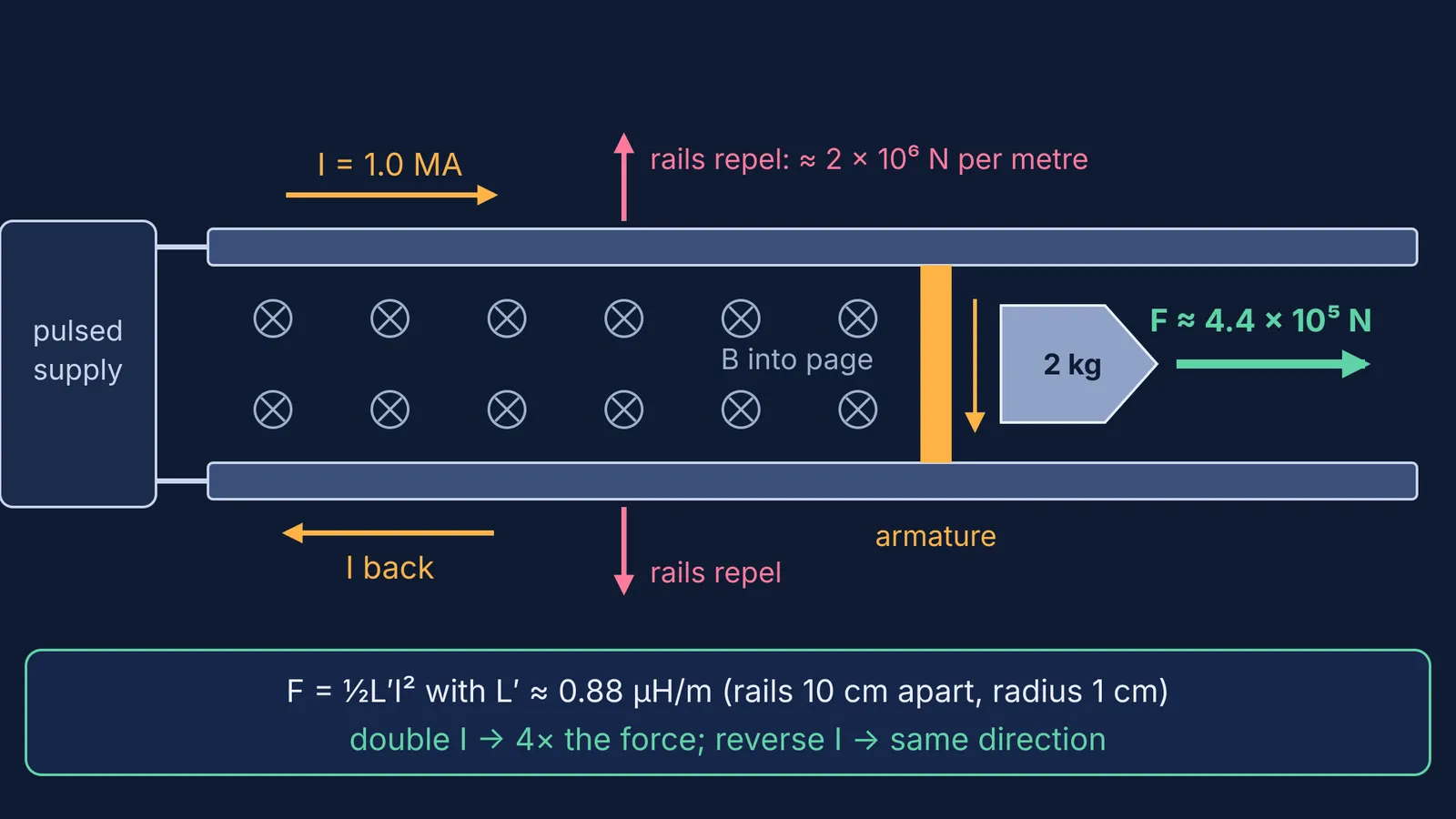
Look from above, supply on the left. Current goes right along the top rail, down through the armature and left along the bottom rail. By the right-hand rule, both rails make a field into the page between them, so the fields add.
The armature carries I across this field, so it feels F = IL × B: current down the page crossed with a field into the page gives a force to the right, away from the supply. Two things follow.
The force goes as I². The field is proportional to I, and the current in the armature is I, so F ∝ I². Reverse the current and both the field and the armature current reverse, so the force still points away from the supply. In principle the direction of the push does not depend on the direction of the current.
The rails push each other apart. They carry opposite currents, and antiparallel currents repel. That is the force between two long wires, covered in force between parallel currents and the definition of the ampere.
Why is the field at the armature μ₀I/4πx, not μ₀I/2πx?
B = μ₀I/2πx is for an infinitely long wire. A rail carries current only up to the armature, so at the armature each rail is a semi-infinite wire seen from opposite its end.
For a straight wire segment, the Biot–Savart law gives B = (μ₀I/4πx)(sin α + sin β), where α and β are the angles to the two ends measured from the perpendicular. For a point opposite the end of a semi-infinite wire, one angle is 0° and the other is 90°, so B = μ₀I/4πx. That is half the infinite-wire value.
Now add both rails. Let the rail axes be a distance d apart, each rail have radius r, and x be the distance from one rail's axis along the armature. The field at x is μ₀I/4πx + μ₀I/4π(d − x). Integrate I B dx across the armature from x = r to x = d − r:
F = (μ₀I²/2π) ln[(d − r)/r]
This treats each rail as a thin wire along its axis, so it is an estimate for thick real rails, but it gets the size and scaling right.
Worked example: how hard does a million amperes push?
Take rails 10 cm apart centre to centre, rail radius 1 cm, and I = 1.0 × 10⁶ A. Use μ₀/4π = 10⁻⁷ T m/A.
Prefactor. μ₀I²/2π = 2 × 10⁻⁷ × (10⁶)² = 2 × 10⁵ N. Units check: T m/A × A² = (N/A m) × m × A = N.
Log term. (d − r)/r = 9 cm / 1 cm = 9, and ln 9 = 2.197.
Force. F = 2 × 10⁵ × 2.197 = 4.39 × 10⁵ N, about 4.4 × 10⁵ N., the weight of about 45 tonnes.
Sanity check. If you had used the infinite-wire field you would get 8.8 × 10⁵ N, exactly double. That is the most common wrong answer.
What is the inductance gradient, and why is F = ½L′I²?
As the armature slides forward by dx, the current loop gets longer, so its self-inductance grows by L′ dx, where L′ is the inductance per metre of rail. At constant current the magnetic force does work F dx = ½I² dL, which gives
F = ½L′I²
For two thin parallel rails, L′ = (μ₀/π) ln[(d − r)/r]. With our numbers, L′ = 4 × 10⁻⁷ × 2.197 = 8.8 × 10⁻⁷ H/m, about 0.88 µH per metre. Then F = ½ × 8.79 × 10⁻⁷ × 10¹² = 4.4 × 10⁵ N, the same answer.
How fast does the projectile leave the rails?
Take projectile plus armature as 2 kg on 6 m rails, with the current held at 1.0 MA and no friction or air drag.
Acceleration. a = F/m = 4.39 × 10⁵ / 2 = 2.2 × 10⁵ m/s². Divide by g = 9.81 m/s²: about 22,000 g.
Work done. W = F × L = 4.39 × 10⁵ × 6 = 2.6 × 10⁶ J, or 2.6 MJ. All of it becomes kinetic energy in this ideal model.
Exit speed. v = √(2FL/m) = √(2 × 4.39 × 10⁵ × 6 / 2) = 1620 m/s. With the speed of sound at about 343 m/s in air at 20 °C, that is about Mach 4.7.
Time on the rails. Starting from rest at constant acceleration, t = 2L/v = 12/1620 = 7.4 ms.
The catapults in how jets take off and land on an aircraft carrier do the opposite: a heavy aircraft, a long stroke and a moderate force.
For a real-world scale, a US Navy test railgun at the Naval Surface Warfare Center in Dahlgren, Virginia fired a 33 MJ shot on 10 December 2010, listed as a world record by Guinness World Records. That is about 12 times the 2.6 MJ in our example. The Navy cut railgun research from its budget proposal in 2021, and Defense News reported that the prototype's barrel had to be replaced after about a dozen or two dozen shots, against roughly 600 firings for a conventional gun barrel.
Why do the rails try to fly apart?
Behind the armature, the two rails are long antiparallel currents a distance d apart, so each metre of rail is pushed outward by about μ₀I²/2πd. With I = 10⁶ A and d = 0.10 m this is 2 × 10⁵ × 10 = 2 × 10⁶ N per metre, the weight of about 200 tonnes on every metre of barrel. That is why railguns are built with massive clamps or a stiff containment structure around the rails.
The bigger engineering problem is the sliding contact: a conductor moving at over a kilometre per second while carrying a million amperes arcs, melts and wears the rails. The current comes as a short pulse from large capacitor banks or pulsed generators. Compare how maglev trains float, where gentler magnetic forces act over a long track with no sliding electrical contact.
If you want to practise the finite-wire field and force integrals behind this, the Fermi Problem Library has a step-by-step solver that explains the reasoning at each stage.
Quick checklist
At the armature each rail is semi-infinite: B = μ₀I/4πx, half the infinite-wire value.
F = (μ₀I²/2π) ln[(d − r)/r] = ½L′I², with L′ ≈ 0.88 µH/m for our rails.
1.0 MA gives about 4.4 × 10⁵ N; 2 kg over 6 m leaves at about 1620 m/s after 7.4 ms.
F ∝ I²: double the current, four times the force; reverse it, same direction.
The rails repel each other with about 2 × 10⁶ N per metre and need heavy clamping.


