

On this page
Radium-223 is an alpha emitter. Almost every nucleus of it that decays throws out a helium-4 nucleus and becomes radon-219. But about once in a billion decays it does something stranger: it throws out an entire carbon-14 nucleus, six protons and eight neutrons in one piece, and becomes lead-209. This is cluster decay. It is a good exercise in Q values, and it shows clearly that a bigger energy release does not mean a faster decay.
What is cluster decay?
Cluster decay is spontaneous emission of a nucleus heavier than an alpha particle but much lighter than a fission fragment. The two routes for ²²³Ra are:
Alpha decay: ²²³₈₈Ra → ²¹⁹₈₆Rn + ⁴₂He
Cluster decay: ²²³₈₈Ra → ²⁰⁹₈₂Pb + ¹⁴₆C
Check that both balance. Mass numbers: 219 + 4 = 223 and 209 + 14 = 223. Charges: 86 + 2 = 88 and 82 + 6 = 88. The daughter ²⁰⁹Pb has 82 protons, a magic number. Lead daughters near ²⁰⁸Pb are very tightly bound, which is what makes the Q value large.
The first observation was reported by H. J. Rose and G. A. Jones of Oxford in A new kind of natural radioactivity (Nature, 1984). They measured a ¹⁴C to alpha ratio of (8.5 ± 2.5) × 10⁻¹⁰.
How do you calculate the Q value for ¹⁴C emission?
Use atomic masses on both sides. Radium has 88 electrons; lead has 82 and carbon has 6, so the electron masses cancel (88 = 82 + 6). The masses below are from the AME2020 atomic mass evaluation, rounded to six decimal places:
²²³Ra: 223.018501 u
²⁰⁹Pb: 208.981090 u
¹⁴C: 14.003242 u
²¹⁹Rn: 219.009479 u
⁴He: 4.002603 u
Take 1 u = 931.494 MeV/c².
Mass defect for ¹⁴C emission. Δm = 223.018501 − 208.981090 − 14.003242 = 0.034169 u.
Q for ¹⁴C emission. Q = 0.034169 × 931.494 = 31.83 MeV.
Mass defect for alpha emission. Δm = 223.018501 − 219.009479 − 4.002603 = 0.006419 u.
Q for alpha emission. Q = 0.006419 × 931.494 = 5.98 MeV.
Both are positive, so both decays are energetically allowed. The ¹⁴C route releases more than five times as much energy.
If you use an older mass table, your answer may differ in the last digit. That is a table difference, not an error in method.
How is the energy shared between the fragments?
The parent is at rest, so the two fragments fly apart with equal and opposite momenta. With p the same for both, kinetic energy p²/2m is shared in inverse proportion to mass. The lighter fragment carries the fraction M/(M + m), where M is the heavy daughter's mass.
¹⁴C: 31.83 × 209/223 = 29.8 MeV. The ²⁰⁹Pb recoils with the remaining 2.0 MeV.
Alpha: 5.98 × 219/223 = 5.87 MeV. The ²¹⁹Rn recoils with about 0.11 MeV.
The alpha value is for a decay straight to the ground state of ²¹⁹Rn. In practice, most ²²³Ra alphas leave radon in an excited state, so the most common measured alpha energy is 5.72 MeV (NNDC NuDat data for ²²³Ra). The method of sharing is worked for alpha decay in recoil of the daughter nucleus in alpha decay.
Why does alpha decay win by a billion to one?
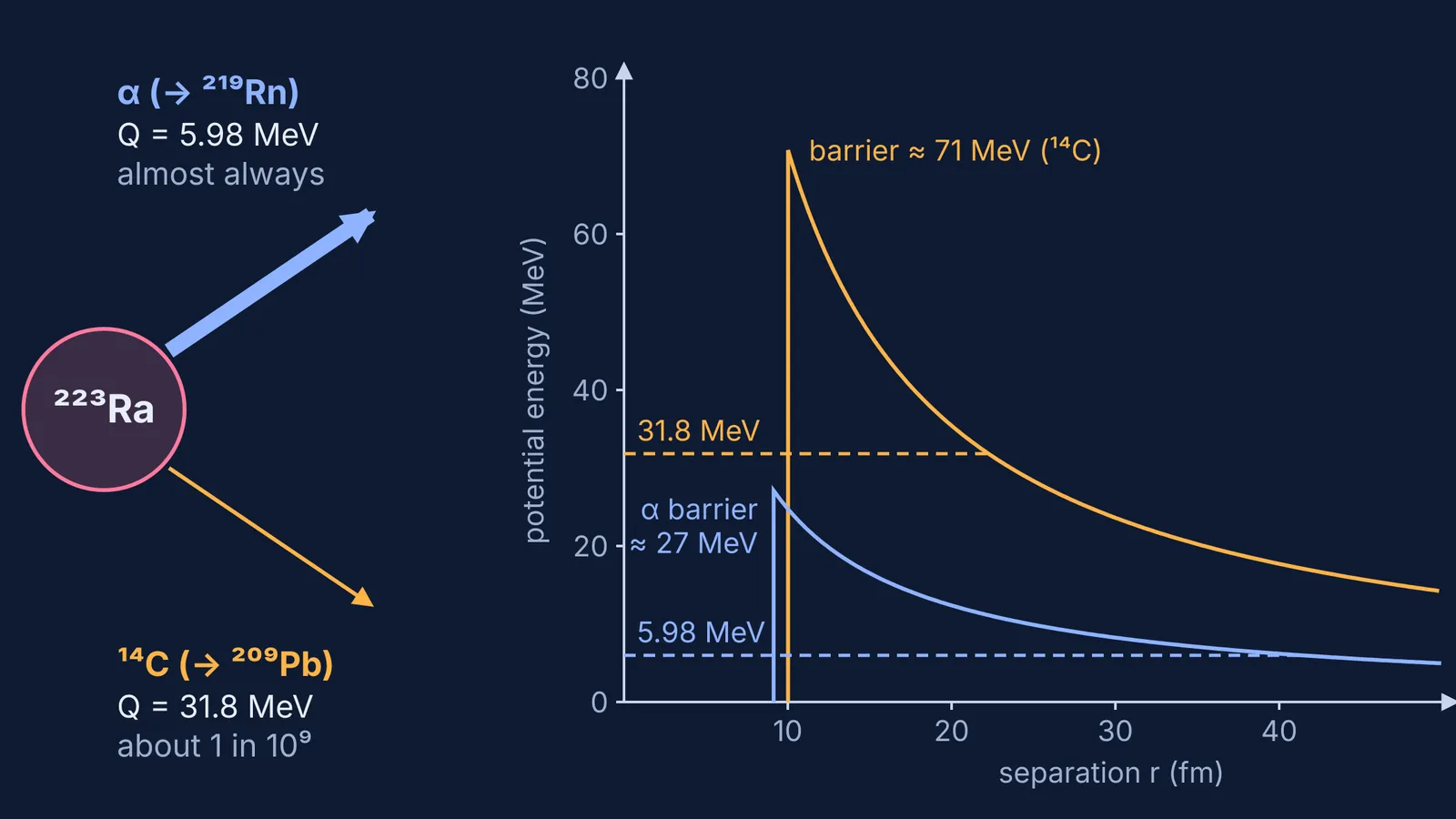
If Q decided the rate, ¹⁴C emission would dominate. It does not. The evaluated nuclear data give ¹⁴C emission a branch of 8.9 × 10⁻¹⁰ of all decays, about 1 in 1.1 billion, with a half-life of 11.43 days for ²²³Ra (NNDC NuDat). The reason is the Coulomb barrier.
Both fragments must get out past the electric repulsion of the daughter nucleus. A rough barrier height is V = kZ₁Z₂e²/R, with ke² = 1.44 MeV fm and the touching distance R = 1.2(A₁^(1/3) + A₂^(1/3)) fm.
¹⁴C against ²⁰⁹Pb: R = 1.2 × (2.41 + 5.93) = 10.0 fm, so V ≈ 1.44 × 6 × 82 / 10.0 ≈ 71 MeV.
Alpha against ²¹⁹Rn: R = 1.2 × (1.59 + 6.03) = 9.1 fm, so V ≈ 1.44 × 2 × 86 / 9.1 ≈ 27 MeV.
Both particles sit below their barriers and must tunnel through, the idea George Gamow used for alpha decay (see how Gamow explained alpha decay with quantum tunnelling). The ¹⁴C has to get through a barrier about 39 MeV above its energy, while the alpha is about 21 MeV below its barrier. The ¹⁴C is also 3.5 times heavier, and the tunnelling probability falls exponentially with √(mass × height) times width.
The barrier is not the whole story. A rough tunnelling estimate accounts for a large factor but not the full billion. Models of cluster decay also include the chance that 14 nucleons happen to be grouped into a ¹⁴C cluster at the surface of the nucleus, which is far smaller than the chance of finding an alpha cluster there. The message for exams is simple: Q tells you whether a decay can happen, not how often.
How rare is it in practice?
Take a source of ²²³Ra with an activity of 1 MBq, which is 10⁶ decays per second. Carbon-14 emissions per day = 10⁶ × 8.9 × 10⁻¹⁰ × 86,400 ≈ 77. Against 8.6 × 10¹⁰ alpha decays in the same day, that is almost nothing. It is not a meaningful source of the ¹⁴C used in carbon dating, which is made in the atmosphere by cosmic rays.
Why is radium-223 used in medicine?
Radium is in group 2 with calcium, and its ions follow calcium into bone. Radium-223 dichloride is the active substance of Xofigo, made by Bayer. The US FDA's prescribing information (initial approval 2013) lists it for castration-resistant prostate cancer with symptomatic bone metastases and no known spread to other organs, and the European Medicines Agency's Xofigo page describes a similar use. The FDA label states that it mimics calcium, binds to bone mineral at sites of increased bone turnover, and that its alpha particles travel less than 100 micrometres in tissue. The physics that matters is the alpha decay: short range, high energy deposited per micrometre. The ¹⁴C branch plays no role. This is physics background only, not medical advice.
If you want to revise the Q value and binding energy ideas behind this, the Concept Library covers them one concept at a time. Q values for reactions you trigger, rather than spontaneous decays, are worked in how to calculate the Q value of a nuclear reaction.
Quick checklist
²²³Ra → ²⁰⁹Pb + ¹⁴C: Q = 31.83 MeV; ²²³Ra → ²¹⁹Rn + α: Q = 5.98 MeV.
Atomic masses work because 88 = 82 + 6 electrons.
Light fragment's share: Q × M/(M + m); ¹⁴C gets 29.8 MeV, alpha 5.87 MeV.
Branching ratio about 8.9 × 10⁻¹⁰; half-life 11.43 days.
Coulomb barriers: about 71 MeV for ¹⁴C, about 27 MeV for alpha.
A larger Q does not mean a faster decay.


