
On this page
In the summer of 1928, George Gamow, a 24-year-old physicist from Odessa working in Göttingen, solved a long-standing puzzle in radioactivity: how does an alpha particle leave a nucleus without enough energy to climb the wall holding it in? His answer was quantum tunnelling (Wikipedia: George Gamow).
What puzzle did Gamow solve?
An alpha particle is a helium-4 nucleus. Uranium-238 emits one and becomes thorium-234, with a half-life of 4.468 billion years and a decay energy (Q) of 4.270 MeV, according to the KAERI nuclide table hosted at MIT.
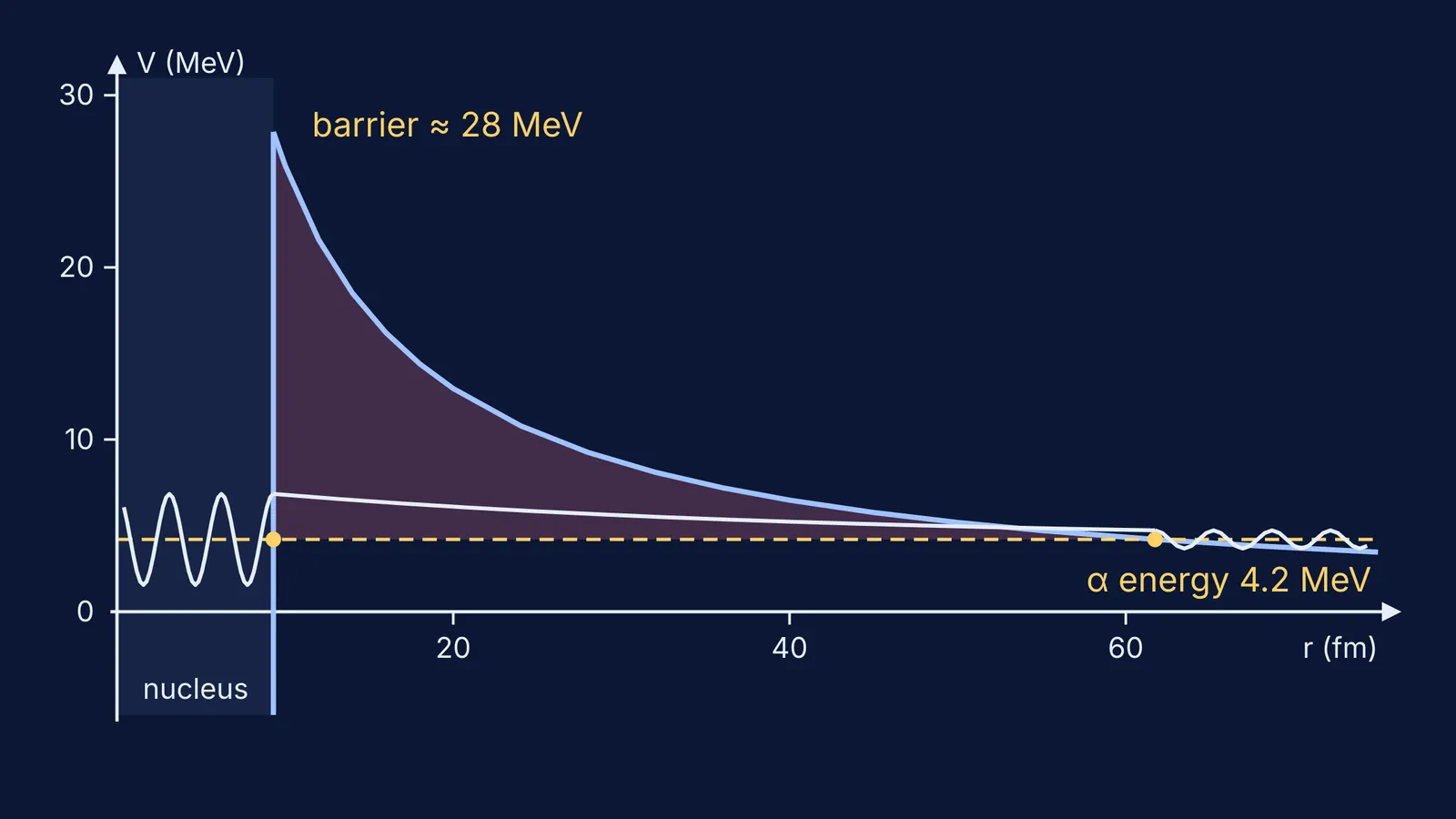
Rutherford's scattering experiments showed that the electric repulsion around a uranium nucleus is far stronger. The barrier "might be as high as 25 MeV, more than five times the kinetic energy" of the 4.2 MeV alpha particles uranium-238 emits, says EBSCO's history of Gamow's theory. Classically, an alpha with 4.2 MeV can never cross a 25 MeV wall.
A second clue: in 1911 Hans Geiger and John Mitchell Nuttall had found an experimental rule linking an emitter's half-life to its alpha energy (same EBSCO source). Nobody knew why.
How does quantum tunnelling let an alpha particle escape?
In wave mechanics a particle is described by a wave function, the idea behind Schrödinger's wave equation for atomic orbitals. Where the particle's energy is below the potential energy, the wave does not stop at the wall: inside the barrier it becomes "a decaying exponential" (HyperPhysics on alpha tunnelling). If the wall is finite, a little of the wave reaches the far side, so the particle has a small chance of being found outside.
Gamow pictured the alpha hitting the barrier from inside again and again, with a tiny chance of getting through each time. His paper, "Zur Quantentheorie des Atomkernes", appeared in Zeitschrift für Physik, volume 51 (DOI 10.1007/BF01343196). Ronald Gurney and Edward Condon reached the same idea independently in Nature on 22 September 1928 (DOI 10.1038/122439a0). Gamow's formula reproduced the Geiger-Nuttall law, and the probability of a particle tunnelling through a Coulomb barrier is now called the Gamow factor (Wikipedia on Gamow's work).
How long does an alpha particle take to tunnel out of uranium-238?
Here is a rough version of Gamow's calculation, using ħc = 197.327 MeV fm (NIST), the fine-structure constant 1/137.036 (NIST), the alpha rest energy 3727.38 MeV (NIST) and nuclear radius R = r0 A^(1/3) with r0 about 1.2 fm (HyperPhysics on nuclear size).
Alpha energy: Q = 4.270 MeV is shared with the recoiling thorium nucleus, so the alpha gets Q × 234/238 ≈ 4.20 MeV (why the energy splits this way).
Where the barrier starts: the touching distance is R = 1.2 × (234^(1/3) + 4^(1/3)) ≈ 9.3 fm.
Barrier height: e²/(4πε₀) = ħc/137.036 ≈ 1.44 MeV fm, so V = 2 × 90 × 1.44/9.3 ≈ 28 MeV, almost seven times the alpha's energy.
Barrier width: the Coulomb energy falls to 4.20 MeV at b = 259.2/4.20 ≈ 62 fm, so the wall is about 52 fm thick.
Chance per hit: the Gamow exponent, 2G = 2√(2mc²/E) × (180/137.036) × [arccos√x − √(x(1 − x))] with x = R/b, comes to about 90, so the chance is e^(−90), about 7 × 10^(−40).
Hits per second: at 4.2 MeV the alpha moves at about 0.047c, so it crosses the 2R ≈ 19 fm span and hits the wall about 8 × 10^20 times a second.
Half-life: the rate is about 8 × 10^20 × 7 × 10^(−40) ≈ 5 × 10^(−19) per second, so the half-life is ln 2 divided by that, about 4 × 10^10 years.
The measured value is 4.468 × 10^9 years (KAERI). Our crude model is about ten times too slow, yet after multiplying numbers near 10^21 and 10^(−39) it lands within one power of ten.
Why do alpha half-lives vary so much?
Because the escape chance sits in an exponent, a small energy change makes a huge difference in time. Alpha emitters' half-lives span "20 orders of magnitude, from about a tenth of a microsecond to 10 billion years", while their alpha energies only run from about 4 to 9 MeV (HyperPhysics). Polonium-212 emits an 8.78 MeV alpha and has a half-life of 0.3 microseconds, against billions of years for uranium-238.
For how half-life works in exam sums, see radioactive decay and half-life: the maths.
How should you revise alpha decay and tunnelling?
Draw the potential-energy graph from memory: a well inside, a sharp edge at R, a 1/r fall outside, and a flat line for the alpha's energy.
Mark the two turning points and shade the forbidden region between them.
Repeat steps 2 to 4 for polonium-212 (daughter lead-208, Z = 82, alpha energy 8.78 MeV). You should get a barrier near 26 MeV, matching the 26.4 MeV on HyperPhysics's alpha tunnelling page, and a width of about 18 fm, against 52 fm for uranium.
If the graph still feels abstract, the Fermi Simulation Lab has interactive simulations for ideas that are easier to see than to read, and the Fermi Problem Library has worked problems with a step-by-step solver that explains the reasoning.
Next time you see a half-life in a table, try steps 2 to 4 for that nucleus.