

On this page
When a phone plays a song, a stream of numbers has to become a voltage. One of the simplest circuits that does this is the R-2R ladder: resistors of only two values, R and 2R, and one switch per bit. Series and parallel rules plus Thevenin's theorem explain it completely. For a 4-bit ladder with a 5 V reference, the code 1011 comes out as exactly 3.4375 V.
What is an R-2R ladder?
An R-2R ladder is a digital-to-analogue converter (DAC). Picture a row of nodes joined by resistors of value R along the top. From every node a 2R resistor, a "leg", runs down to a switch. Each switch belongs to one bit of the input number: a 1 connects its leg to the reference voltage V_ref, and a 0 connects it to ground. At the far end, the least significant bit (LSB) end, one extra 2R resistor goes straight to ground. The output is taken from the other end, next to the most significant bit (MSB).
The result is
V_out = V_ref × code / 2ⁿ
where n is the number of bits and code is the input read as an ordinary number. This is the transfer function given in Texas Instruments' voltage-mode multiplying DAC reference design (TIDUAF0), which uses this same ladder.
Why does each bit count half as much as the next?
The trick is that the ladder looks the same from every rung. Start at the LSB end. The terminating 2R and the LSB's own 2R leg sit in parallel, which gives R. Add the next series R and you have 2R again. So at every node, looking back towards the LSB end, you see 2R, and that sits in parallel with the node's own 2R leg.
Two equal resistances share current equally, so each step is a halving. In Thevenin terms, every node averages the voltage coming from the left with its own leg's voltage, and hands on a source of resistance R.
This is not the self-similarity trick from the infinite ladder of resistors, where the ladder never ends. Here the ladder is finite, and the termination resistor is what makes the first rung look like all the others.
How do you work out the output for 1011?
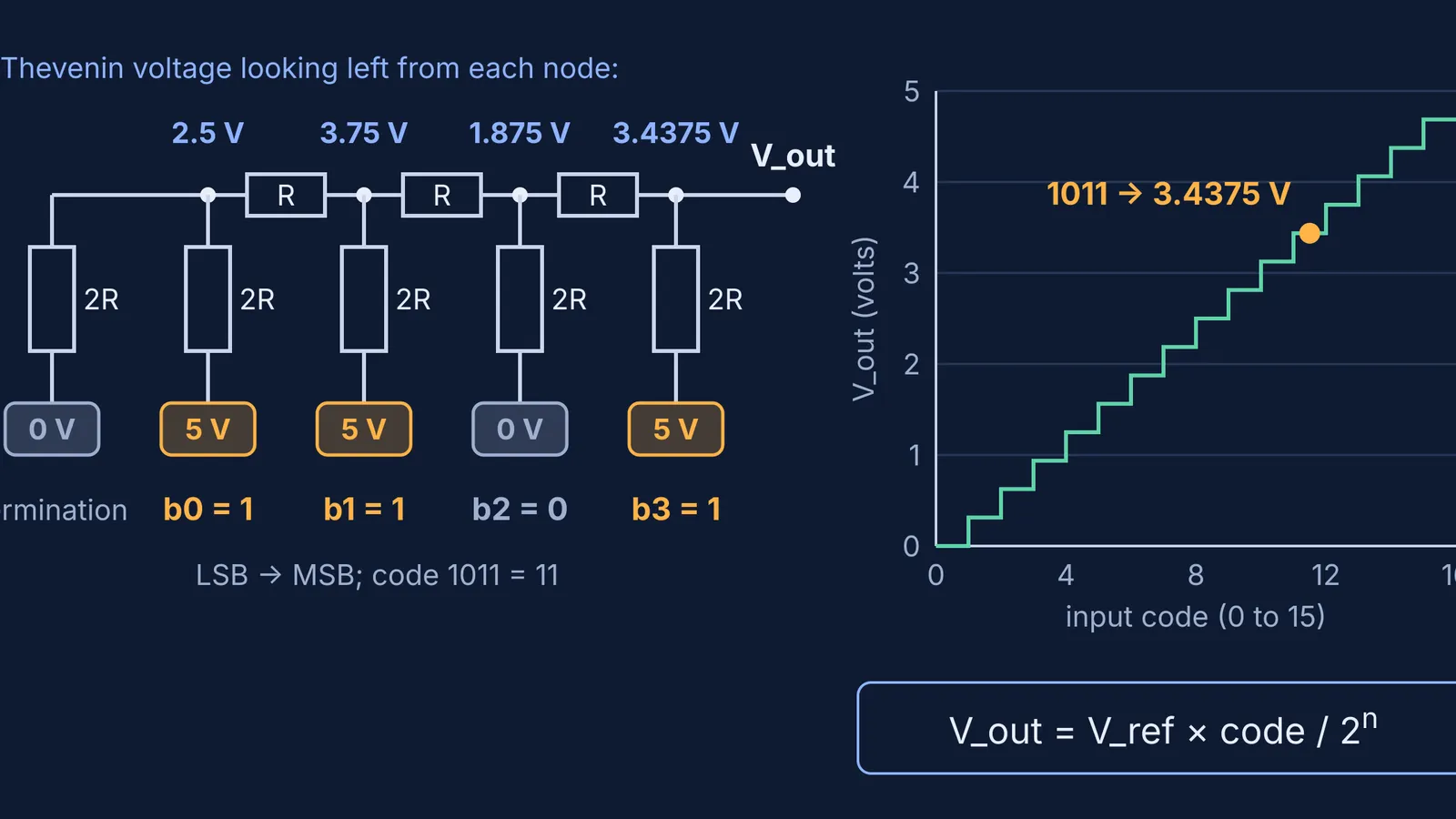
Take n = 4, V_ref = 5 V, code 1011. Reading from the MSB, the bits are b₃ = 1, b₂ = 0, b₁ = 1, b₀ = 1. Work from the LSB end, replacing everything to the left of each node with its Thevenin equivalent, as in Thevenin's theorem for reducing a network.
Worked example: 4-bit ladder, code 1011
Node 0 (b₀ = 1). The termination 2R goes to 0 V and the leg 2R goes to 5 V. Two equal resistors form a divider, so the Thevenin voltage is (0 + 5)/2 = 2.5 V, and the Thevenin resistance is 2R ∥ 2R = R.
Series R. Adding the R to node 1 gives a source of 2.5 V behind 2R.
Node 1 (b₁ = 1). Now 2.5 V behind 2R meets 5 V behind 2R. Equal resistances, so the node sits at the average: (2.5 + 5)/2 = 3.75 V, again behind R.
Node 2 (b₂ = 0). The leg goes to 0 V: (3.75 + 0)/2 = 1.875 V.
Node 3 (b₃ = 1). (1.875 + 5)/2 = 3.4375 V. This is the output node.
Check with the formula. 1011 in binary is 8 + 2 + 1 = 11, and 5 × 11/16 = 3.4375 V. The same.
Check with superposition. Each bit alone gives V_ref/2, V_ref/4, V_ref/8 and V_ref/16 from MSB to LSB: 2.5, 1.25, 0.625 and 0.3125 V. Adding 2.5 + 0.625 + 0.3125 gives 3.4375 V again.
Solving the four node equations directly (Kirchhoff's current law) also gives 3.4375 V. The output behaves as a source of internal resistance R, whatever the code.
One step of the staircase is V_ref/2ⁿ. With 5 V, that is 312.5 mV for 4 bits, 19.5 mV for 8 bits, 1.22 mV for 12 bits and 76.3 µV for 16 bits.
Why not just use resistors in the ratio 1 : 2 : 4 : 8?
You can. A binary-weighted DAC gives each bit its own resistor, R, 2R, 4R, 8R and so on, into a common summing point. The catch is the range. For n bits the largest resistor is 2ⁿ⁻¹ times the smallest: 1 : 128 for 8 bits and 1 : 32,768 for 16 bits. Making resistors that span that range on one chip, all with the same accuracy and the same drift with temperature, is hard.
Accuracy is the other problem. The MSB carries half the full output. To keep its error under half a step, its value must be right to 1 part in 2ⁿ: 0.39% for 8 bits, 0.024% for 12 bits and 0.0015% for 16 bits.
The R-2R ladder does not escape that demand: its MSB leg needs the same relative accuracy. What it changes is what has to match. Every resistor is R or 2R, and 2R can be built as two R in series, so a chip maker matches many copies of one identical resistor instead of a 1 : 32,768 spread. The TI design note states the point directly: mismatched 2R legs create linearity errors, the 2R resistors are often trimmed to match each other, and higher-resolution devices depend on stronger matching in the ladder.
What makes a real R-2R ladder fall short?
Loading. As above, the output must be buffered. In TI's design the amplifier's high input resistance keeps the divider isolated from the load.
Switch resistance. Each switch is a transistor with a small on-resistance that adds to its 2R leg. If all switches matched, this would only scale the output slightly. Mismatches between them distort the steps, so TI drives the switches hard to keep their on-resistances matched.
Missing termination. Leave out the end 2R and every weight changes. The 4-bit ladder then gives 3.71 V for 1011 instead of 3.4375 V, with the MSB alone worth 2.53 V and the LSB 0.47 V.
Linearity, not tolerance, is the rating. Real converters are specified by how far each step strays, in units of one step (LSB). The DAC7811 in TI's design, for example, is rated at 1 LSB integral non-linearity at 12 bits.
If you want more Kirchhoff and Thevenin problems worked like this, the Fermi Problem Library has a step-by-step solver that explains the reasoning. The plain two-resistor case is in the potential divider and how a rheostat sets V_out.
What mistakes cost marks on R-2R ladder questions?
Putting the MSB at the wrong end. The bit nearest the output is worth half of V_ref.
Forgetting the termination 2R at the LSB end.
Assuming the output can drive any load.
Quick checklist
Only two values: R along the chain, 2R in each leg and at the end.
V_out = V_ref × code / 2ⁿ; output resistance R.
Each node averages: Thevenin voltage = (voltage from the left + leg voltage)/2.
4 bits, 5 V, 1011: 2.5, 3.75, 1.875, 3.4375 V node by node.
One step = V_ref/2ⁿ: 19.5 mV at 8 bits, 76.3 µV at 16 bits.
Binary-weighted needs a 1 : 2ⁿ⁻¹ spread; R-2R needs matched copies of one value.


