

On this page
Turn down many LED lamps or screens and the LED current is not reduced at all. Instead the LED is switched fully on and off hundreds or thousands of times a second, and the fraction of time it is on sets the brightness. This is pulse-width modulation, or PWM. Your eye averages the pulses, but a phone camera and a moving hand do not, which is why some lights put dark stripes across your videos.
How does PWM dimming work?
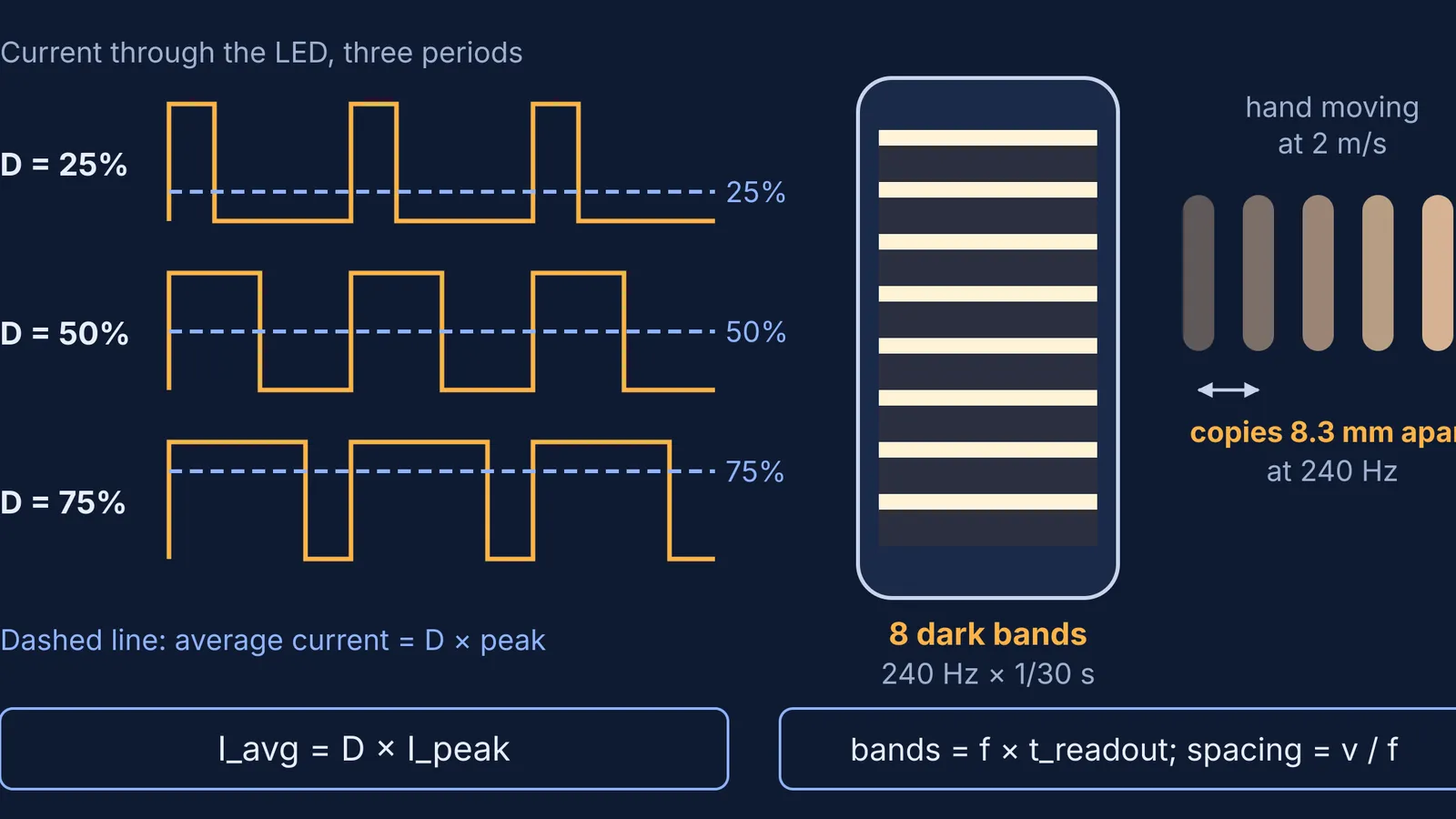
A PWM dimmer repeats a cycle of period T = 1/f. For a time DT the LED carries its full rated current I_peak; for the rest of the cycle it carries none. D is the duty cycle, a number between 0 and 1. The average current is
I_avg = D × I_peak
and since an LED's light output is close to proportional to its current, the average light is about D times full brightness. A 25% duty cycle gives roughly a quarter of the light. How a 555 timer produces such a train of pulses is worked in the 555 timer blinking LED project; here the same idea runs hundreds of times faster.
Why switch instead of lowering the current? A switch that is fully on or fully off wastes little power, and while the LED is on it runs at the current it was designed and rated for. Reducing the current also dims an LED, without flicker, and some drivers combine both methods.
One caution: "25% of the light" is not "looks 25% as bright". The eye's response is roughly logarithmic, so a lamp at a quarter of its output looks brighter than a quarter.
Why don't you see the light flickering?
At 240 Hz each cycle lasts 4.17 ms. At D = 0.25 the LED is on for 1.04 ms and off for 3.13 ms. That is far too fast to follow when you and the lamp are both still; your visual system blends the pulses into a steady average. The limit on how fast flicker can be before it blends is covered in persistence of vision and flip-book frame rates.
Not seeing flicker does not mean your nervous system ignores it. A 2015 presentation on flicker for the US Department of Energy by Naomi Miller of Pacific Northwest National Laboratory and Brad Lehman, chair of the IEEE group that wrote the flicker recommendations (IEEE 1789), separates visible flicker, which you perceive, from invisible flicker, where the light's modulation is sensed by the eye and brain but not perceived.
Why does a phone video of an LED lamp show dark bands?
Most phone cameras use a rolling shutter. They do not capture the whole frame at once; they read the sensor row by row from top to bottom. If reading the full frame takes a time t_readout, then rows near the top and bottom are exposed at different moments. Rows exposed while the LED was on come out bright; rows exposed while it was off come out dark. The number of on-off cycles that fit into one readout is
bands = f × t_readout
The readout time depends on the phone and its settings, so treat 1/30 s below as an illustrative value. The same row-by-row timing is what bends propeller blades in phone videos, covered in the wagon-wheel effect and strobing.
Worked example: a 350 mA LED dimmed to 25% at 240 Hz
Average current. I_avg = D × I_peak = 0.25 × 350 mA = 87.5 mA. The light is about a quarter of full output.
Period. T = 1/f = 1/240 s = 4.17 ms.
On and off times. On: 0.25 × 4.17 = 1.04 ms. Off: 4.17 − 1.04 = 3.13 ms.
Bands in the video. With a readout time of 1/30 s: 240 × 1/30 = 8 dark bands across the frame. If the readout takes 1/60 s: 240 × 1/60 = 4 bands.
Faster dimmer. At 1 kHz with a 1/30 s readout: 1000/30 = 33 bands, each much thinner and easier to miss.
A moving hand. A hand moving at 2 m/s is lit once per cycle, so you see separate copies a distance v/f apart: 2/240 m = 8.3 mm at 240 Hz, 2.0 mm at 1 kHz and 0.1 mm at 20 kHz. At 0.1 mm the copies merge into a smooth blur.
Check units. Hz × s is a pure number (bands); (m/s)/(1/s) is metres (spacing).
Why does a waved hand leave a trail of copies?
Under PWM light a moving finger is lit only during each on-time, so instead of a smooth blur you see a row of sharp images. The DOE presentation calls this the stroboscopic effect when an object moves and your eye is still. When your eye moves and the light is still, for example as you glance across a lamp, you can see a dotted trail of the lamp itself; this is the phantom array effect. Both make flicker visible at frequencies too high to see directly, and waving your fingers in the light is one of the simple checks the presentation suggests.
To see how strobing samples a moving object, the Fermi Simulation Lab has interactive simulations for ideas that are easier to see than read.
How fast should an LED dimmer switch?
The DOE presentation summarises the IEEE 1789 recommended practice this way:
The flicker frequency should be at least 100 Hz.
The percent flicker, 100% × (max − min)/(max + min), should not exceed 0.08 × frequency for normal populations, or 0.0333 × frequency for especially sensitive groups.
At 120 Hz that allows 10%. At 1,250 Hz or higher, 100% flicker is allowed.
A PWM lamp switching fully off has 100% flicker. At 240 Hz the rule allows only 0.08 × 240 = 19.2%, which rounds up to 20%, so plain PWM at 240 Hz falls outside it. The same lamp at 1,250 Hz or more is within it. The presentation advises manufacturers to avoid PWM dimming unless combined with other techniques.
On health, the presentation lists potential flicker-induced impairments: neurological problems including epileptic seizures; headaches, fatigue, blurred vision and eyestrain; migraines; reduced visual task performance; increased autistic behaviours, especially in children; and distraction. It notes that longer exposure, brighter flashes, larger areas of the retina and higher contrast make flicker worse. These are risks the IEEE group set out to reduce, not effects every lamp produces; if lighting gives you headaches, a doctor is the right person to ask.
What mistakes cost marks on duty cycle questions?
Writing the average current as I_peak/2 regardless of D.
Using the rms value √D × I_peak where the average is asked, or the other way round.
Thinking a light you cannot see flickering is steady.
Forgetting that band counts depend on the camera's readout time, which varies.
Quick checklist
PWM: full current for a fraction D of each cycle; I_avg = D × I_peak.
350 mA at D = 0.25 averages 87.5 mA.
240 Hz: 4.17 ms cycle, 1.04 ms on, 3.13 ms off.
Rolling-shutter bands = f × t_readout: 8 for 240 Hz at 1/30 s.
Copies of a moving object are v/f apart: 8.3 mm at 2 m/s and 240 Hz.
IEEE 1789 (as summarised by DOE): percent flicker ≤ 0.08 × f; 100% allowed at 1,250 Hz and above.


