

On this page
These eight original NEET-style questions follow set 1 of our Properties of Solids and Liquids NEET practice questions. They test sub-topics set 1 skipped.
Which topics does set 2 cover, and how should you use it?
The National Medical Commission's updated syllabus for NEET (UG)-2026 lists Properties of Solids and Liquids as Physics Unit 7. It covers shear modulus, thermal expansion, Wien's law, U-tube pressure, calorimetry, surface energy, thermal stress and Young's modulus from the NCERT Class 11 chapters on solids, fluids and thermal properties.
Cover the answers; allow about 15 minutes.
Write the formula and units before any number.
Read every trap; redo misses two days later.
As in NEET-UG 2026, whose NTA information bulletin gave +4 for a correct answer and −1 for a wrong one, wild guesses cost marks. Take g = 10 m/s².
Easy: shear, a heated hole and Wien's law
Q1 (easy). A rubber pad has a top face of 20 cm × 10 cm and is 4.0 cm thick. A horizontal force of 6.0 × 10³ N shifts the top face sideways by 2.0 mm while the bottom stays fixed. What is the shear modulus?
(A) 1.5 × 10⁴ Pa (B) 3.0 × 10⁵ Pa (C) 6.0 × 10⁶ Pa (D) 3.0 × 10⁷ Pa
Answer: (C). Stress = 6000/0.020 = 3.0 × 10⁵ Pa; strain = 0.002/0.040 = 0.050; G = 6.0 × 10⁶ Pa.
Trap: (D) divides the shift by the 20 cm length, not the thickness; (B) stops at the stress.
Q2 (easy). An aluminium plate has a circular hole of area 50.00 cm² at 20 °C. It is heated to 220 °C (α = 2.3 × 10⁻⁵ K⁻¹). What is the hole's area now?
(A) 49.54 cm² (B) 50.23 cm² (C) 50.46 cm² (D) 50.69 cm²
Answer: (C). A hole expands like the metal that would fill it: ΔA = 2αAΔT = 2 × 2.3 × 10⁻⁵ × 50.00 × 200 = 0.46 cm².
Trap: (A) assumes the hole shrinks; (B) uses α instead of 2α.
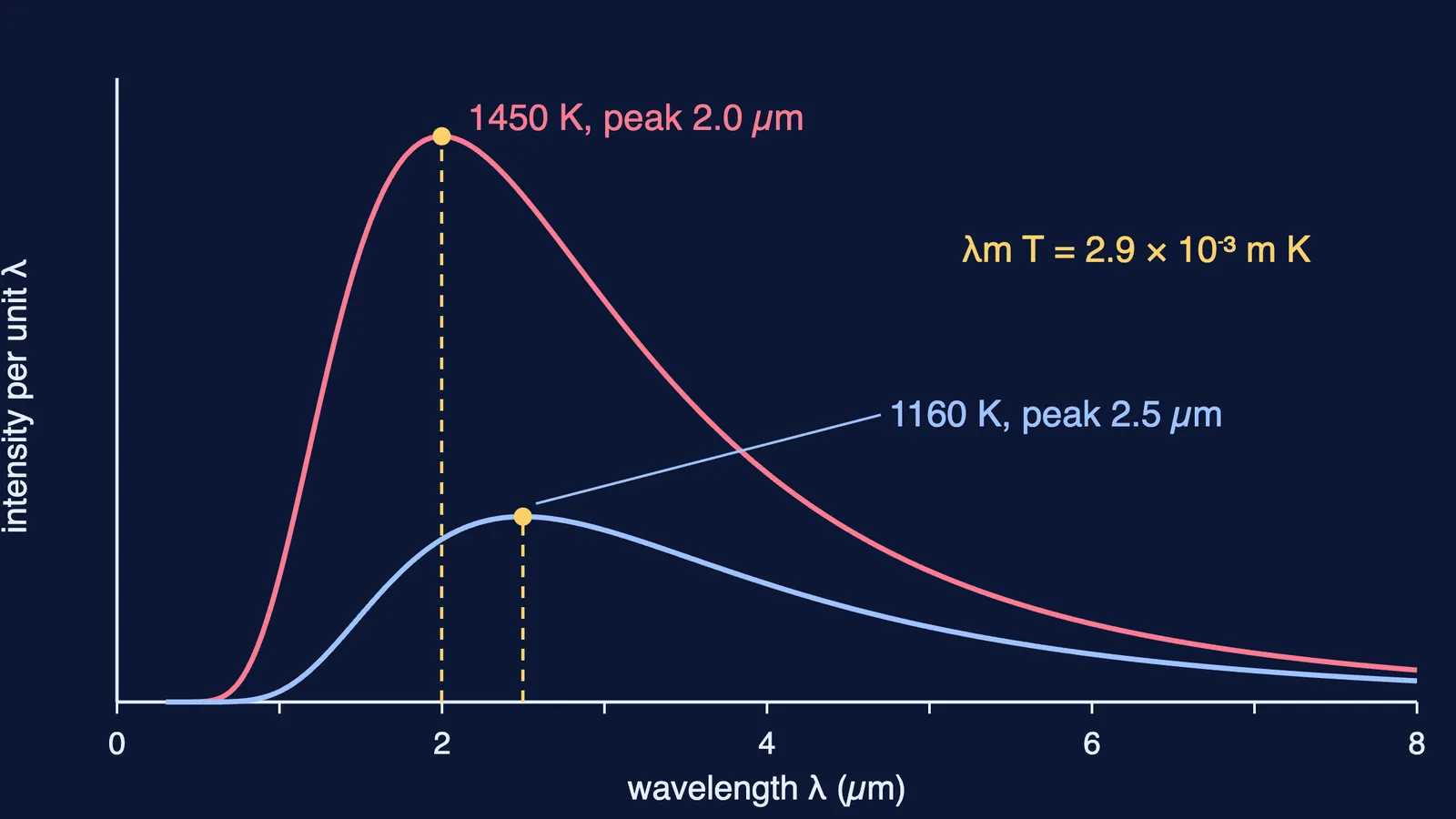
Q3 (easy). Radiation from a furnace wall peaks at 2.5 µm. Treating it as a blackbody with Wien's constant 2.9 × 10⁻³ m K, what is its temperature?
(A) 887 °C (B) 1160 °C (C) 1433 °C (D) 1.13 × 10⁴ °C
Answer: (A). T = b/λm = 2.9 × 10⁻³/2.5 × 10⁻⁶ = 1160 K, which is 887 °C.
Trap: (B) leaves the kelvin value unconverted; (C) adds 273 instead of subtracting.
Medium: U-tube, calorimeter and a soap film
Q4 (medium). Oil is poured into one arm of a water-filled U-tube until the oil column is 15 cm tall. The oil's surface then stands 3.0 cm above the water's surface in the other arm. What is the oil's density?
(A) 200 kg/m³ (B) 800 kg/m³ (C) 1000 kg/m³ (D) 1250 kg/m³
Answer: (B). Pressures match at the oil-water interface level. The water above it is 15 − 3.0 = 12 cm, so ρ × 15 = 1000 × 12 and ρ = 800 kg/m³.
Trap: (A) treats the 3.0 cm gap as the water column; (D) inverts the ratio.
Q5 (medium). A 175 g copper calorimeter (0.40 J/g °C) holds 150 g of water (4.2 J/g °C) at 25 °C. A 100 g metal block at 100 °C is dropped in; everything settles at 30 °C. Ignoring losses, what is the metal's specific heat?
(A) 0.35 J/g °C (B) 0.45 J/g °C (C) 0.47 J/g °C (D) 0.50 J/g °C
Answer: (D). Heat gained = (630 + 70) × 5 = 3500 J. Heat lost = 100 × c × 70, so c = 0.50 J/g °C.
Trap: (B) leaves out the calorimeter; (C) takes the block's drop as 75 °C.
Q6 (medium). A soap film fills a U-shaped wire frame closed by a sliding wire 8.0 cm long. The surface tension is 0.030 N/m. How much work is needed to pull the slider out slowly by 5.0 cm?
(A) 1.2 × 10⁻⁴ J (B) 2.4 × 10⁻⁴ J (C) 4.8 × 10⁻⁴ J (D) 4.8 × 10⁻³ J
Answer: (B). The film has two surfaces, so W = 2T × L × x = 2 × 0.030 × 0.080 × 0.050 = 2.4 × 10⁻⁴ J.
Trap: (A) counts one surface; (D) is the force 2TL in newtons, not the work.
Hard: a cooling wire and a rod on two wires
Q7 (hard). A steel wire 2.0 m long and 1.0 mm in diameter is stretched between two rigid supports with a tension of 50 N at 40 °C. It cools to 10 °C. With Y = 2.0 × 10¹¹ N/m² and α = 1.2 × 10⁻⁵ K⁻¹, what is the new tension?
(A) 57 N (B) 107 N (C) 163 N (D) 276 N
Answer: (B). Blocked contraction adds stress YαΔT = 2.0 × 10¹¹ × 1.2 × 10⁻⁵ × 30 = 7.2 × 10⁷ Pa. With A = π(0.50 × 10⁻³)² = 7.85 × 10⁻⁷ m², that is about 57 N more, so about 107 N in all.
Trap: (A) forgets the 50 N already there; (D) uses the diameter as the radius.
Q8 (hard). A light rigid rod 1.2 m long hangs horizontally from two vertical wires of equal length, one at each end: steel on the left (Y = 2.0 × 10¹¹ N/m², diameter d), brass on the right (Y = 1.0 × 10¹¹ N/m², diameter 2d). Where must a load hang so the rod stays horizontal?
(A) 0.40 m from the steel end (B) 0.60 m from the steel end (C) 0.80 m from the steel end (D) 0.96 m from the steel end
Answer: (C). Equal stretch needs equal T/(YA). Brass has half the Y but four times the area, so T_b = 2T_s. Torques about the load: T_s x = 2T_s(1.2 − x), giving x = 0.80 m.
Trap: (B) uses the diameter ratio instead of the area ratio; (A) ignores the diameters.
What should you revise after set 2?
Missed Q2, Q3 or Q5: our Thermal Properties of Matter Class 11 guide covers expansion, calorimetry and radiation.
Missed Q1, Q7 or Q8: reread NCERT sections 8.4 and 8.5.
For theory and a study plan, see how to prepare Properties of Solids and Liquids for NEET.
If a step keeps failing, the Fermi Problem Library has worked problems with a step-by-step solver that explains the reasoning rather than printing an answer.


