

On this page
This set follows set 1 of our JEE Main practice questions on properties of solids and liquids and covers what that set skipped.
Which sub-topics does set 2 cover?
Properties of Solids and Liquids is Unit 7 of the Syllabus for JEE (Main) - 2027 published by NTA. Every question comes from the NCERT Class 11 chapters on solids, fluids and thermal properties (Reprint 2026-27). For theory, read our guide on how to prepare Properties of Solids and Liquids for JEE Main.
How should you attempt set 2?
Cover the answers; allow 18 minutes.
Convert cm, mm, cm² and nm to SI first.
Tag each miss as a formula, unit or concept slip.
Take g = 10 m/s².
Easy: expansion, viscosity and capillary rise
Q1 (easy). A copper sphere (α = 1.7 × 10⁻⁵ K⁻¹) is heated from 20 °C to 120 °C. By what percentage does its volume increase?
(A) 0.17% (B) 0.34% (C) 0.51% (D) 5.1%
Answer: (C). For volume, α_V = 3α_l, so ΔV/V = 3 × 1.7 × 10⁻⁵ × 100 = 5.1 × 10⁻³, or 0.51%.
Trap: (A) uses the linear coefficient; (B) is the area change.
Q2 (easy). A plate of area 0.25 m² slides at a steady 0.30 m/s over an oil layer 1.5 mm thick on a fixed surface. The oil's viscosity is 0.60 Pa s. What force keeps the plate moving?
(A) 6.8 × 10⁻⁵ N (B) 3.0 × 10⁻² N (C) 30 N (D) 120 N
Answer: (C). The velocity gradient is v/d, so F = ηAv/d = 0.60 × 0.25 × 0.30/(1.5 × 10⁻³) = 30 N.
Trap: (B) leaves the thickness in millimetres; (D) is the shear stress, 120 Pa, read as a force.
Q3 (easy). A liquid of density 800 kg/m³ and surface tension 0.050 N/m meets glass at a contact angle of 60°. How high does it rise in a glass capillary of internal diameter 0.50 mm?
(A) 1.25 cm (B) 2.5 cm (C) 4.3 cm (D) 5.0 cm
Answer: (B). With r = 0.25 mm, h = 2S cos θ/(rρg) = 2 × 0.050 × 0.5/(2.5 × 10⁻⁴ × 800 × 10) = 0.025 m.
Trap: (D) drops cos θ; (C) uses sin 60°; (A) puts the diameter in place of the radius.
Medium: can you link Wien's law, thermal stress and surface energy?
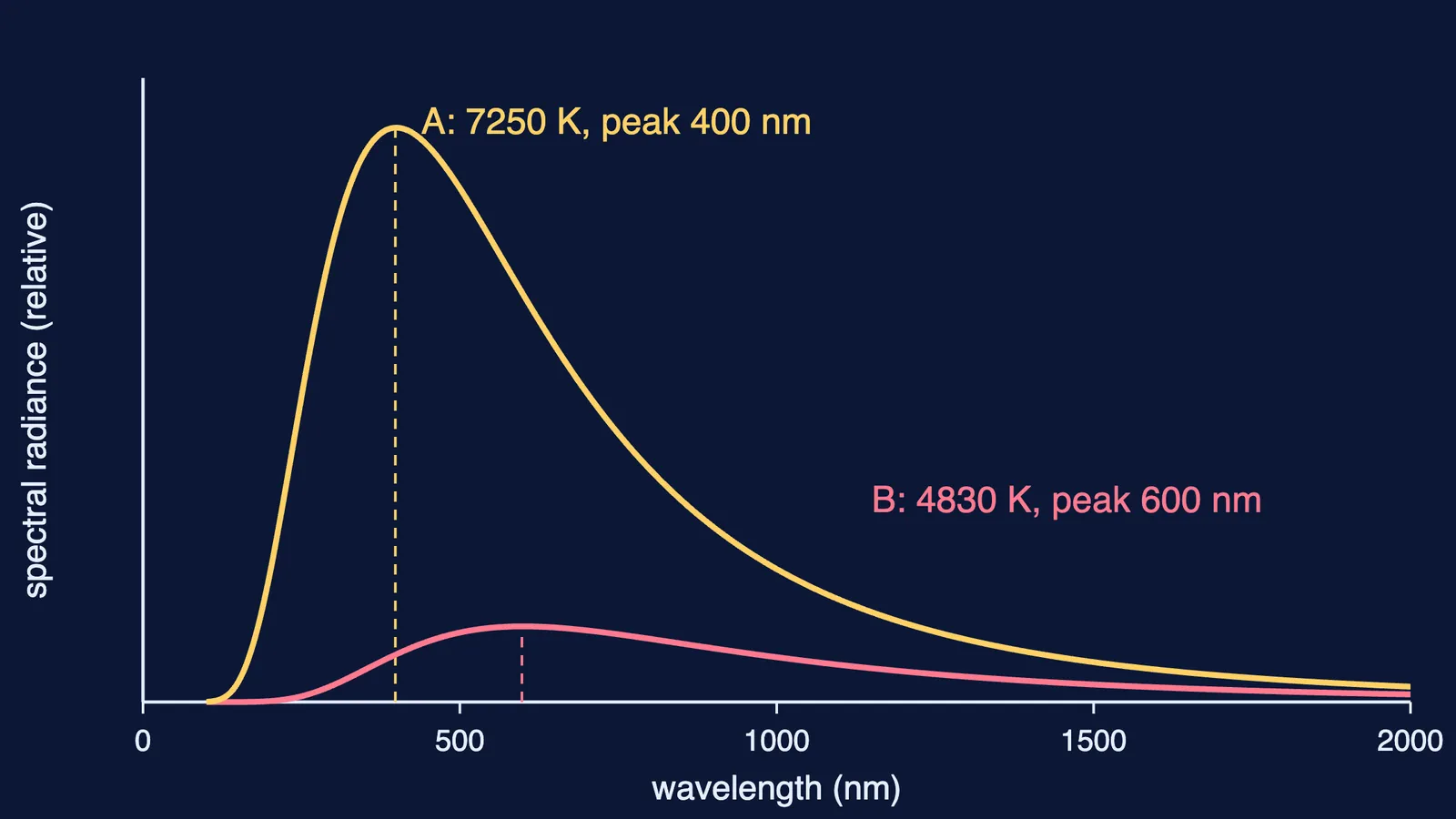
Q4 (medium). Two black-body spheres A and B radiate equal total power. A's spectrum peaks at 400 nm and B's at 600 nm. What is the ratio of B's radius to A's?
(A) 0.44 (B) 1.5 (C) 2.25 (D) 5.06
Answer: (C). Wien's law, λ_m T = constant, gives T_A/T_B = 600/400 = 1.5. Power goes as R²T⁴, so equal power needs R_B/R_A = (T_A/T_B)² = 2.25.
Trap: (D) forgets the R² area factor; (B) stops at the temperature ratio.
Q5 (medium). A brass rod 2.0 m long is fixed to a rigid wall at one end. At 20 °C a 0.80 mm gap separates its free end from a second rigid wall. Take Y = 1.0 × 10¹¹ N/m² and α = 2.0 × 10⁻⁵ K⁻¹. What compressive stress is in the rod at 100 °C?
(A) 4.0 × 10⁷ Pa (B) 1.2 × 10⁸ Pa (C) 1.6 × 10⁸ Pa (D) 2.0 × 10⁸ Pa
Answer: (B). The gap closes after ΔT = 0.80 × 10⁻³/(2.0 × 10⁻⁵ × 2.0) = 20 K, at 40 °C. The last 60 K is blocked, so stress = YαΔT = 1.0 × 10¹¹ × 2.0 × 10⁻⁵ × 60 = 1.2 × 10⁸ Pa.
Trap: (C) ignores the gap; (D) takes 100 °C as the temperature change; (A) uses only the 20 K that closes the gap.
Q6 (medium). Twenty-seven water droplets, each of radius 1.0 mm, merge into one drop. With surface tension 0.072 N/m, how much surface energy is released?
(A) 8.1 × 10⁻⁶ J (B) 1.6 × 10⁻⁵ J (C) 2.4 × 10⁻⁵ J (D) 3.3 × 10⁻⁵ J
Answer: (B). Volume is conserved, so R = 3.0 mm. The energy released is S × 4π(27r² − R²) = 0.072 × 4π × 18 × 10⁻⁶ ≈ 1.6 × 10⁻⁵ J.
Trap: (C) forgets the big drop's own surface; (D) counts two surfaces, as for a bubble.
Hard: conduction into ice and a two-metal wire
Q7 (hard, numerical value). A lagged copper rod 40 cm long, of cross-section 5.6 cm² and thermal conductivity 400 W/(m K), has one end in boiling water (100 °C) and the other in ice-water (0 °C). The latent heat of fusion of ice is 3.36 × 10⁵ J/kg. In the steady state, how many grams of ice melt per minute?
Answer: 10. H = kAΔT/L = 400 × 5.6 × 10⁻⁴ × 100/0.40 = 56 W. In 60 s that is 3360 J, which melts 3360/(3.36 × 10⁵) kg = 10 g.
Trap: 0.17, the mass melted per second rather than per minute.
Q8 (hard). Light steel and copper wires, each 1.0 m long with cross-section 1.0 mm², are joined end to end. The steel end is fixed to a wall and a 100 N force pulls the copper end along the wires. Take Y = 2.0 × 10¹¹ N/m² for steel and 1.0 × 10¹¹ N/m² for copper. What total elastic potential energy do the wires store?
(A) 0.050 J (B) 0.067 J (C) 0.075 J (D) 0.15 J
Answer: (C). Each wire carries 100 N, so steel stretches FL/(AY) = 0.50 mm and copper 1.0 mm. Then U = ½F(ΔL₁ + ΔL₂) = ½ × 100 × 1.5 × 10⁻³ = 0.075 J.
Trap: (B) uses the average Young's modulus, 1.5 × 10¹¹ N/m², for the whole 2.0 m; (D) leaves out the ½.
Where should you go after set 2?
Missed Q1, Q5 or Q7: work through our list of common calorimetry and thermal-properties mistakes in JEE and NEET.
Missed Q2, Q3 or Q6: reread NCERT sections 9.5 and 9.6 on viscosity and surface tension.
Missed Q4 or Q8: redo them tomorrow without notes.
If one step keeps going wrong, the Fermi Problem Library has worked problems with a step-by-step solver that explains the reasoning rather than printing an answer.


