

On this page
These eight questions are written for Section B of JEE Main Physics, where you type a number instead of picking an option. We wrote them ourselves, not from NCERT, the exemplar or past papers. Each has a worked solution and the wrong number you are most likely to type.
How are numerical-value questions marked in JEE Main?
The Information Bulletin for JEE (Main) 2027 gives Physics 20 multiple-choice questions in Section A and 5 numerical-value questions in Section B. You enter an integer on an on-screen keypad, "rounded off to the nearest integer". A correct answer earns +4, a wrong one −1 and a blank 0.
All eight stay inside Unit 7 of the Syllabus for JEE (Main) - 2027 and the NCERT Class 11 chapters on solids, fluids and thermal properties (Reprint 2026-27). Take g = 10 m/s² and water's density as 1000 kg/m³.
New to the chapter? Read how to prepare Properties of Solids and Liquids for JEE Main, or try Properties of Solids and Liquids JEE Main practice questions, set 1.
Easy: a pillar, a porthole and a pipe
Q1 (easy). A vertical aluminium pillar 2.0 m tall, of cross-section 4.0 cm², carries a 28 kN load on top. Take Y = 7.0 × 10¹⁰ Pa and ignore the pillar's weight. By how much does it shorten, in μm?
Answer: 2000. ΔL = FL/(AY) = 28 × 10³ × 2.0/(4.0 × 10⁻⁴ × 7.0 × 10¹⁰) = 2.0 × 10⁻³ m, or 2000 μm.
Trap: 20, from writing 4.0 cm² as 4.0 × 10⁻² m².
Q2 (easy). A submarine has a vertical rectangular window 20 cm × 25 cm whose centre is 32 m below the sea surface. Seawater's density is 1025 kg/m³, and the cabin is kept at atmospheric pressure (1.0 × 10⁵ Pa). Find the net force of the water and cabin air on the window, in N.
Answer: 16400. Atmospheric pressure acts on both faces and cancels, leaving the gauge pressure at the centre: ρgh = 1025 × 10 × 32 = 3.28 × 10⁵ Pa. For a uniform vertical window the centre's pressure is the average, so F = 3.28 × 10⁵ × 0.050 = 16400 N.
Trap: 21400, which adds atmospheric pressure outside but not inside.
Q3 (easy). Water (density 1000 kg/m³, viscosity 1.0 × 10⁻³ Pa s) flows through a pipe of internal diameter 2.0 cm. Take the flow to stay streamline while the Reynolds number ρvD/η, with D the internal diameter, is at most 2000. Find the highest mean speed for streamline flow, in cm/s.
Answer: 10. v = 2000η/(ρD) = 2000 × 1.0 × 10⁻³/(1000 × 0.020) = 0.10 m/s, or 10 cm/s.
Trap: 20, from using the radius in place of D.
Medium: a wet glass sandwich, a rising pipe and a full flask
Q4 (medium). Two flat glass plates, each with an overlap area of 25 cm², hold a water film 0.036 mm thick between them (S = 0.072 N/m, contact angle 0°). What force, in N, beyond the plates' weight pulls them straight apart?
Answer: 10. The film's edge is a curved surface with radius d/2 in one plane, so the water is below atmospheric pressure by S/(d/2) = 2S/d = 4000 Pa. F = 2SA/d = 2 × 0.072 × 25 × 10⁻⁴/(0.036 × 10⁻³) = 10 N.
Trap: 5, from taking the meniscus radius as d.
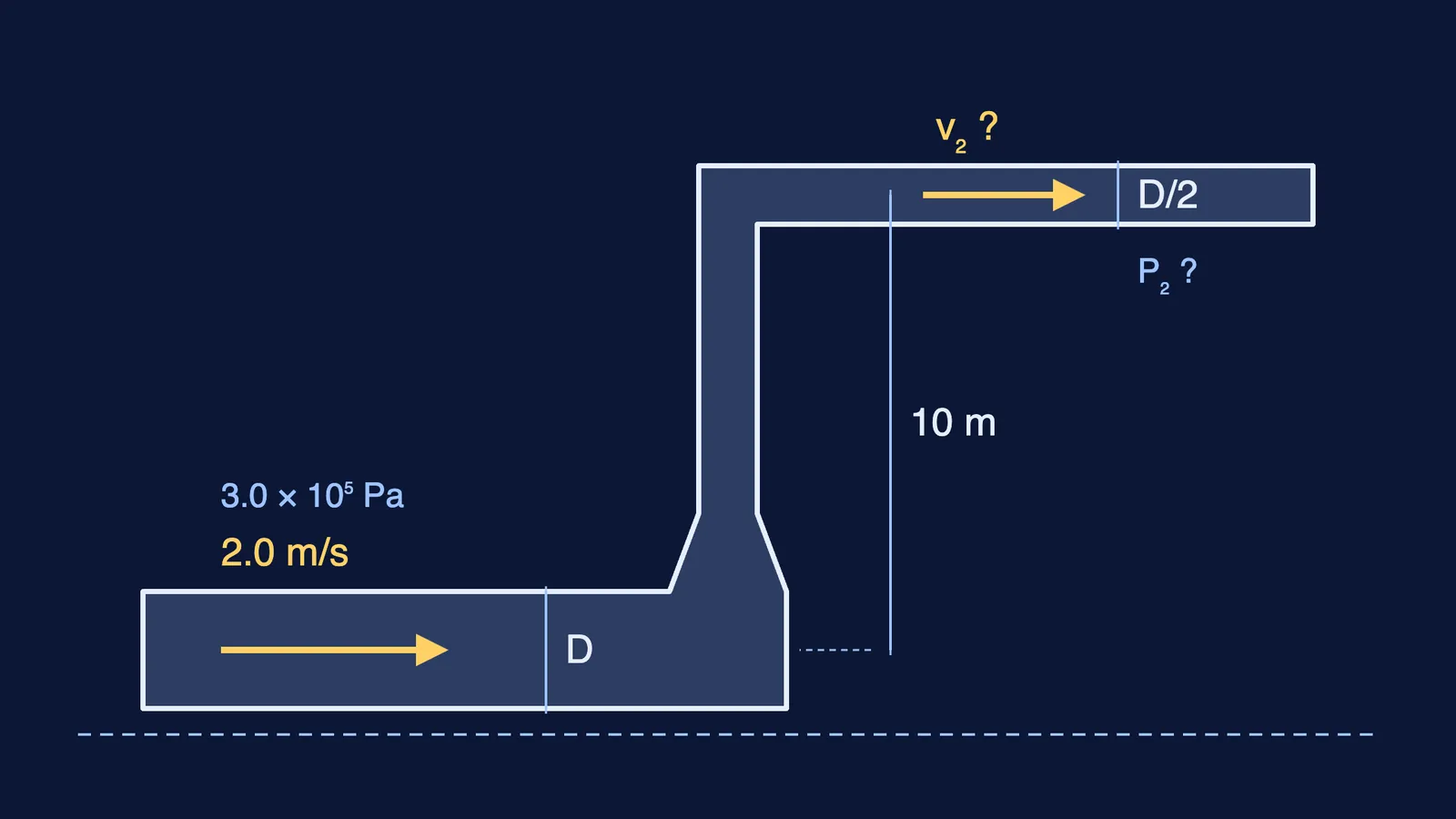
Q5 (medium). Water flows steadily up a pipe. At ground level the diameter is D, speed 2.0 m/s and pressure 3.0 × 10⁵ Pa; 10 m higher the diameter is D/2. Find the pressure there, in kPa.
Answer: 170. Halving D quarters the area, so v₂ = 4 × 2.0 = 8.0 m/s. Bernoulli: P₂ = 3.0 × 10⁵ + ½ × 1000 × (2.0² − 8.0²) − 1000 × 10 × 10 = 1.70 × 10⁵ Pa.
Trap: 194, from only doubling the speed.
Q6 (medium). A glass flask (linear expansivity 1.0 × 10⁻⁵ K⁻¹) is filled to the brim with 1000 cm³ of a liquid (volume expansivity 7.5 × 10⁻⁴ K⁻¹) at 20 °C. Both are heated to 70 °C. How much liquid spills, in cm³?
Answer: 36. The flask's volume grows with 3α, so the spill is V(γ − 3α)ΔT = 1000 × (7.5 × 10⁻⁴ − 3.0 × 10⁻⁵) × 50 = 36 cm³.
Trap: 37, from using α instead of 3α for the glass.
Hard: a hot shell and ice that thickens
Q7 (hard). A hollow sphere of a material with k = 0.25 W/m K has inner radius 10 cm and outer radius 20 cm. Its inner surface is held at 100 °C and its outer surface at 0 °C. Find the steady heat current, in W, to the nearest integer.
Answer: 63. A thin shell of radius r and thickness dr has resistance dr/(4πkr²). Integrating from r₁ to r₂: H = 4πk r₁r₂ΔT/(r₂ − r₁) = 4π × 0.25 × 0.10 × 0.20 × 100/0.10 = 62.8 W.
Trap: 31, from the slab formula with the inner area.
Q8 (hard). Ice 2.0 cm thick covers a pond; the air above is at −10 °C and the water below at 0 °C. For ice, ρ = 900 kg/m³, L = 3.36 × 10⁵ J/kg and k = 2.0 W/m K. How many minutes, to the nearest integer, until it is 4.0 cm thick?
Answer: 151. Heat conducted up through ice of thickness x freezes a new layer below: ρL dx/dt = kθ/x. Integrating, t = ρL(x₂² − x₁²)/(2kθ) = 900 × 3.36 × 10⁵ × (0.040² − 0.020²)/(2 × 2.0 × 10) = 9072 s, or 151.2 minutes.
Trap: 302, which drops the 2 from integrating x dx.
How do you get the number right in this chapter?
SI first. 1 mm² is 10⁻⁶ m² and 1 cm² is 10⁻⁴ m².
Gauge or absolute? Atmospheric pressure cancels when it acts on both sides.
Square the diameter. Halve a pipe's diameter and the speed rises four times.
Match α to the dimension. Volumes expand with 3α, not α.
Round once, at the end. Carry three significant figures; 62.8 W becomes 63, not 62.
Does one step keep going wrong? The Fermi Problem Library has worked problems with a step-by-step solver that explains the reasoning rather than printing an answer.
Redo every miss two days later, without your old working.


