

On this page
Hormones come up twice in school biology: in the plant chapter and the animal chapter. Most students learn them as two separate lists. They are easier to remember side by side if you ask the same three questions of each: where is the hormone made, how does it travel, and what does it do when it arrives? Below, we answer those questions for auxin and for thyroxine.
What is the main difference between plant hormones and animal hormones?
The biggest difference is where the hormone is made. Animals make many hormones in endocrine glands. The thyroid gland, for example, makes its hormone by attaching iodine to tyrosine units in a protein called thyroglobulin, as Gregory Brent's 2012 review in the Journal of Clinical Investigation describes.
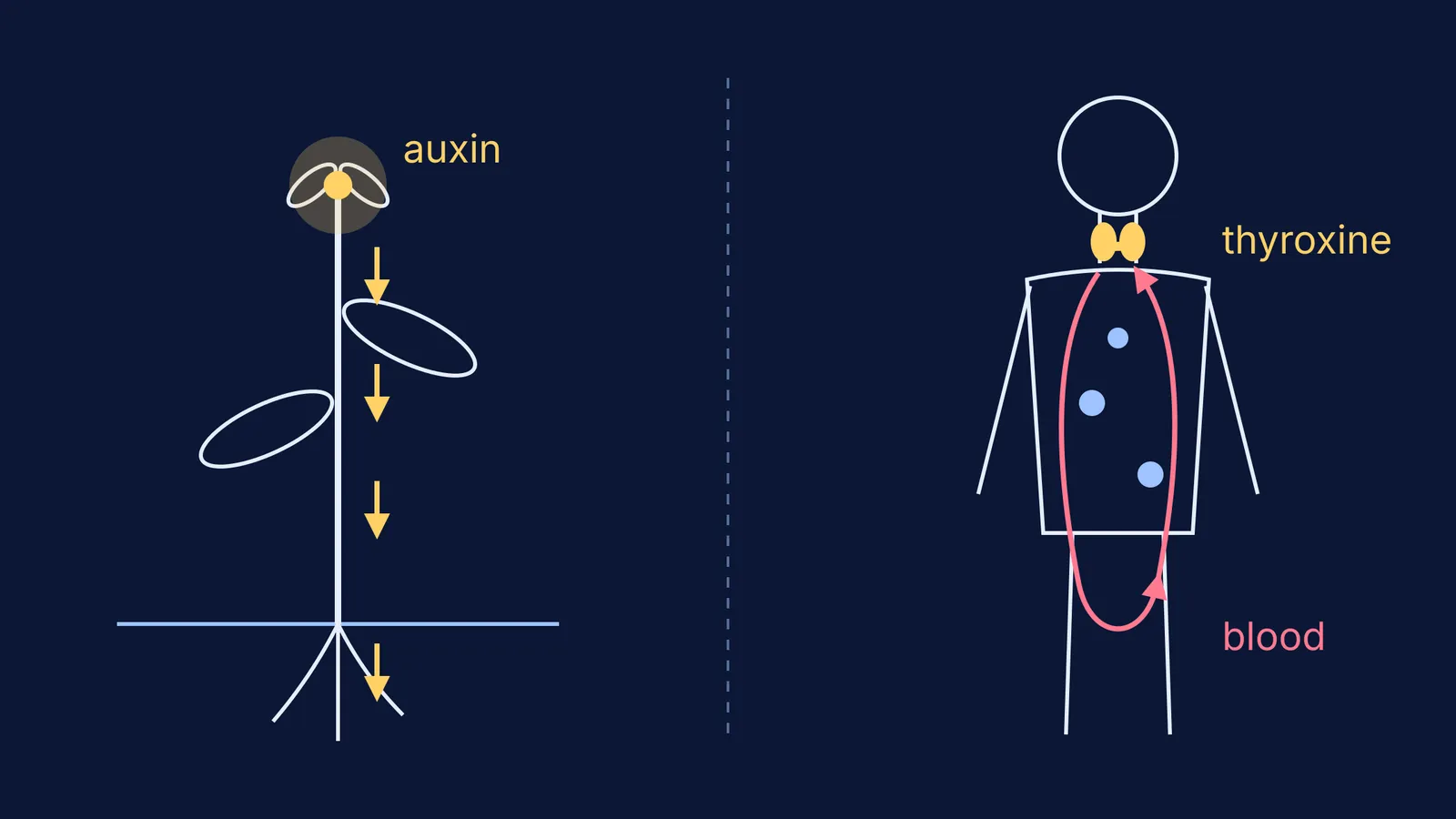
Plants have no glands. Their hormones are made by ordinary living tissues, and auxin, the hormone we follow here, is made mostly where the plant is growing. That difference also shapes how the hormone travels.
Where are plant hormones made if plants have no glands?
A 2001 study in The Plant Journal by Karin Ljung and colleagues measured the main auxin, indole-3-acetic acid (IAA), in young Arabidopsis plants. The youngest leaves, under 0.5 mm long, had the most IAA and the highest capacity to make it. As those leaves grew to full size, their IAA content fell nearly one hundred-fold.
Cotyledons, expanding leaves and roots could all make IAA too. In tobacco leaves, dividing tissue held ten times more IAA than tissue that was only lengthening. So auxin is made mostly where cells are young and dividing, but almost any part of the plant can make some.
How do plant and animal hormones travel?
Auxin can travel the whole length of the plant, from shoot to root, and more local transport is needed for bending responses such as growing towards light, according to Woodward and Bartel's review in Annals of Botany. A review by Zažímalová and colleagues explains that carrier proteins move auxin into cells (AUX1/LAX) and out of them (PIN proteins), passing it from cell to cell. Auxin can also travel long distances in the phloem.
Thyroxine (T4) travels in the blood, held by three plasma proteins: thyroxine-binding globulin, transthyretin and albumin. George Schussler's review in Thyroid explains that these proteins keep the free T4 level steady for cells to take up. The hypothalamus and pituitary control the level of free T4.
How do auxin and thyroxine act on target cells?
Here the two are more alike. In 2005, Dharmasiri, Dharmasiri and Estelle showed in Nature that a protein called TIR1 is an auxin receptor. When auxin binds to it, Aux/IAA repressor proteins are broken down, and the genes they were holding back are switched on.
Thyroxine acts mostly after cells convert it to the more active form, T3. Brent's review describes T3 binding to thyroid hormone receptors that start gene transcription. It calls thyroid hormone essential for development, growth, nerve cell development and metabolic control in mammals. In both cases the hormone changes which genes a cell uses.
Auxin vs thyroxine: a side-by-side comparison
The sources are linked in the sections above.
Made in: auxin mainly in young leaves and other growing tissue, with no gland; thyroxine in the thyroid gland.
Raw material: auxin (IAA) from the amino acid tryptophan or a closely related precursor; thyroxine from tyrosine and iodine.
Travels by: auxin cell to cell through carrier proteins, and in the phloem; thyroxine in the blood, bound to transport proteins.
Direction: auxin mainly from shoot to root; thyroxine wherever the blood goes.
Receptor: auxin binds TIR1; thyroxine works through thyroid hormone receptors, mostly as T3.
End result: in both, a change in which genes the target cell uses.
Classic effects: auxin controls growth and bending towards light; thyroxine controls growth, development and metabolism.
How do you write this in an exam answer?
For a 3-mark "differentiate" question, give one point each for site, transport and action, with an example pair:
Site: Plant hormones are made by ordinary tissues, not glands; auxin, for example, comes mainly from young leaves and other growing regions. Animal hormones are made in endocrine glands, for example thyroxine in the thyroid.
Transport: Plant hormones such as auxin pass from cell to cell, and auxin also travels in the phloem. Animal hormones are carried in the blood.
Action: Auxin promotes growth and bending towards light. Thyroxine regulates growth, development and metabolism.
For more, read our explainer on plant growth regulators, the animal side in chemical coordination and hormones, and how auxin bends a shoot towards light.
Cell-to-cell flow is easier to follow when you can see it. The Fermi Simulation Lab has interactive simulations for ideas that are easier to see than to read. If a word like "receptor" or "phloem" is the weak link, the Fermi Concept Library has a lesson for every biology concept.


