

On this page
This is set 2 of our Physics and Measurement practice questions for NEET-UG. It follows set 1 of the Physics and Measurement NEET practice questions and covers the parts of the chapter that set 1 skipped.
The NMC syllabus for NEET (UG)-2026 lists Physics Unit 1 as units, SI units, least count, significant figures, errors in measurement, dimensions and dimensional analysis. The rules come from NCERT Class 11 Physics Chapter 1, Units and Measurement, the 2026-27 reprint.
How should you use this set?
Cover the answers and give yourself ten minutes for all eight.
Write the rule you used next to each answer.
Read every trap line, even after a correct answer.
If the theory still feels shaky, start with our guide on how to prepare Physics and Measurement for NEET.
Easy: do you know the rules NCERT states?
Q1 (easy). Using the NCERT rule for rounding off, what are 6.835 and 4.265, each rounded to three significant figures?
(A) 6.84 and 4.27 (B) 6.83 and 4.26 (C) 6.84 and 4.26 (D) 6.83 and 4.27
Answer: (C). When the digit you drop is exactly 5, NCERT says to leave the previous digit alone if it is even and raise it by 1 if it is odd. In 6.835 the previous digit, 3, is odd, so you get 6.84. In 4.265 the previous digit, 6, is even, so you get 4.26.
Trap: (A) always rounds a 5 up, which is the school maths habit, not the NCERT rule.
Q2 (easy). By NCERT's rules, which of these measured values has exactly three significant figures?
(A) 0.04050 m (B) 4.050 × 10² m (C) 4050 m (D) 40.50 m
Answer: (C). Trailing zeros in a number with no decimal point are not significant, so 4050 has three (4, 0, 5). The other three have four, because trailing zeros after a decimal point count.
Trap: (A) looks short, but its leading zeros only place the decimal point.
Q3 (easy). Which pair of quantities does NOT have the same dimensions?
(A) Impulse and momentum (B) Torque and work (C) Pressure and energy per unit volume (D) Surface tension and force per unit area
Answer: (D). Surface tension is force per unit length, [M T⁻²]. Force per unit area is [M L⁻¹ T⁻²], the dimensions of pressure. The other three pairs match: [M L T⁻¹], [M L² T⁻²] and [M L⁻¹ T⁻²].
Trap: (B) feels different because torque is a vector and work a scalar, but dimensions ignore direction.
Medium: can you turn errors and units into a reported answer?
Q4 (medium). The radius of a ball bearing is measured as 2.50 ± 0.01 cm. How should its volume be reported?
(A) 65.4 ± 0.03 cm³ (B) 65.4 ± 0.3 cm³ (C) 65.4 ± 0.8 cm³ (D) 65.4 ± 1.2 cm³
Answer: (C). V = (4/3)πr³ = 65.45 cm³, or 65.4 cm³ to three significant figures. The relative error in r is 0.01/2.50 = 0.4%, and V depends on r³, so its relative error is 3 × 0.4% = 1.2%. The absolute error is 1.2% of 65.45 ≈ 0.8 cm³.
Trap: (D) reports the percentage (1.2) as if it were the error in cm³.
Q5 (medium). A student half-remembers the escape speed from a planet of mass M and radius R, where G is the gravitational constant, [M⁻¹ L³ T⁻²]. Which version can be correct on dimensional grounds?
(A) √(2GMR) (B) √(2GM/R) (C) 2GM/R (D) √(2GM/R²)
Answer: (B). GM has dimensions [L³ T⁻²]. Dividing by R gives [L² T⁻²], and its square root is [L T⁻¹], a speed. (D) is the square root of an acceleration.
Trap: (C) drops the square root. A dimension check can prove a formula wrong, never right.
Q6 (medium). A stopwatch shows 48.6 s for 25 identical laps of a toy train. What is the time for one lap?
(A) 1.944 s (B) 1.94 s (C) 1.9 s (D) 2 s
Answer: (B). 48.6/25 = 1.944 s. The 25 is a count, an exact number with unlimited significant figures, so only 48.6 (three significant figures) limits the answer: 1.94 s.
Trap: (C) treats 25 as a measured value with two significant figures.
Hard: can you chain dimensions and errors?
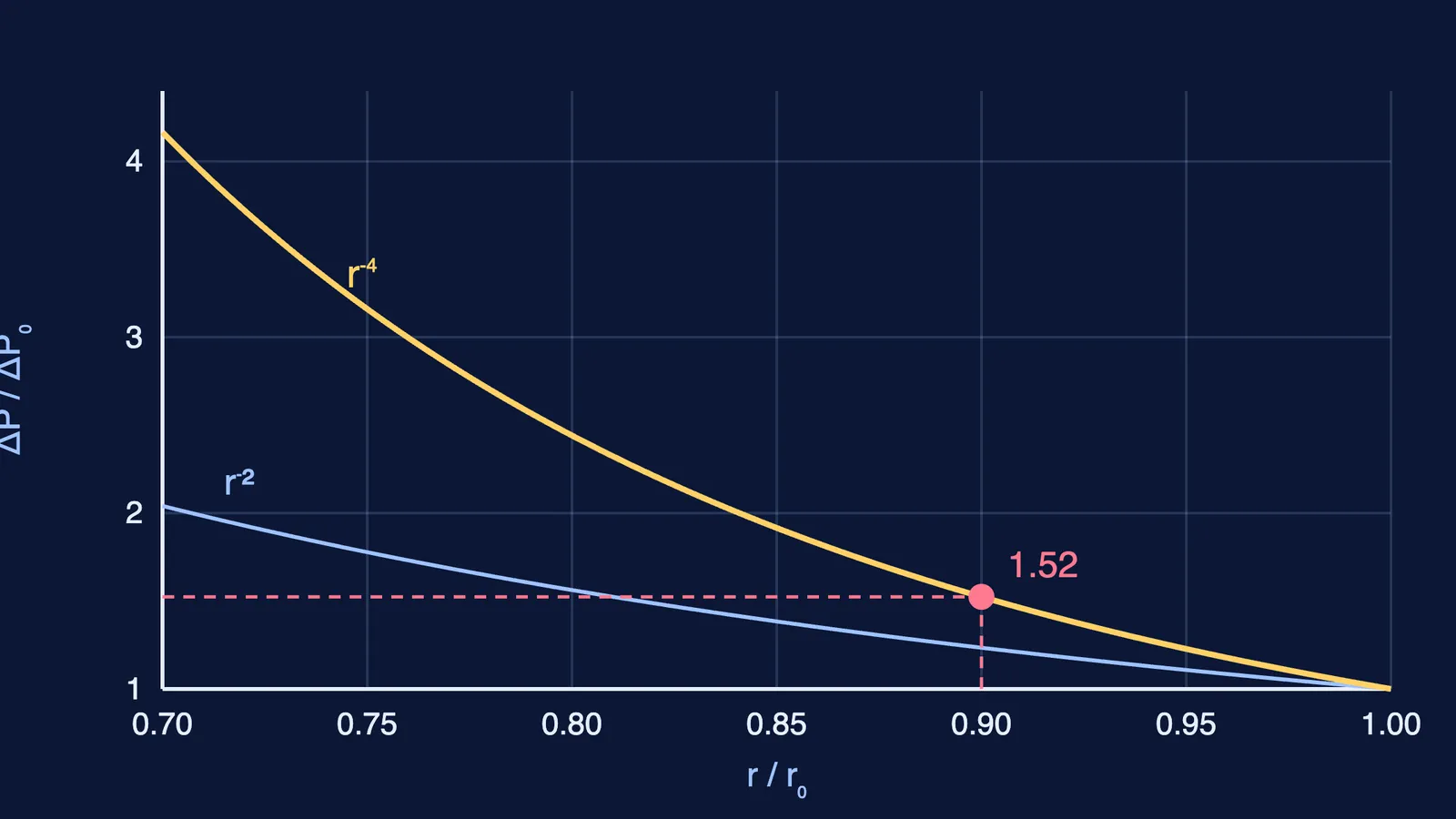
Q7 (hard). The steady flow rate Q (volume per second) of a liquid through a narrow tube depends only on the pressure drop per unit length ΔP/l, the tube's radius r and the viscosity η. A deposit narrows the tube's radius by 10%. Roughly how much must ΔP rise to keep Q the same?
(A) 11% (B) 23% (C) 52% (D) 69%
Answer: (C). Write Q ∝ (ΔP/l)ᵃ rᵇ ηᶜ, with ΔP/l = [M L⁻² T⁻²] and η = [M L⁻¹ T⁻¹]. From M: a + c = 0. From T: −2a − c = −1. So a = 1 and c = −1, and then L gives −2a + b − c = 3, so b = 4. Since Q ∝ ΔP r⁴/(ηl), ΔP must scale as 1/r⁴ = 1/0.9⁴ ≈ 1.52, a rise of about 52%. More in our explainer on why flow rate depends on the fourth power of the radius.
Trap: (B) treats the flow as depending only on the cross-sectional area, r².
Q8 (hard). A sphere's radius is found from its mass and density as r = (3m/4πρ)^(1/3). The mass has a 1.2% error and the density a 0.9% error. What is the maximum percentage error in the surface area 4πr² worked out from this radius?
(A) 0.7% (B) 1.4% (C) 2.1% (D) 4.2%
Answer: (B). Errors add even for a quotient, so m/ρ has an error of 1.2 + 0.9 = 2.1%. The cube root divides that by 3, which gives 0.7% for r. Area goes as r², so you double it: 1.4%.
Trap: (D) doubles 2.1% and forgets the cube root. (A) stops at the radius.
What should you do after this set?
Sort your misses into rule misses (Q1, Q2, Q6) and chain misses (Q4, Q7, Q8). For rule misses, reread NCERT section 1.3, including 1.3.2. For chain misses, redo the question, writing each quantity's power before any arithmetic.
If you keep reaching the right answer by a shaky method, the Fermi Problem Library has worked problems with a step-by-step solver that explains the reasoning rather than printing an answer.
Then try both sets, mixed, in sixteen minutes.


