

On this page
These eight Oscillations questions are written for Section B of JEE Main Physics, where you type a number instead of choosing an option. We wrote all eight; none comes from NCERT, the exemplar or a past paper.
How are numerical-value questions marked in JEE Main?
The Information Bulletin for JEE (Main) 2027 gives Physics 20 multiple-choice questions in Section A and 5 numerical-value questions in Section B. In Section B you enter an integer on an on-screen keypad, and the answer "should be rounded off to the nearest integer". A correct answer earns +4, a wrong one −1 and a blank 0.
All eight questions stay inside the oscillations part of Unit 10, Oscillations and Waves, in the Syllabus for JEE (Main) - 2027: SHM and its equation, phase, springs, energy and the simple pendulum. The matching text is Chapter 13 of NCERT Class 11 Physics Part II (Reprint 2026-27).
New to the chapter? Start with how to prepare Oscillations for JEE Main, then try Oscillations JEE Main practice questions, set 1.
Easy: speed, pendulum length and energy
Q1 (easy). A particle moves as x = 17 cos(3t + π/6), with x in cm and t in s. Find its speed, in cm/s, when x = −8 cm.
Answer: 45. v = ω√(A² − x²) = 3 × √(289 − 64) = 3 × 15 = 45 cm/s.
Trap: 27, from ω(A − |x|) (speed is not linear in x).
Q2 (easy). The length of a simple pendulum is increased by 69%. By what percentage does its period increase?
Answer: 30. T ∝ √L, so the new period is √1.69 = 1.3 times the old one, a 30% increase.
Trap: 35, from the rule "half the percentage change in L" (34.5), which holds only for small changes.
Q3 (easy). A 2.0 kg block on a spring of force constant 50 N/m oscillates on a smooth floor with total energy 0.13 J. Find its distance from the mean position, in cm, at the moment its speed is 0.20 m/s.
Answer: 6. KE = ½ × 2.0 × 0.20² = 0.04 J, so the spring holds 0.13 − 0.04 = 0.09 J. Then ½ × 50 × x² = 0.09 gives x² = 0.0036 and x = 0.06 m.
Trap: 7, the amplitude √(2 × 0.13/50) = 7.2 cm, from putting all the energy in the spring.
Medium: adding SHMs, a spring on a slope, timing a speed
Q4 (medium). A particle is acted on by two SHMs along the same line, x₁ = 30 sin ωt and x₂ = 40 sin(ωt + π/3), both in mm. Find the amplitude of the resulting motion, in mm, to the nearest integer.
Answer: 61. A = √(A₁² + A₂² + 2A₁A₂ cos δ) = √(900 + 1600 + 2 × 30 × 40 × 0.5) = √3700 = 60.8 mm.
Trap: 50, from √(30² + 40²), which is right only when the phase difference is π/2.
Q5 (medium). A 0.75 kg block on a smooth slope inclined at 30° is tied to a light spring of force constant 300 N/m, whose upper end is fixed at the top of the slope. The block is pulled a little down the slope and released. Find the period of its oscillation, in milliseconds, to the nearest integer.
Answer: 314. Gravity along the slope only shifts the equilibrium point; the restoring force is still k times the displacement from it. So T = 2π√(m/k) = 2π × √(0.75/300) = 2π × 0.05 = 0.314 s = 314 ms.
Trap: 222, from putting m sin 30° in place of m, as if the slope reduced the inertia.
Q6 (medium). A particle in SHM with a period of 1.2 s is released from rest at an extreme position. Find the least time, in milliseconds, after which its speed is half its maximum speed.
Answer: 100. From the extreme, x = A cos ωt and the speed is ωA|sin ωt|. Half the maximum means sin ωt = 1/2, so ωt = π/6 and t = T/12 = 1.2/12 s = 0.1 s = 100 ms.
Trap: 200, the time to reach x = A/2 (T/6), which confuses half the displacement with half the speed.
Hard: amplitude from a snapshot, distance in SHM
Q7 (hard). At one instant a block in SHM is 2.0 cm from its mean position, moving at 0.30 m/s, with an acceleration of 1.8 m/s². Find its amplitude in mm, to the nearest integer.
Answer: 37. a = ω²x gives ω² = 1.8/0.02 = 90 s⁻². Then A² = x² + v²/ω² = 0.0004 + 0.09/90 = 0.0014 m², so A = 0.0374 m = 37.4 mm.
Trap: 20, which takes the snapshot position as the amplitude although the block is still moving.
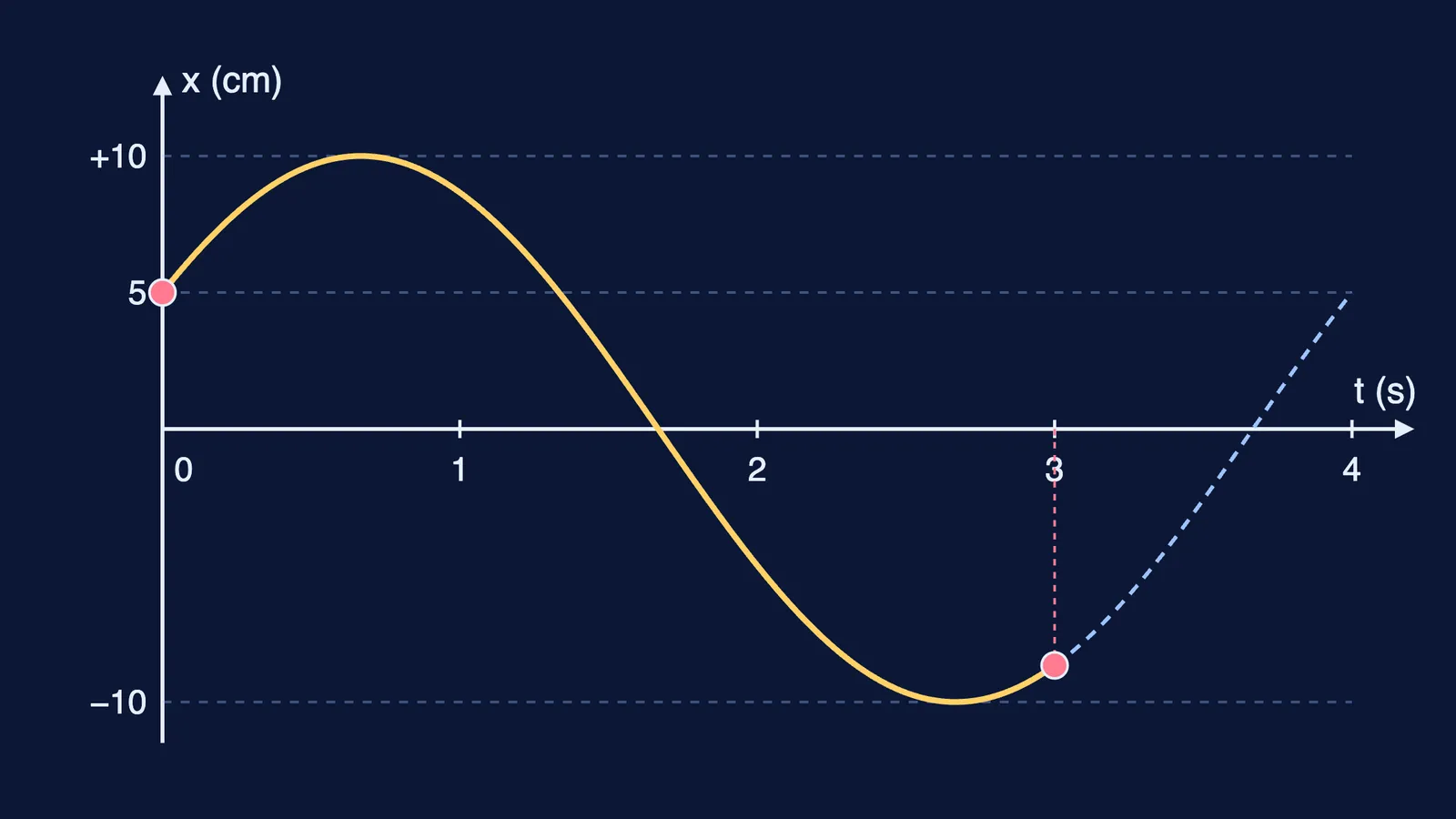
Q8 (hard). A particle moves as x = 10 sin(πt/2 + π/6), with x in cm and t in s. Find the distance it travels, in cm, in the first 3 s, to the nearest integer.
Answer: 26. The period is 4 s. It starts at x = 5 cm moving outwards, reaches +10 cm at t = 2/3 s and −10 cm at t = 8/3 s, then turns back to x = 10 sin(5π/3) = −8.66 cm at t = 3 s. Distance = 5 + 20 + 1.34 = 26.3 cm.
Trap: 30, from "3 s is three-quarters of a period, so the distance is 3A", which holds only for a start at the mean position or an extreme.
How do you get the number right in Oscillations?
Match units to the stem. Q7 gives cm and m/s but asks for mm; Q5 and Q6 want milliseconds. Convert at the last line.
Round once, at the end. Carry three or four significant figures until then.
Square, then sign. Speed and energy depend on x², so x = −8 cm and +8 cm give the same speed. Type a speed or a distance as a positive number.
Draw the x–t curve for any distance question. In Q8 the displacement is 13.7 cm, not 26.3 cm.
Use exact ratios for big changes. √1.69 = 1.3 is exact; "half the percentage" is only for changes of a few per cent.
Can't see why a step in your working fails? The Fermi Problem Library has worked problems with a step-by-step solver that explains the reasoning rather than printing an answer.


