

On this page
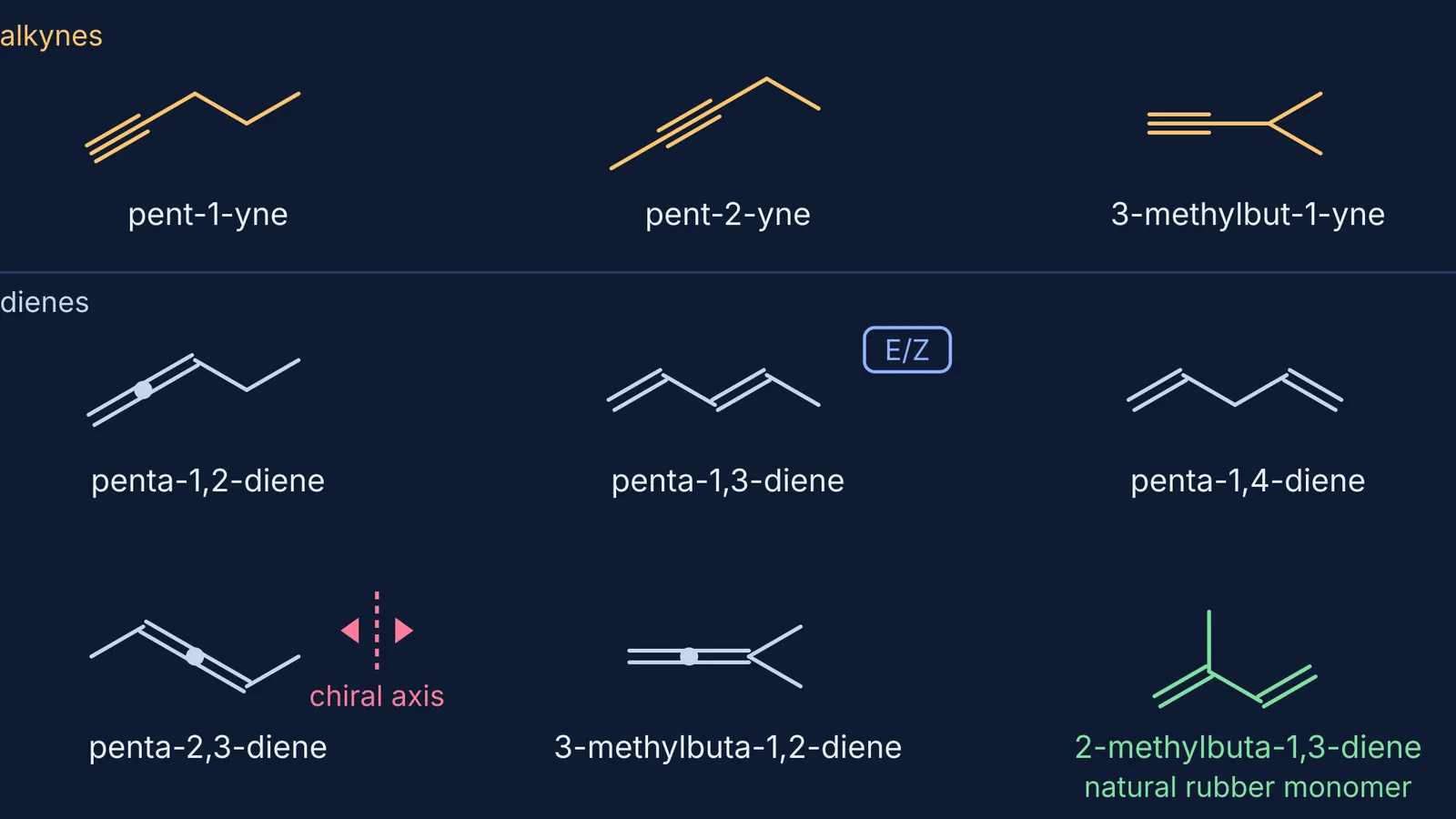
"How many open-chain isomers does C₅H₈ have?" is a favourite counting question in JEE practice sets, and the answer depends on what you count. There are 9 structural isomers: 3 alkynes and 6 dienes. If the question also counts stereoisomers, two of those nine split into pairs, and the total becomes 11. This post builds the list step by step so you can check that nothing is missing and nothing is counted twice.
What does the formula C₅H₈ tell you?
Start with the degree of unsaturation. For a hydrocarbon CₙHₘ it is (2n + 2 − m)/2. For C₅H₈ that is (10 + 2 − 8)/2 = 2. A saturated open chain of five carbons would be C₅H₁₂, and you are four hydrogens short, which means two "units" of unsaturation.
In an open chain there are no rings, so those two units must be multiple bonds. That leaves two families:
One triple bond: an alkyne.
Two double bonds: a diene. The double bonds can be cumulated (C=C=C, an allene), conjugated (C=C–C=C) or isolated (separated by at least one CH₂).
The scope matters. C₅H₈ also has many cyclic isomers: cyclopentene, methylenecyclobutane, the methylcyclobutenes, vinylcyclopropane, spiropentane, bicyclo[2.1.0]pentane and more. So 9 is the open-chain count, not the total for the formula. If a question does not say "open-chain", read it carefully before answering.
The method is the same one used for four carbons in the C₄H₆ alkyne and diene isomers. Five carbons add something new: branched dienes and a chiral allene.
How many C₅H₈ alkynes are there?
Draw the three five-carbon skeletons first: the straight chain, the chain with one methyl branch (the 2-methylbutane skeleton) and the neopentane skeleton with a central carbon bonded to four others. Then place the triple bond.
Straight chain. The triple bond can sit between C1 and C2 or between C2 and C3. Putting it between C3 and C4 is the same molecule numbered from the other end. That gives pent-1-yne, CH≡C–CH₂CH₂CH₃, and pent-2-yne, CH₃–C≡C–CH₂CH₃.
Branched chain. Each carbon of a triple bond needs at least two hydrogens to give up, and must have at most two carbon neighbours. The branch carbon already has three, so it cannot be part of the triple bond. The only place left is the far end: CH≡C–CH(CH₃)₂, 3-methylbut-1-yne.
Neopentane skeleton. The central carbon already has four carbon neighbours, so no multiple bond can touch it. The outer carbons are bonded only to the centre. No alkyne or diene is possible.
So there are 3 alkynes. Pent-2-yne has no geometrical isomers. The C–C≡C–C unit is linear, so there is no "same side" or "opposite side".
How many C₅H₈ dienes are there?
Straight chain. There are four C–C bonds. Choose two of them for the double bonds and remove the choices that are the same molecule read backwards:
C1=C2 and C2=C3: CH₂=C=CH–CH₂CH₃, penta-1,2-diene (cumulated).
C1=C2 and C3=C4: CH₂=CH–CH=CH–CH₃, penta-1,3-diene (conjugated).
C1=C2 and C4=C5: CH₂=CH–CH₂–CH=CH₂, penta-1,4-diene (isolated).
C2=C3 and C3=C4: CH₃–CH=C=CH–CH₃, penta-2,3-diene (cumulated).
The other two choices are repeats: "penta-3,4-diene" is penta-1,2-diene and "penta-2,4-diene" is penta-1,3-diene. That gives 4.
Branched chain. The branch carbon has only one hydrogen, so it can carry at most one double bond. That leaves two dienes:
CH₂=C(CH₃)–CH=CH₂, 2-methylbuta-1,3-diene, better known as isoprene, the monomer of natural rubber.
(CH₃)₂C=C=CH₂, 3-methylbuta-1,2-diene, an allene.
So there are 6 dienes, and 3 + 6 = 9 structural isomers. We checked this list with a short script that tried every possible placement of bond orders on every five-carbon open chain, kept only those with valence 4 at each carbon and eight hydrogens, and removed duplicates. It found exactly these nine.
Watch the names. "2-Methylbut-2-yne" and "2-methylbuta-1,2-diene" cannot exist, because the branch carbon would need five bonds. "3-Methylbuta-1,3-diene" is isoprene numbered from the wrong end.
Which C₅H₈ isomers show stereoisomerism?
Go through the nine one at a time and ask two questions. Does a C=C have two different groups on each end? Does an allene have two different groups on each end carbon?
Penta-1,3-diene: E and Z. The C3=C4 double bond carries H and CH=CH₂ on one carbon, and H and CH₃ on the other. So it has E and Z forms. The C1=C2 bond has two H on C1, so it adds nothing.
Penta-2,3-diene: two enantiomers. In an allene, the groups on the two end carbons lie in perpendicular planes. Here each end carbon carries H and CH₃, so the molecule has no mirror plane and exists as a pair of enantiomers. It is chiral without any chiral carbon. The geometry is explained in chiral molecules without a chiral carbon: allenes and biphenyls.
Penta-1,2-diene and 3-methylbuta-1,2-diene: not chiral. In each, one end carbon has two identical groups (=CH₂, or C(CH₃)₂). That gives a mirror plane.
Penta-1,4-diene and isoprene: no E/Z. Each double bond has a terminal =CH₂ or a carbon with two identical groups.
The three alkynes: none.
So stereoisomers add one extra to penta-1,3-diene and one extra to penta-2,3-diene: 9 + 1 + 1 = 11. Our script's stereo check gave the same answer.
Worked example: which C₅H₈ fits the clues?
A compound X, C₅H₈, takes up two moles of H₂ to give 2-methylbutane. X gives no precipitate with ammoniacal silver nitrate. What can X be?
Use the hydrogenation product. Hydrogenation keeps the carbon skeleton. 2-Methylbutane means X has the branched skeleton. From the list, the branched isomers are 3-methylbut-1-yne, isoprene and 3-methylbuta-1,2-diene.
Use the silver test. Ammoniacal AgNO₃ gives a white precipitate (a silver acetylide) with terminal alkynes, which have an acidic ≡C–H. 3-Methylbut-1-yne is a terminal alkyne, so it would give a precipitate. It is ruled out.
Answer. X is isoprene or 3-methylbuta-1,2-diene.
Tell them apart. Ozonolysis of isoprene gives two HCHO and CH₃COCHO (methylglyoxal). The allene gives acetone among its products, which isoprene cannot give. Isoprene is also a conjugated diene, so it does Diels–Alder reactions and 1,4-additions; the allene does not.
A useful side note: all six straight-chain isomers give pentane on full hydrogenation. That is why hydrogenation alone cannot separate them.
If you want more isomer-counting problems with every step shown, the Fermi Problem Library has a step-by-step solver that explains the reasoning, not just the final number.
How does this compare with C₅H₁₀?
C₅H₁₀ has one degree of unsaturation fewer, so it has one double bond or one ring. It has 5 open-chain alkenes (6 with cis- and trans-pent-2-ene) and several rings, counted in the number of isomers of C₅H₁₀. The same habits work for both formulas: fix the skeleton, place the unsaturation, remove repeats, then check stereo last.
Quick checklist
Degree of unsaturation of C₅H₈ is 2: one triple bond or two double bonds in an open chain.
Alkynes: pent-1-yne, pent-2-yne, 3-methylbut-1-yne (3).
Dienes: penta-1,2-, 1,3-, 1,4- and 2,3-diene, 3-methylbuta-1,2-diene and isoprene (6).
9 structural isomers; 11 with stereo (E/Z penta-1,3-diene, enantiomers of penta-2,3-diene).
Penta-1,2-diene and 3-methylbuta-1,2-diene are not chiral.
The neopentane skeleton gives nothing; cyclic isomers are a separate count.


