

On this page
The molecular formula C₄H₆ has a degree of unsaturation of two (PubChem). This mathematical constraint dictates that its isomers must contain a combination of two double bonds, one triple bond, one ring and one double bond, or two rings. By exploring these combinations, we find exactly nine distinct constitutional isomers, grouped into alkynes, dienes, and cyclic compounds.
What is the degree of unsaturation for C4H6?
The first step in finding all isomers for a molecular formula is calculating its degree of unsaturation (DoU). For a hydrocarbon, the formula is DoU = C - (H / 2) + 1. Plugging in the numbers for C₄H₆ gives 4 - (6 / 2) + 1 = 2.
A degree of unsaturation of two rules out any fully saturated alkanes and forces every C₄H₆ isomer into one of three functional groups: alkynes, dienes, or cyclic compounds. Let us break them down by functional type.
What are the alkyne isomers of C4H6?
Alkynes contain a carbon-carbon triple bond, which uses up both degrees of unsaturation at once. With a chain of four carbon atoms, the triple bond can be placed either at the end of the chain or in the middle, giving two possible isomers:
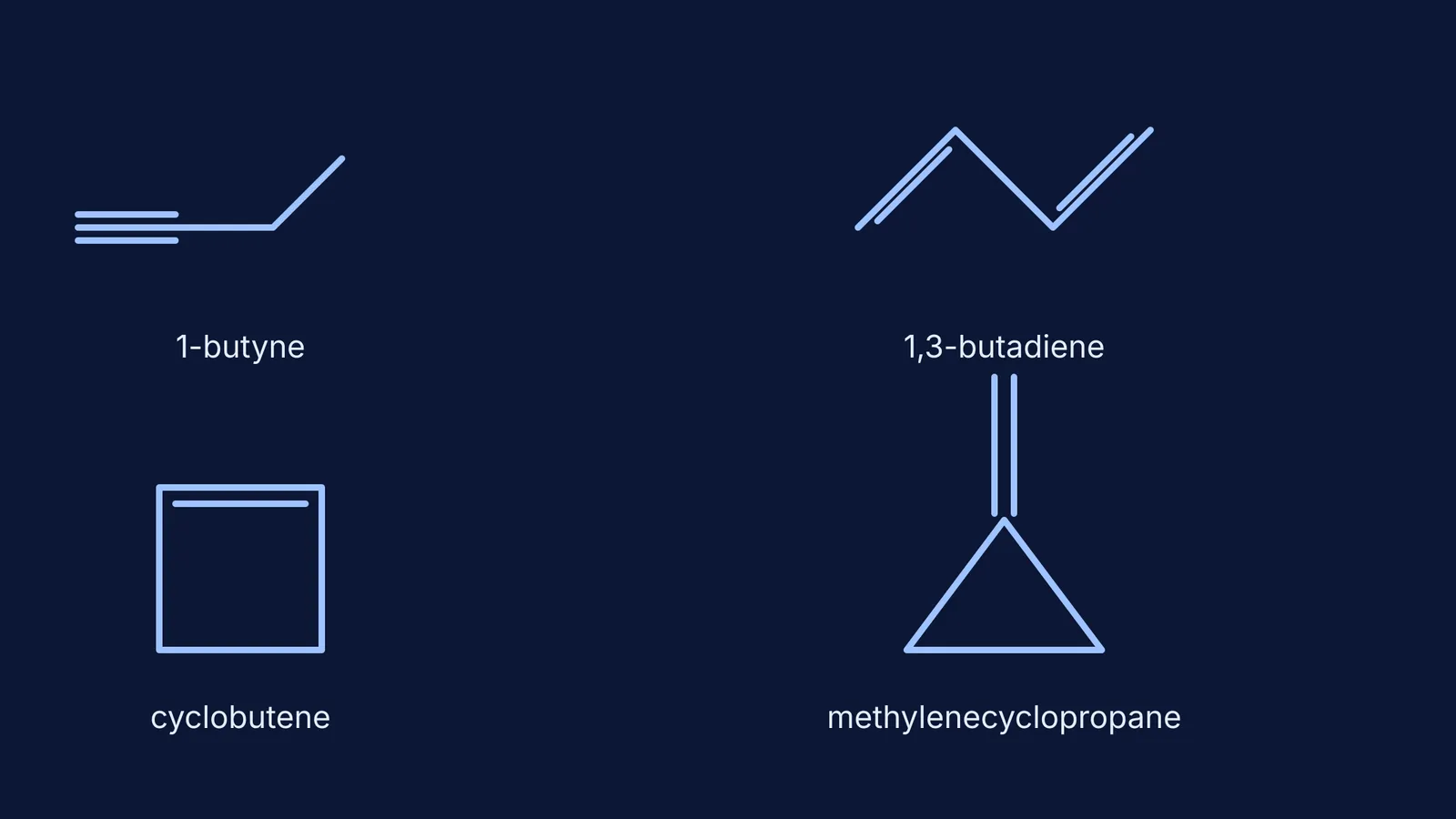
1-butyne: A terminal alkyne with the triple bond between the first and second carbon atoms (HC≡C-CH₂-CH₃). It features a linear geometry at the triple bond.
2-butyne: An internal alkyne with the triple bond located exactly in the center (CH₃-C≡C-CH₃). Because the molecule is symmetrical, 2-butyne is significantly more stable than its terminal counterpart.
What are the diene isomers of C4H6?
Dienes use up their two degrees of unsaturation with two separate double bonds. In a four-carbon chain, there are two distinct ways to arrange them:
1,2-butadiene: A cumulated diene where two adjacent double bonds share a single central carbon atom (CH₂=C=CH-CH₃). These cumulated systems, also known as allenes, are relatively high in energy because cumulated double bonds have higher energy than conjugated ones.
1,3-butadiene: A conjugated diene where the double bonds are separated by one single bond (CH₂=CH-CH=CH₂). This alternating pattern allows the electrons to delocalize across the entire molecule. This delocalization makes 1,3-butadiene the most stable isomer of C₄H₆ and an essential monomer for manufacturing synthetic rubber (PubChem).
If you struggle to recall which organic structures are stable and why, the Fermi Concept Library contains every concept in chemistry—including conjugation and electron delocalization—each with its own lesson and its place in the map.
What are the cyclic isomers of C4H6?
A ring counts as one degree of unsaturation. To reach a DoU of two, a cyclic C₄H₆ isomer must also include either one double bond (forming a cycloalkene) or a second ring (forming a bicyclic compound). There are five such cyclic isomers:
Cyclobutene: A simple four-membered ring containing one double bond.
1-methylcyclopropene: A three-membered ring featuring a double bond, with a methyl group attached to one of the double-bonded carbon atoms.
3-methylcyclopropene: A three-membered cyclopropene ring with the methyl group attached to the single saturated carbon at the top of the ring.
Methylenecyclopropane: A three-membered ring with a double bond located completely outside the ring structure, known as an exocyclic double bond (=CH₂).
Bicyclo[1.1.0]butane: The only bicyclic isomer of C₄H₆. It consists of two three-membered rings fused together, using up both degrees of unsaturation purely through its ring closures, without any double bonds.
Drawing these highly strained ring structures correctly can be tricky, especially when balancing bond angles. When working through complex organic chemistry problem sets, a student can bring an assignment to Fermi's AI tutor. The tutor works out what they already know, builds a plan for the session, and teaches through it—drawing the figure and checking understanding as it goes.
If you need a refresher on naming simpler carbon chains before tackling rings and alkynes, reviewing the rules for C4H10O isomers: telling the four alcohols and three ethers apart or Structural isomers in Class 10: butane and pentane drawn out is an excellent place to start.


